
Varanasi Trip Guide: Best Places to Visit, 5-Day Itinerary, Ghats, Food, Hotels and Travel Tips
A Varanasi trip is not an ordinary city break. You do not come here merely to visit a collection of monuments and tick them off a sightseeing list. Varanasi is a destination where the attraction is the city itself — its riverfront, temples, ancient lanes, markets, food, rituals, music and the daily life unfolding around the Ganga.
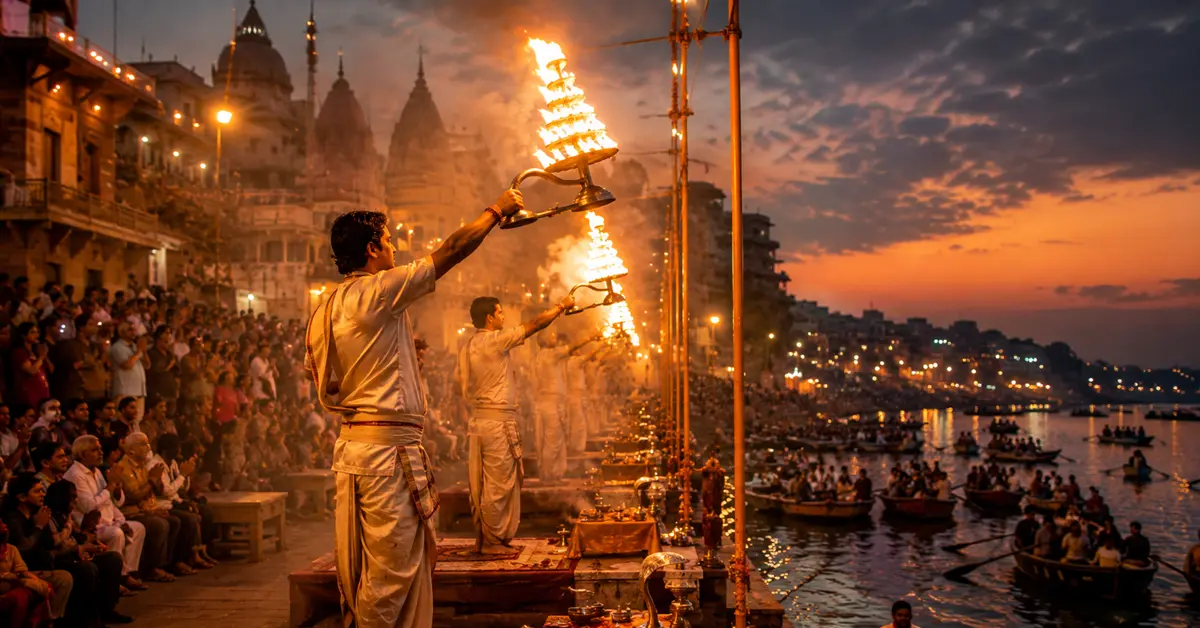
Known by three names — Varanasi, Banaras and Kashi — the city has an atmosphere that is difficult to replicate anywhere else. Early in the morning, wooden boats move quietly across the Ganga while pilgrims perform rituals along the ghats. By afternoon, the narrow lanes of the old city become a lively maze of shops, temples, food stalls and pedestrians. After sunset, the riverfront changes once again as lamps, prayers and crowds create the unforgettable spectacle of the Ganga Aarti.
A well-planned Varanasi trip can combine spirituality, history, architecture, photography, food and cultural exploration without requiring a very long holiday. Three days are enough for the major highlights, while four or five days allow you to experience the city at a much more comfortable pace.
This guide is designed for travellers planning their first visit and covers everything from the best time to visit and transportation to the major attractions, food, accommodation, costs and a detailed itinerary.
Destination at a Glance
| Information | Details |
|---|---|
| Country / State | India / Uttar Pradesh |
| Destination | Varanasi, also known as Banaras and Kashi |
| Ideal Trip Duration | 3–5 days |
| Best Time to Visit | October to March |
| Currency | Indian Rupee (₹ / INR) |
| Language | Hindi and Bhojpuri; English is commonly understood in tourist areas |
| Time Difference | None for travellers within India |
| Visa Requirement | Not applicable to Indian citizens; foreign nationals need the appropriate Indian visa or applicable electronic travel authorization |
| Suitable For | Solo travellers, couples, families, senior citizens and groups |
| Approx. Daily Budget | Budget: ₹1,500–₹3,000; Mid-range: ₹3,500–₹7,000; Premium: ₹8,000+ per person |
These are broad planning figures. Accommodation, festival periods, private transportation, dining preferences and special religious services can substantially change the final cost.
Why Visit Varanasi?
Varanasi has many famous attractions, but its appeal goes well beyond individual sights.
1. Experience the Ganga at Sunrise
For a first-time visitor, a sunrise boat ride on the Ganga should be near the top of the list.
The experience begins before the city is fully awake. As the boat moves along the river, the eastern sky gradually changes colour while the ghats become increasingly active.
You may see pilgrims taking a holy bath, people offering prayers, priests preparing for ceremonies, locals exercising and boats carrying visitors along the river.
The view from the water is also different from the view from the ghats. Instead of seeing one section of the riverfront, you can appreciate the extraordinary scale and continuity of the ghats.
For photographers, early morning is particularly rewarding because the softer light creates excellent conditions for capturing the architecture and riverfront activity.
2. Visit Kashi Vishwanath Temple
The Shri Kashi Vishwanath Temple is one of the most important Hindu temples in India and one of the twelve Jyotirlingas dedicated to Lord Shiva.
Its location in the old city places it at the centre of Varanasi’s religious landscape.
The temple is not simply another sightseeing attraction. For millions of devotees, visiting Kashi Vishwanath is a pilgrimage experience.
The current temple information states that the temple opens at 2:30 AM. Mangala Aarti is scheduled from 3:00 AM to 4:00 AM, followed by general darshan periods during the day. The temple normally closes at 11:00 PM, with different aarti and darshan windows throughout the day.
Paid services are available for certain rituals and special darshan arrangements. For example, the temple’s current schedule lists Mangala Aarti at ₹500 and Saptarishi Aarti at ₹300, while Sugam Darshan pricing is currently listed separately by the temple administration.
Because temple schedules and availability can change on special days, travellers should verify the applicable schedule before visiting.
3. Watch the Ganga Aarti
The evening Ganga Aarti at Dashashwamedh Ghat is perhaps the most recognisable Varanasi experience.
As sunset approaches, people begin gathering along the riverfront. The atmosphere gradually becomes more intense as priests prepare for the ceremony.
Lamps, incense, bells, chants and the movement of the priests create a highly visual ritual.
There are several ways to watch it:
- From the steps of Dashashwamedh Ghat
- From a nearby rooftop
- From a boat on the Ganga
- From surrounding buildings with river views
The ghat itself offers the most immediate experience, but it can become extremely crowded.
A boat provides a different perspective and allows you to see the illuminated riverfront from the water.
If you dislike very large crowds, consider spending some time around Assi Ghat as well.
4. Explore Sarnath
Sarnath is one of the most important historical and Buddhist destinations near Varanasi.
It is traditionally associated with Gautama Buddha delivering his first sermon after attaining enlightenment. The archaeological remains, stupas, museum and Buddhist monasteries make it a very different experience from the crowded lanes of central Varanasi.
Sarnath is generally around 10 km from the central city, although the actual journey time depends on traffic and where you are staying.
A visit normally takes several hours, so it works particularly well as a half-day or full-day excursion.
For travellers interested in history, religion, archaeology or architecture, Sarnath should not be treated as an optional extra.
5. Discover Banarasi Food
Food is one of the most enjoyable parts of travelling through Varanasi.
The city is particularly well known for vegetarian street food and traditional snacks.
Some dishes and experiences worth trying include:
- Kachori-sabzi
- Jalebi
- Tamatar chaat
- Aloo tikki
- Chooda-matar
- Lassi
- Malaiyyo during its seasonal period
- Banarasi sweets
- Banarasi paan
The best approach is not to try everything in one day.
Instead, spread your food exploration throughout the trip.
Start with breakfast at a traditional local shop, try a chaat in the afternoon and finish an evening walk with lassi or a sweet.
6. Walk Through the Old City
The old city around Godowlia, Vishwanath Gali and the Kashi Vishwanath area can initially feel overwhelming.
The lanes are narrow and frequently crowded.
Pedestrians share the streets with scooters, e-rickshaws, shopkeepers, cows and pilgrims. Some lanes seem to lead nowhere, while others suddenly open into small courtyards or temple areas.
Do not try to rush through this part of Varanasi.
Walking is actually one of the best ways to experience it.
You may discover tiny shrines, old buildings, silk shops, flower sellers, traditional sweet shops and cafés that you would never notice from a vehicle.
Best Time to Visit Varanasi
The best overall period for a Varanasi trip is October to March.
However, each season offers a different experience.
October and November
The weather generally becomes more comfortable after the monsoon.
October can still be warm during the afternoon, while November is usually much more pleasant for sightseeing.
The festive season also brings additional activity to the city.
If you enjoy photography and cultural experiences, this can be an excellent period to visit.
December to February
Winter is among the most popular seasons for Varanasi.
Daytime conditions are generally comfortable for walking, temple visits and sightseeing.
Early mornings can be cold, particularly when travelling by boat.
Fog can occasionally develop during winter mornings, which may affect visibility and sometimes transportation schedules.
If you have a very early train or flight, allow extra time.
March
March is still suitable for travel, particularly during the first half, although temperatures begin rising.
It can be a good choice for travellers who want pleasant weather without the colder mornings of winter.
April to June
Summer is the least comfortable period for extensive daytime sightseeing.
Temperatures can become very high, particularly in May and June.
If you must visit during this period, organise your day around the weather:
Early morning → sightseeing
Afternoon → hotel/rest
Late afternoon and evening → sightseeing
This schedule can make a major difference.
July to September
The monsoon brings rainfall and high humidity.
The Ganga can rise considerably during the rainy season, and the condition or accessibility of certain riverfront areas can change.
Boating should be planned according to the prevailing river and weather conditions.
The monsoon can nevertheless provide a different perspective of Varanasi, particularly for travellers who prefer fewer tourists and dramatic skies.
Varanasi Weather Guide
| Season | Typical Conditions |
|---|---|
| Winter | Cool mornings, pleasant afternoons and occasional fog |
| Spring | Pleasant initially, then increasingly warm |
| Summer | Very hot afternoons and strong sunshine |
| Monsoon | Humid, rainy and potentially high river levels |
| Autumn | Comfortable temperatures and generally good sightseeing conditions |
For most first-time travellers, November to February offers the most comfortable combination of weather and sightseeing conditions.
How Many Days Are Enough for a Varanasi Trip?
The ideal duration depends on how deeply you want to experience the city.
2 Days in Varanasi
Two days are enough for the essential highlights, but the schedule will be busy.
You can cover:
- Sunrise boat ride
- Kashi Vishwanath Temple
- Main ghats
- Ganga Aarti
- Old-city walk
- Sarnath
This is suitable for a weekend-style visit.
3 Days in Varanasi
Three days are a much better option.
You can combine:
- Ghats
- Temples
- Ganga Aarti
- Old-city exploration
- Sarnath
- Local food
- Shopping
There is still relatively little spare time, but the main attractions can be covered comfortably.
4 Days in Varanasi
Four days are ideal for travellers who want a balanced holiday.
You can add:
- Assi Ghat
- BHU
- More temples
- Additional ghats
- Local food walks
- More relaxed shopping
5 Days in Varanasi
Five days are recommended for travellers who want to understand Varanasi rather than simply photograph its major attractions.
You can slow down and revisit the riverfront at different times of the day.
You can also explore lesser-known places and spend more time eating, shopping and walking through the old city.
For this guide, the detailed itinerary will therefore be designed around five days.
How to Reach Varanasi
Varanasi is one of the better-connected cities in Uttar Pradesh.
You can reach it by air, train or road.
By Air
The main airport is Lal Bahadur Shastri International Airport, commonly referred to as Varanasi Airport.
The airport is located at Babatpur, approximately 25–30 km from the central tourist areas.
Travel time varies substantially according to traffic.
Flights connect Varanasi with major Indian cities, including Delhi, Mumbai, Bengaluru, Hyderabad and Kolkata, although individual routes and frequencies can change.
For travellers coming from distant parts of India, flying is generally the fastest option.
Airport to City
A taxi or app-based cab is usually the simplest choice.
A practical planning figure is approximately ₹500–₹1,200, depending on your destination, vehicle category and traffic.
For a family with luggage, a private cab is generally more convenient than combining multiple local transport options.
Varanasi by Train
For many Indian travellers, the train is actually the most convenient way to reach Varanasi.
The principal stations include:
- Varanasi Junction
- Banaras Railway Station
- Kashi Railway Station
There are railway connections with numerous cities across North, Central and East India.
Travellers coming from Delhi, Lucknow, Prayagraj, Patna, Kolkata and other cities can often find convenient services.
An overnight train can also be a smart budget option because you can travel while sleeping and save the cost of one hotel night.
During major festivals and holiday periods, trains can become heavily booked, so advance planning is advisable.
Varanasi by Road
Varanasi has road connections with several cities in Uttar Pradesh and neighbouring states.
Road travel is particularly practical when Varanasi forms part of a larger North Indian itinerary.
For example, you can combine Varanasi with:
- Prayagraj
- Ayodhya
- Lucknow
- Bodh Gaya
- Chitrakoot
For very long journeys, however, train or air travel is generally more comfortable.
Getting Around Varanasi
One of the first things to understand about Varanasi is that you cannot reach every attraction by car.
The most interesting parts of the old city are often pedestrian areas or narrow lanes.
Auto-Rickshaw
Auto-rickshaws are useful for short and medium-distance journeys.
A short local journey may cost approximately ₹50–₹150, while longer rides will cost more.
Always establish the fare before starting if the auto is not using a meter.
E-Rickshaw
E-rickshaws are inexpensive and useful for moving around areas where larger vehicles are inconvenient.
They are particularly practical for connecting roads around the old city.
App-Based Cabs
App-based taxis are useful for:
- Airport transfers
- Sarnath
- BHU
- Railway stations
- Hotels outside the old city
- Longer local journeys
However, do not expect a cab to drop you directly at every ghat or temple.
For several major attractions, you will need to walk the final section.
Walking
Walking is one of the best ways to experience old Varanasi.
Wear comfortable shoes because you may unexpectedly spend several hours walking through the lanes.
During summer, avoid long walks during the afternoon.
Boat
A boat ride on the Ganga is an essential part of a first Varanasi visit.
Prices vary according to:
- Boat type
- Shared or private booking
- Duration
- Season
- Time of day
- Festival period
- Demand
For general planning, a shared boat may cost around ₹100–₹300 per person, while a private boat can commonly fall around ₹800–₹2,000 or more, depending on the arrangement.
These are indicative figures rather than fixed government rates.
Before boarding, confirm the total price, duration and route.
For sunrise or evening rides, booking through your hotel or a reputable local operator can make the process easier.
Local SIM and Internet in Varanasi
Indian travellers can use their existing mobile connection.
Major Indian telecom operators operate in Varanasi, and network availability is generally good across the city.
However, signal quality can vary inside the narrowest parts of the old city.
Foreign travellers should consider an Indian SIM or an international roaming plan.
Hotels, restaurants and cafés in tourist areas commonly provide Wi-Fi.
Nevertheless, keep important information available offline.
Download:
- Hotel address
- Train or flight tickets
- Maps
- Important contact numbers
- Identification document copies
This becomes especially useful when walking through the old city, where mobile navigation can sometimes become confusing.
Money and Currency
The currency is the Indian Rupee (₹ / INR).
Digital payments are widespread, and UPI is accepted by a large number of hotels, restaurants, shops and local businesses.
However, cash is still useful.
Keep some smaller notes for:
- Street food
- Auto-rickshaws
- E-rickshaws
- Boat rides
- Small shops
- Local markets
- Temple-related purchases
Do not rely exclusively on digital payment methods.
International travellers should use authorised currency exchange services and check the exchange rate before exchanging substantial amounts.
Is Varanasi Safe for Tourists?
Varanasi receives large numbers of domestic and international visitors every year.
For most tourists, the main practical concerns are crowds, traffic, overcharging, pickpocketing, unofficial guides and confusing lanes rather than serious crime.
A few simple precautions make the experience much easier.
Keep valuables secure
Crowded areas such as Godowlia, Vishwanath Gali and major festival gatherings require additional attention.
Keep your phone and wallet secure.
Confirm prices beforehand
Always agree on the fare before taking an auto, e-rickshaw or private boat.
Be cautious with unsolicited offers
You may encounter people offering:
- Special temple entry
- VIP darshan
- Religious services
- Private tours
- Unusually cheap boat rides
Do not pay large amounts without understanding exactly what you are purchasing.
Respect religious spaces
Varanasi is a living religious city, not an open-air museum.
Dress respectfully and follow instructions at temples and other religious sites.
Be particularly careful around cremation ghats
Manikarnika and Harishchandra Ghats are active cremation sites.
Visitors should behave respectfully and should not treat cremation ceremonies as tourist spectacles.
Photography can be intrusive and should be avoided unless clearly permitted.
Varanasi Trip Budget
Your total expenditure will depend mainly on accommodation and transportation.
Solo Traveller
A budget-conscious solo traveller can reasonably plan around:
₹1,500–₹3,000 per day
A more comfortable solo trip with a better hotel and more private transportation may cost:
₹3,500–₹6,000 per day
Couple
For two people sharing a room, a comfortable mid-range budget is approximately:
₹5,000–₹9,000 per day
This can cover accommodation, food, local transportation and regular sightseeing.
A premium hotel, private boat and private cab can push the daily cost substantially higher.
Family
For a family of four, a practical comfortable range is approximately:
₹8,000–₹15,000 per day
Families should budget more for private cabs and larger rooms.
Travelling with elderly parents can also make private transportation worthwhile.
Group
For four to six travellers, sharing rooms and private transport can reduce the per-person cost.
A reasonable planning figure is:
₹2,500–₹5,000 per person per day
depending on accommodation and activities.
Where to Stay in Varanasi
The neighbourhood you choose can have a major effect on your experience.
Assi Ghat
Assi Ghat is one of the best areas for travellers who want a lively riverside atmosphere without staying right in the middle of the most congested old-city lanes.
It works particularly well for:
- Couples
- Solo travellers
- Young travellers
- Long stays
- Café lovers
The area also gives easy access to the southern ghats.
Godowlia and Dashashwamedh Area
This is the right choice if your priority is being close to the central religious attractions.
You will be relatively close to:
- Kashi Vishwanath Temple
- Dashashwamedh Ghat
- Vishwanath Gali
- Major shopping areas
The major disadvantage is the crowds.
If you value convenience for sightseeing more than peace and quiet, this area is worth considering.
Cantonment Area
Cantonment is better suited to travellers who prefer:
- Larger hotels
- Easier road access
- Conventional city surroundings
- Better access for private cars
It is particularly convenient for families who do not want to stay in the narrow old-city lanes.
Sarnath
Sarnath is a peaceful alternative for travellers who prefer a quieter environment.
It is particularly attractive to visitors focused on Buddhist heritage and history.
However, staying in Sarnath means travelling into central Varanasi for the ghats and major temples.
Approximate Hotel Budget
Hotel prices vary greatly according to season, weekends, festivals and availability.
| Category | Approximate Price Per Night |
|---|---|
| Budget | ₹800–₹2,500 |
| Mid-range | ₹2,500–₹6,000 |
| Luxury / Premium | ₹7,000–₹20,000+ |
For a first Varanasi trip, location can be more important than luxury.
A modest hotel near the area you want to explore may be more convenient than an expensive property that requires long daily taxi rides.
A 5-Day Varanasi Trip at a Glance
The detailed itinerary will be covered later in this guide, but the overall structure is:
Day 1 — Arrival, Old City and Ganga Aarti
Arrive in Varanasi, check into your hotel, explore the old city and spend the evening around Dashashwamedh Ghat.
Day 2 — Sunrise Boat Ride and Major Ghats
Begin before sunrise, take a boat on the Ganga, explore the ghats and temples, enjoy a traditional breakfast and experience another side of the riverfront in the evening.
Day 3 — Sarnath
Spend the morning and afternoon exploring Sarnath’s Buddhist and archaeological attractions before returning to Varanasi.
Day 4 — BHU, Assi Ghat and Southern Varanasi
Explore Banaras Hindu University, visit important temples in the area and spend the evening around Assi Ghat.
Day 5 — Food, Shopping and Hidden Corners
Use the final day for Banarasi food, silk shopping, markets, lesser-known attractions and relaxed time beside the Ganga before departure.
This structure deliberately avoids packing ten attractions into every day. Varanasi is much more enjoyable when there is some breathing room in the schedule.
What Makes Varanasi Different?
The most important thing to understand before visiting is that Varanasi is not a conventional tourist city.
The most memorable moment may not be a famous temple.
It could be a sunrise over the river.
It could be a conversation with a boatman.
It could be a plate of hot kachori and sabzi from a small shop.
It could be walking through a lane and suddenly discovering a centuries-old shrine.
It could be sitting quietly at Assi Ghat in the evening.
It could be watching the city change from the river as the lights begin appearing along the ghats.
This is why it is worth leaving some unscheduled time during your trip.
Do not make the mistake of measuring your Varanasi experience by the number of attractions you have visited.
Important Things to Know Before Your Varanasi Trip
Start Your Days Early
Sunrise is one of the best times in Varanasi.
The weather is usually more comfortable, the riverfront is visually beautiful and the city feels completely different from its afternoon version.
Do Not Depend Entirely on Cars
Many important areas are accessible only by walking.
Plan accordingly.
Carry Comfortable Footwear
You may walk considerably more than expected.
Sandals or shoes that are comfortable for several hours are preferable.
Keep Small Cash
Digital payments are common, but cash remains useful for small transactions.
Agree on Boat Prices
Never assume that a quoted boat price includes unlimited time.
Confirm the duration and total cost before starting.
Respect Religious Customs
Not every ceremony is a tourist attraction.
Observe respectfully, particularly around sensitive religious and cremation sites.
Do Not Rush Sarnath
Sarnath deserves several hours rather than a quick photo stop.
Its importance is historical and religious rather than purely visual.
The heart of a Varanasi trip lies along the Ganga and in the ancient neighbourhoods surrounding its ghats and temples. Some places are important because of their religious significance, some because of their history, and others simply because they allow you to experience the distinctive rhythm of Banaras.
A useful way to explore Varanasi is not to treat every attraction as a separate stop. Several major places are within walking distance of one another, while others are better combined into a half-day route. This saves time and also gives you an opportunity to experience the old city between the major sights.
This part covers the most important attractions you should consider for a first visit.
1. Shri Kashi Vishwanath Temple
| Information | Details |
|---|---|
| Location | Vishwanath Gali, near Godowlia, Varanasi |
| Google Rating | Approximately 4.7/5 |
| Google Reviews | Approximately 119,000+ |
| Entry Fee | General darshan: No standard entry fee; paid darshan and rituals available |
| Main Timings | Temple opens around 2:30 AM; general darshan and aarti timings vary through the day |
| Recommended Duration | 1.5–3 hours, depending on queue and darshan |
| Best Time to Visit | Early morning; avoid peak crowd periods if possible |
| How to Reach | Walk from the designated vehicle drop-off areas; autos/cabs cannot enter the narrow temple lanes |
| Approx. Transport Cost | ₹50–₹150 for a short auto/e-rickshaw connection; walking is preferable near the temple |
| Practical Tip | Carry minimal belongings and check the latest security and darshan requirements before visiting |
Google Maps currently shows the main Shri Kashi Vishwanath Temple at about 4.7/5 with more than 119,000 reviews, making it one of the most reviewed religious attractions in Varanasi.
The temple’s official schedule currently lists opening at 2:30 AM, Mangala Aarti from 3:00 AM to 4:00 AM, several darshan periods through the day and closure around 11:00 PM. Paid services and special aartis have separate schedules and charges.
Why Is Kashi Vishwanath Temple Famous?
Kashi Vishwanath is dedicated to Lord Shiva and is regarded as one of the twelve Jyotirlingas.
Its significance extends far beyond its architecture. Kashi has traditionally been considered one of the holiest cities for Shaivite devotees, and pilgrimage to the temple is an important spiritual journey for many Hindus.
The present temple complex is closely associated with the history of Varanasi and has undergone reconstruction and redevelopment over different periods.
The modern Kashi Vishwanath Corridor has made the approach to the temple considerably more spacious than the traditional narrow lanes once associated with the immediate temple area.
What Should You Experience?
The most important experience is darshan rather than simply viewing the building.
Take time to observe the atmosphere around the temple complex, the movement of pilgrims and the surrounding lanes.
If you are interested in religious architecture, also pay attention to how the temple area connects with the Ganga through the newer corridor.
Is It Worth Visiting?
Absolutely.
Even travellers who are not religious can appreciate the temple’s extraordinary historical and cultural importance.
However, this is not a place to approach like an ordinary tourist attraction. Respectful behaviour and patience are essential.
2. Dashashwamedh Ghat
| Information | Details |
|---|---|
| Location | Near Godowlia and Kashi Vishwanath Temple, Varanasi |
| Google Rating | Approximately 4.6/5 |
| Google Reviews | More than 70,000 |
| Entry Fee | Free |
| Opening & Closing | Open throughout the day; river activities depend on conditions |
| Recommended Duration | 1–2 hours; longer if attending Ganga Aarti |
| Best Time to Visit | Sunrise or evening |
| How to Reach | Walk from Godowlia/Kashi Vishwanath area |
| Approx. Transport Cost | ₹50–₹150 to nearby drop-off point; final approach is on foot |
| Practical Tip | For Ganga Aarti, arrive early because the ghat becomes extremely crowded |
Current Google-derived information places Dashashwamedh Ghat at approximately 4.6/5 with more than 70,000 reviews.
Why Is Dashashwamedh Ghat Famous?
Dashashwamedh is perhaps the most famous ghat in Varanasi.
It is located close to Kashi Vishwanath Temple and is one of the principal locations associated with the evening Ganga Aarti.
The name is traditionally associated with the legend of ten Ashwamedha sacrifices performed by Lord Brahma.
Whether you visit at sunrise, afternoon or evening, the ghat has a different character each time.
Morning
The atmosphere is dominated by pilgrims, boatmen and people beginning their day beside the Ganga.
Afternoon
The riverfront becomes comparatively quieter, although activity continues throughout the day.
Evening
This is when Dashashwamedh becomes extraordinarily busy.
Visitors gather for the Ganga Aarti, and boats line up in the river facing the ghat.
Is It Worth Visiting?
Yes — this is an essential stop.
Even if you do not attend the Ganga Aarti, visiting the ghat during the morning or late afternoon gives you a much better understanding of Varanasi.
3. Ganga Aarti at Dashashwamedh Ghat
| Information | Details |
|---|---|
| Location | Dashashwamedh Ghat |
| Google Rating | Associated with Dashashwamedh Ghat |
| Entry Fee | Free from the ghat; boat/rooftop viewing involves separate charges |
| Timing | Evening; exact timing changes seasonally |
| Recommended Duration | 1–1.5 hours |
| Best Time | Arrive 30–60 minutes before the ceremony |
| How to Reach | Walk from Godowlia or nearby old-city areas |
| Approx. Transport Cost | ₹50–₹150 to the nearby area; walk the final stretch |
| Practical Tip | Do not arrive at the last minute during peak season |
The Ganga Aarti is not a separate monument but an experience that deserves its own place in your itinerary.
As evening approaches, the riverfront begins filling with people.
The soundscape changes first.
Temple bells, conversations, devotional singing and announcements gradually build before the main ritual begins.
Priests dressed in traditional attire perform coordinated movements with large lamps, incense and other ceremonial objects.
From the river, the spectacle looks particularly striking because you can see the illuminated ghat as a whole.
Boat or Ghat: Which Is Better?
Both provide different experiences.
From the ghat: You feel closer to the ceremony and the people participating in it.
From a boat: You get the best overall view of the illuminated riverfront.
For a first visit, doing the evening Aarti from a boat can be memorable, provided the boat operator is reliable and the price is agreed beforehand.
4. Assi Ghat
| Information | Details |
|---|---|
| Location | Southern end of the main Varanasi ghats |
| Google Rating | Approximately 4.6/5 |
| Google Reviews | Approximately 74,000+ |
| Entry Fee | Free |
| Opening & Closing | Open throughout the day |
| Recommended Duration | 1–2 hours; longer if attending morning/evening programmes |
| Best Time to Visit | Early morning and sunset |
| How to Reach | Auto, e-rickshaw or taxi to nearby roads; final stretch on foot |
| Approx. Transport Cost | ₹100–₹250 from central areas, depending on distance and traffic |
| Practical Tip | Stay around Assi for sunrise if you want a quieter start to the day |
Current Google-derived data places Assi Ghat at around 4.6/5 with more than 74,000 reviews.
Why Is Assi Ghat Famous?
Assi Ghat has a different personality from Dashashwamedh.
It is still an important religious site, but the atmosphere can feel more relaxed and open.
The ghat is particularly associated with morning activities, yoga, cultural programmes and the early-day riverfront atmosphere.
For travellers staying in the Assi area, it can become a natural part of their daily routine rather than merely another attraction.
Wake up early, walk down to the river, have tea and watch the city gradually become active.
That is often more enjoyable than arriving in the middle of a busy sightseeing schedule.
What Should You Do Here?
Try visiting twice:
Morning: Experience the peaceful riverfront atmosphere.
Evening: Sit by the river and observe the changing light.
If you are staying nearby, walking around Assi after dinner can also be pleasant, although normal urban precautions should still be followed.
Is It Worth Visiting?
Definitely.
For many travellers, Assi Ghat becomes one of their favourite places in Varanasi precisely because it feels less overwhelming than the busiest central ghats.
5. Manikarnika Ghat
| Information | Details |
|---|---|
| Location | Northern-central stretch of Varanasi ghats |
| Google Rating | Approximately 4.6/5 |
| Google Reviews | Approximately 10,000+ on current aggregated Google-derived listings |
| Entry Fee | Free |
| Opening & Closing | Active throughout the day and night |
| Recommended Duration | 20–45 minutes for respectful observation from an appropriate distance |
| Best Time to Visit | Daytime if simply viewing the riverfront |
| How to Reach | Walk along the ghats or view from a boat |
| Approx. Transport Cost | Included within local boat route or ₹50–₹150 to nearby areas |
| Practical Tip | This is an active cremation site; do not photograph or treat ceremonies as entertainment |
Manikarnika Ghat is one of Varanasi’s most sacred and sensitive locations. Current Google-derived listings show a rating of around 4.6/5 with more than 10,000 reviews.
Why Is Manikarnika Ghat Famous?
Manikarnika is traditionally regarded as one of the principal cremation grounds in Varanasi.
According to Hindu belief, cremation at this sacred location is associated with liberation from the cycle of rebirth.
The ghat therefore represents an important part of Varanasi’s spiritual philosophy surrounding life, death and liberation.
This is one place where travellers should completely change their mindset.
It is not a sightseeing performance.
Families are carrying out deeply personal religious rites, often during an extremely difficult moment in their lives.
How Should Tourists Behave?
The answer is simple:
Observe from a respectful distance.
Do not take photographs of cremations.
Do not approach grieving families.
Do not ask intrusive questions.
Do not treat the burning pyres as a photographic opportunity.
A boat passing at an appropriate distance can provide an understanding of the scale and setting without intruding on the ceremonies.
Is It Worth Visiting?
Yes, but only for travellers who are comfortable with its nature.
It is important for understanding Varanasi’s religious philosophy, but it is not suitable for everyone.
6. Kaal Bhairav Temple
| Information | Details |
|---|---|
| Location | Vishweshwarganj area, Varanasi |
| Google Rating | Approximately 4.7/5 |
| Google Reviews | More than 27,000 |
| Entry Fee | No standard entry fee |
| Timings | Timings can vary; early morning is generally preferable |
| Recommended Duration | 30–60 minutes |
| Best Time to Visit | Early morning or a less crowded period |
| How to Reach | Auto/e-rickshaw to the nearby area, then walk |
| Approx. Transport Cost | ₹50–₹150 from nearby old-city areas |
| Practical Tip | Be cautious of unsolicited people offering paid rituals or services |
Current Google-derived information places Kaal Bhairav Temple at approximately 4.7/5 with more than 27,000 reviews.
Why Is Kaal Bhairav Temple Famous?
Kaal Bhairav is traditionally regarded as the guardian or Kotwal of Kashi.
For devotees, visiting Kaal Bhairav is an important part of the spiritual journey through Varanasi.
The temple is situated in a busy neighbourhood rather than an isolated monumental complex. That makes the approach part of the experience.
Flower sellers, small shops and narrow lanes surround the temple.
The atmosphere inside is generally intense and devotional.
A Practical Warning
Tourists may encounter people offering special pujas or rituals.
If you do not want to participate in a paid ritual, simply decline politely.
If you do want a ritual performed, establish the price beforehand.
This is one of the places where knowing exactly what you want can prevent unnecessary expenditure.
Is It Worth Visiting?
Yes, particularly if temples and Varanasi’s religious traditions are central to your trip.
It can also be combined efficiently with the old-city sightseeing route.
7. Sankat Mochan Hanuman Temple
| Information | Details |
|---|---|
| Location | Near Assi area, Varanasi |
| Google Rating | Check current Google listing before travel |
| Entry Fee | Free |
| Timings | Approximately 5:00 AM–11:30 AM and 3:00 PM–11:00 PM |
| Recommended Duration | 45–90 minutes |
| Best Time to Visit | Early morning or after the afternoon reopening |
| How to Reach | Auto, e-rickshaw or taxi |
| Approx. Transport Cost | ₹100–₹250 from central tourist areas |
| Practical Tip | Follow security instructions and avoid carrying prohibited items |
The Kashi official portal currently lists Sankat Mochan Temple’s opening periods as 5:00 AM–11:30 AM and 3:00 PM–11:00 PM.
Why Is Sankat Mochan Temple Famous?
Sankat Mochan is dedicated to Lord Hanuman and is one of Varanasi’s best-known Hanuman temples.
It has an important place in the city’s religious and cultural life.
The temple is also associated with the famous Sankat Mochan Sangeet Samaroh, a classical music and dance festival that brings prominent performers to Varanasi.
This connection between devotion and Indian classical arts makes the temple particularly interesting for culturally curious travellers.
What Should You Experience?
The atmosphere is more important than the architecture.
Listen to the devotional singing and observe how worshippers interact with the temple space.
Photography and mobile-phone restrictions should be taken seriously.
Is It Worth Visiting?
Yes, especially when combined with Assi Ghat and the southern Varanasi sightseeing route.
8. Banaras Hindu University
| Information | Details |
|---|---|
| Location | South Varanasi |
| Google Rating | Ratings vary by individual campus locations |
| Entry Fee | Campus access generally free; individual museums/attractions may charge separately |
| Timings | Vary according to campus facility |
| Recommended Duration | 1.5–3 hours |
| Best Time to Visit | Morning or late afternoon |
| How to Reach | Auto, e-rickshaw or cab |
| Approx. Transport Cost | ₹100–₹300 from central Varanasi |
| Practical Tip | Check individual facility timings before planning a museum visit |
Banaras Hindu University is not simply a tourist attraction.
Founded in the early twentieth century, it became one of India’s most prominent centres of higher education and learning.
The university campus provides a striking contrast to the crowded old city.
One of its best-known landmarks is the New Vishwanath Temple, also known as Birla Temple.
The temple is open to visitors and has a distinctive tall white structure.
Why Include BHU?
It demonstrates another side of Varanasi.
The city is not only about temples and ghats. It has also played a major role in education, Sanskrit scholarship, music, arts and intellectual life.
For travellers interested in Indian culture beyond religious tourism, BHU is worth including.
9. New Vishwanath Temple
| Information | Details |
|---|---|
| Location | Banaras Hindu University campus |
| Google Rating | Approximately 4.8/5 for the BHU Vishwanath Temple listing |
| Google Reviews | More than 5,000 |
| Entry Fee | Free |
| Timings | Generally daytime and evening; verify locally before visiting |
| Recommended Duration | 30–60 minutes |
| Best Time to Visit | Morning or late afternoon |
| How to Reach | Enter BHU campus and follow signs to the temple |
| Approx. Transport Cost | ₹100–₹300 from central Varanasi |
| Practical Tip | Combine with BHU rather than making a separate cross-city trip |
Google Maps currently lists the Shri Vishwanath Temple inside BHU at around 4.8/5 with more than 5,000 reviews.
Why Is It Famous?
The temple was constructed as part of the BHU campus and is inspired by the architectural and spiritual traditions associated with Kashi Vishwanath.
Unlike the crowded old-city temple, the BHU temple sits in a much more spacious environment.
This makes it easier for visitors to appreciate the structure itself.
Is It Worth Visiting?
Yes, if you have at least three days in Varanasi.
It is not a substitute for Kashi Vishwanath Temple, but the two provide completely different experiences.
10. Ramnagar Fort
| Information | Details |
|---|---|
| Location | Ramnagar, across the Ganga from central Varanasi |
| Google / Visitor Rating | Ratings vary across platforms |
| Entry Fee | Museum/fort charges vary; verify locally before visiting |
| Timings | Commonly listed around 10:00 AM–5:00 PM |
| Recommended Duration | 1.5–2.5 hours |
| Best Time to Visit | October to March, especially morning or late afternoon |
| How to Reach | Taxi/auto via bridge or boat depending on conditions |
| Approx. Transport Cost | ₹300–₹700 by road from central Varanasi, depending on vehicle |
| Practical Tip | Combine with BHU or southern ghats to avoid unnecessary cross-city travel |
Ramnagar Fort is located across the Ganga and is associated with the former royal family of Varanasi.
Available tourism sources commonly list visiting hours around 10 AM to 5 PM, although published entry-fee information differs between sources, so it is sensible to confirm the current charge at the time of travel.
Why Is Ramnagar Fort Famous?
The fort provides a completely different historical perspective on Varanasi.
Its museum contains a collection associated with the former royal household, including old vehicles, weapons, royal objects, manuscripts and other artefacts.
The fort’s position beside the Ganga also gives it considerable visual appeal.
It is particularly interesting during the period associated with the traditional Ram Lila celebrations.
Is It Worth Visiting?
Worth visiting if you enjoy history and heritage.
If your trip is only two days long, however, I would prioritise the ghats, Kashi Vishwanath, Ganga Aarti and Sarnath.
For a four- or five-day Varanasi trip, Ramnagar Fort becomes a more sensible addition.
11. Sarnath
| Information | Details |
|---|---|
| Location | Sarnath, approximately 10 km from central Varanasi |
| Visitor Rating | Approximately 4.4/5 on major visitor platforms |
| Reviews | More than 3,000 on Tripadvisor; Google figures vary by individual listing |
| Entry Fee | Individual monuments/museum may have separate charges |
| Timings | Vary by monument and museum |
| Recommended Duration | 3–5 hours |
| Best Time to Visit | Morning or late afternoon |
| How to Reach | Taxi, auto or e-rickshaw |
| Approx. Transport Cost | ₹400–₹800 round trip by local cab/auto arrangement |
| Practical Tip | Visit the archaeological zone and museum together rather than treating Sarnath as a quick photo stop |
Sarnath is currently listed among Varanasi’s leading attractions, with visitor platforms placing it around 4.4/5 and thousands of reviews.
There is also a major current development: Sarnath was added to the UNESCO World Heritage List in July 2026, recognising its outstanding cultural and Buddhist significance.
Why Is Sarnath Famous?
Sarnath is one of the most important Buddhist sites in the world.
According to Buddhist tradition, Gautama Buddha delivered his first sermon here after attaining enlightenment.
This event is traditionally known as the Dharmachakra Pravartana, or setting the Wheel of Dharma in motion.
The archaeological area contains remains of ancient monasteries, stupas and other structures.
The site is anchored by the enormous Dhamek Stupa, which dominates the landscape.
Why Is Sarnath Important for a Varanasi Trip?
The contrast is fascinating.
Varanasi is intensely crowded, colourful and constantly moving.
Sarnath is comparatively quiet and contemplative.
The two destinations together provide a much broader understanding of the region’s religious history.
Is It Worth Visiting?
Absolutely.
Even if temples are not your main interest, Sarnath’s archaeological and historical importance makes it one of the strongest additions to a Varanasi itinerary.
12. Dhamek Stupa
| Information | Details |
|---|---|
| Location | Archaeological site, Sarnath |
| Entry Fee | Included within the archaeological site’s applicable admission structure |
| Timings | Generally daytime; verify current ASI schedule |
| Recommended Duration | 30–60 minutes |
| Best Time to Visit | Morning or late afternoon |
| How to Reach | Within the Sarnath archaeological complex |
| Approx. Transport Cost | Included in your Sarnath transfer |
| Practical Tip | Do not rush past it; walk around the monument and observe the surrounding archaeological remains |
Why Is Dhamek Stupa Famous?
Dhamek Stupa is the dominant monument at Sarnath.
Its massive cylindrical form makes it one of the most recognisable Buddhist monuments in North India.
The monument is associated with the location where Buddha is traditionally believed to have delivered his first sermon.
The surrounding archaeological remains help visitors understand that Sarnath was once a substantial religious and monastic centre rather than simply a single monument standing in isolation.
What Should You Look For?
Look closely at the stonework and decorative patterns around the lower portions of the monument.
Also spend some time walking through the surrounding ruins.
The historical context becomes much clearer when you see the stupa together with the remains of the ancient complex.
Is It Worth Visiting?
Definitely.
Dhamek Stupa is one of the essential stops in Sarnath and should be included even on a short visit.
How to Arrange These Attractions Efficiently
One of the easiest ways to waste time in Varanasi is to travel back and forth across the city.
Instead, group attractions geographically.
Old City Route
Combine:
Kashi Vishwanath Temple → Vishwanath Gali → Dashashwamedh Ghat → Manikarnika Ghat → nearby ghats
These can be explored primarily on foot.
Southern Varanasi Route
Combine:
BHU → New Vishwanath Temple → Sankat Mochan Temple → Assi Ghat
This makes a natural half-day or full-day route.
Sarnath Route
Combine:
Sarnath Archaeological Site → Dhamek Stupa → Sarnath Museum → Buddhist temples and monasteries
Plan several hours rather than rushing through the area.
Ramnagar Route
Ramnagar Fort works best when combined with other southern-side activities, particularly if you are already travelling around BHU or the southern ghats.
Which Varanasi Attractions Are Absolutely Essential?
If this is your first Varanasi trip, I would divide the attractions into three groups.
Must Visit
- Kashi Vishwanath Temple
- Dashashwamedh Ghat
- Ganga Aarti
- Sunrise boat ride
- Assi Ghat
- Sarnath
Highly Recommended
- Kaal Bhairav Temple
- Manikarnika Ghat
- Sankat Mochan Temple
- BHU
- New Vishwanath Temple
Worth Adding If You Have More Time
- Ramnagar Fort
- Additional ghats
- Smaller temples
- Local markets
- Museums
- Less-touristy neighbourhoods
This approach prevents the common mistake of spending an entire day travelling between attractions that are not necessarily worth prioritising over the riverfront experience.
The Best Way to Experience the Ghats
The ghats should not be visited only once.
Ideally, see them at three different times.
Sunrise
Take a boat or walk along the riverfront.
This is the most atmospheric period.
Late Afternoon
Return to the ghats when the light becomes softer and the city begins preparing for the evening.
This is particularly good for photography.
Evening
Experience the Ganga Aarti and watch the riverfront transform after dark.
Seeing the same ghats at these three different times makes you realise how dramatically Varanasi changes throughout a single day.
Part 2 Travel Planning Tip
Do not try to visit all these attractions in one or two days.
For a comfortable 5-day Varanasi trip, the attractions can be distributed much more intelligently:
Day 1: Old city and Dashashwamedh area
Day 2: Sunrise boat ride, ghats and Kashi Vishwanath
Day 3: Sarnath
Day 4: BHU, Sankat Mochan, Assi Ghat and southern Varanasi
Day 5: Food, shopping, lesser-known places and anything missed
This gives you enough flexibility to deal with crowds, weather, temple queues and unexpected discoveries.
Complete 5-Day Itinerary with Daily Costs, Distances, Food and Travel Tips
A good Varanasi trip itinerary should not simply list as many attractions as possible. The city works better when you group nearby places together, start early, avoid unnecessary crossings through congested areas and leave enough time for the Ganga and the old-city lanes.
The following five-day plan is designed for a first-time visitor. It combines the major temples and ghats with Sarnath, BHU, local food, shopping and some unhurried time by the river.
The distances below are approximate road or walking distances and can vary according to your hotel location and the route available on the day. Transportation costs are planning estimates rather than fixed fares.
Day 1: Arrival, Old City, Kashi Vishwanath and Ganga Aarti
Theme: Introduction to the spiritual heart of Varanasi
| Day 1 Planning | Approximate Details |
|---|---|
| Total local distance | 5–8 km |
| Main transport | Walking + e-rickshaw/auto |
| Travel time | 2–3 hours of actual movement, spread across the day |
| Approx. transport cost | ₹200–₹500 per person |
| Approx. daily budget | ₹2,000–₹4,500 per person excluding hotel |
| Suggested hotel area | Godowlia, Dashashwamedh or Assi Ghat |
| Ideal start | After hotel check-in, preferably by 2:00–3:00 PM |
If you arrive in Varanasi by flight, train or road on the first day, do not immediately attempt a long sightseeing schedule.
Check into your hotel, freshen up and begin with the old city.
Afternoon: Explore Godowlia and Vishwanath Gali
Start around 3:00 PM.
If you are staying near Assi Ghat or Cantonment, take an auto or cab towards Godowlia and get down before entering the pedestrian-heavy area.
From here, walk through the old lanes.
The walk itself is the attraction.
You will encounter:
- Flower sellers
- Religious shops
- Sweet shops
- Small shrines
- Silk stores
- Tea stalls
- Pilgrims
- Local residents
- Narrow lanes leading towards the temple
Do not try to reach every corner.
The idea is to become familiar with the atmosphere before the evening crowds arrive.
Late Afternoon: Kashi Vishwanath Temple
Allow approximately 1.5–3 hours for the temple visit, depending on crowd levels and the type of darshan you choose.
The official temple schedule currently shows multiple darshan and aarti periods throughout the day. The temple opens very early and remains open until late evening, although access arrangements can vary.
For a first-time visitor, it is sensible to check the current official arrangements before leaving the hotel.
Carry as few belongings as possible because security restrictions apply.
After the temple visit, walk towards the river.
Evening: Dashashwamedh Ghat and Ganga Aarti
Reach Dashashwamedh Ghat well before the evening Aarti.
Do not plan to arrive at the exact start time.
The riverfront becomes crowded and finding a good viewing position becomes increasingly difficult.
The exact Aarti timing changes according to sunset and can also be modified for special religious occasions. In March 2026, for example, the ceremony timing was changed because of a lunar eclipse, demonstrating why travellers should not rely on a fixed time throughout the year.
Two ways to watch the Aarti
Option 1: From the ghat
Free and more immersive, but crowded.
Option 2: From a boat
More expensive, but you get a broad view of the illuminated riverfront.
For a private boat, negotiate the total price and duration before boarding.
Dinner on Day 1
For the first evening, stay around the old city rather than travelling to another part of Varanasi for dinner.
Try a light traditional meal or local snacks such as:
- Kachori-sabzi
- Tamatar chaat
- Aloo tikki
- Lassi
- Jalebi
If you prefer a proper restaurant, choose a well-reviewed establishment around Godowlia, Assi or your hotel area.
Do not make the first evening a heavy food expedition. The next morning starts early.
Day 1 Suggested Schedule
| Time | Activity |
|---|---|
| 2:00–3:00 PM | Hotel check-in and rest |
| 3:00–4:00 PM | Travel to Godowlia |
| 4:00–5:30 PM | Old-city lanes and Vishwanath Gali |
| 5:30–7:00 PM | Kashi Vishwanath Temple / darshan |
| 7:00–8:30 PM | Dashashwamedh Ghat and Ganga Aarti |
| 8:30–9:30 PM | Dinner |
| 9:30 PM onward | Return to hotel and rest |
Important: If your train or flight arrives late, do not try to force this entire schedule into the evening. Move Kashi Vishwanath to Day 2.
Day 2: Sunrise Boat Ride, Ghats, Temples and Banarasi Food
Theme: Experience Varanasi from the Ganga
| Day 2 Planning | Approximate Details |
|---|---|
| Total local distance | 6–10 km |
| Main transport | Boat + walking + auto |
| Travel time | 2–3 hours, excluding sightseeing |
| Approx. transport cost | ₹400–₹1,000 per person |
| Approx. daily budget | ₹2,000–₹4,500 per person excluding hotel |
| Suggested hotel area | Assi Ghat or old city |
| Ideal start | Around sunrise |
Day 2 should begin early.
This is probably the most memorable morning of your entire trip.
Morning: Sunrise Boat Ride on the Ganga
Reach the river before sunrise.
You can board from Assi Ghat or another convenient ghat depending on your hotel and boat arrangement.
A sunrise ride generally takes around 60–90 minutes, although private arrangements can be longer.
A typical route allows you to see a long stretch of the riverfront, including major ghats such as:
- Assi Ghat
- Kedar Ghat
- Dashashwamedh Ghat
- Manikarnika Ghat
- Other historic ghats along the river
The view from the boat gives you a completely different understanding of Varanasi.
Do not spend the entire ride looking through your phone camera.
Put the camera down occasionally and simply watch the city wake up.
Breakfast After the Boat Ride
Return to the ghat and have breakfast.
This is a good time to try traditional Banarasi breakfast.
Look for:
Kachori-sabzi + jalebi
or
Kachori + seasonal/local breakfast items
If you are around Assi, you will also find numerous cafés offering Indian and continental breakfast options. Current restaurant listings around Assi include options such as Aum Cafe, Ashish Cafe, Itihaas Alley Kitchen and Pizzeria Vaatika Cafe.
For an authentic experience, however, do not feel that you need a famous restaurant for every meal.
Some of the best food experiences can come from small local establishments.
Late Morning: Walk the Ghats
After breakfast, walk along the riverfront.
Do not attempt to walk every ghat.
Instead, explore a manageable section.
Take your time around:
Assi → Kedar → Harishchandra → Dashashwamedh
The exact route can be adjusted according to your energy level and river conditions.
Manikarnika Ghat
When you reach the area around Manikarnika Ghat, slow down.
This is an active cremation site and should be treated with complete respect.
Do not take photographs of cremation ceremonies.
Do not approach families.
Do not hire someone simply because they claim to provide a special “inside” experience.
The significance of Manikarnika is in understanding Varanasi’s philosophy surrounding death and liberation, not in observing private grief as entertainment.
Lunch: Traditional Banarasi Food
For lunch, you can explore the food around the old city.
Possible choices include:
- Banarasi thali
- Dal
- Seasonal vegetables
- Roti
- Rice
- Kachori
- Chaat
- Lassi
If you want a more relaxed café-style lunch, Assi has numerous choices.
Current listings show a wide range of cafés and restaurants around the ghat, from inexpensive Indian cafés to more expensive multi-cuisine establishments.
Afternoon: Rest at the Hotel
This is an important part of the itinerary.
Do not try to fill the afternoon with sightseeing.
Return to your hotel around 2:00–3:00 PM.
Rest for two or three hours.
This becomes particularly important if you are travelling with children or senior citizens.
Evening: Assi Ghat
Return to Assi Ghat around sunset.
The atmosphere is very different from Dashashwamedh.
Sit near the river.
Have tea.
Watch the boats.
Walk around the ghat.
If there is a cultural or devotional programme taking place, you can spend some time observing it.
The objective is not to collect another attraction.
It is to experience Varanasi.
Dinner Near Assi
Assi is one of the easiest places in Varanasi for travellers looking for cafés and casual restaurants.
Current listings include Aum Cafe, Ashish Cafe, Itihaas Alley Kitchen, Sparrow Cafe and Pizzeria Vaatika Cafe among the better-known options around the area.
For a budget meal, local restaurants and street-food establishments can be substantially cheaper.
A practical dinner budget is:
₹150–₹400 per person at a basic local establishment.
For a café or better restaurant:
₹400–₹800+ per person is a safer planning figure.
Day 2 Suggested Schedule
| Time | Activity |
|---|---|
| 5:00–5:30 AM | Reach the river |
| Sunrise | Boat ride |
| 7:30–8:30 AM | Traditional breakfast |
| 9:00–11:30 AM | Walk along selected ghats |
| 11:30 AM–1:00 PM | Old-city exploration |
| 1:00–2:00 PM | Lunch |
| 2:00–4:30 PM | Hotel rest |
| 5:00–7:00 PM | Assi Ghat |
| 7:30–9:00 PM | Dinner |
| 9:00 PM onward | Hotel |
Day 3: Sarnath – Following the Buddha’s Footsteps
Theme: Buddhist history, archaeology and a quieter side of the region
| Day 3 Planning | Approximate Details |
|---|---|
| Total road distance | Approximately 25–35 km round trip depending on hotel |
| Main transport | Private cab / auto |
| Travel time | Around 1–1.5 hours total road travel |
| Approx. transport cost | ₹500–₹1,500 depending on vehicle and arrangement |
| Approx. daily budget | ₹2,000–₹4,500 per person excluding hotel |
| Suggested hotel area | Any central Varanasi area |
| Ideal start | 7:00–8:00 AM |
Sarnath is best visited in the morning.
The weather is generally more comfortable, and you can explore the archaeological complex before the stronger afternoon heat.
Morning: Travel to Sarnath
Leave Varanasi around 7:00–8:00 AM.
A private cab is the easiest option for families and groups.
An auto can be cheaper for solo travellers or couples, but negotiate the complete return arrangement carefully if you plan to keep the vehicle waiting.
Sarnath Archaeological Area
Begin with the archaeological complex.
The most important attraction here is Dhamek Stupa.
Walk slowly around the ruins instead of simply photographing the main monument.
The site gives you an understanding of Sarnath as an ancient monastic centre.
The quiet atmosphere is a welcome contrast after two days in Varanasi’s busy lanes.
Dhamek Stupa
Spend approximately 30–45 minutes around the stupa and surrounding ruins.
Observe the stonework and decorative details.
Then continue towards the museum.
Sarnath Museum
The museum contains important archaeological material from the region.
One of its best-known objects is the Lion Capital of Ashoka, the national emblem of India.
Allow approximately 45–60 minutes for the museum rather than rushing through it.
Museum and archaeological-site timings can change, so check the current ASI arrangements before travelling.
Lunch in Sarnath
Keep lunch simple.
There are restaurants and cafés around the tourist area, but you do not need to spend a large amount.
A practical lunch budget is:
₹150–₹400 per person
Alternatively, return to Varanasi for lunch if you prefer a greater choice.
Afternoon: Buddhist Temples and Monasteries
After the archaeological complex, explore some of the Buddhist temples and monasteries in Sarnath.
The architecture varies considerably because different Buddhist traditions have established institutions here.
This is one of the more interesting aspects of Sarnath.
You can see influences from:
- India
- Tibet
- Thailand
- Japan
- Sri Lanka
- Other Buddhist cultures
The experience becomes more interesting when you compare the architecture and religious traditions rather than treating each monastery as another photo stop.
Return to Varanasi
Return around 3:00–4:00 PM.
Take a break at your hotel.
Evening: Local Food Experience
Day 3 evening is ideal for a dedicated food outing.
Depending on where you stay, explore areas around:
- Godowlia
- Lanka
- Assi
- Thatheri Bazaar
- Chowk
Try one or two dishes rather than ordering an enormous meal.
Good options include:
Tamatar chaat
Aloo tikki
Lassi
Banarasi sweets
Seasonal malaiyyo
Malaiyyo is especially associated with the cooler months and may not be available year-round.
Recent local discussions also recommend exploring smaller traditional food establishments rather than assuming the most heavily promoted tourist names are automatically the best.
Day 3 Suggested Schedule
| Time | Activity |
|---|---|
| 7:00 AM | Leave hotel |
| 8:00 AM | Reach Sarnath |
| 8:00–10:00 AM | Archaeological complex |
| 10:00–11:00 AM | Dhamek Stupa and surrounding ruins |
| 11:00 AM–12:00 PM | Sarnath Museum |
| 12:00–1:00 PM | Buddhist temples |
| 1:00–2:00 PM | Lunch |
| 2:00–3:30 PM | Additional monasteries / local exploration |
| 3:30–4:30 PM | Return to Varanasi |
| 5:00–7:00 PM | Hotel rest |
| 7:00–9:00 PM | Food exploration |
| 9:00 PM onward | Hotel |
Day 4: BHU, Sankat Mochan, Southern Varanasi and Assi
Theme: Education, culture, temples and the relaxed side of Banaras
| Day 4 Planning | Approximate Details |
|---|---|
| Total road distance | 12–20 km |
| Main transport | Auto/e-rickshaw/cab + walking |
| Travel time | 1.5–2.5 hours |
| Approx. transport cost | ₹300–₹800 per person |
| Approx. daily budget | ₹1,800–₹4,000 per person excluding hotel |
| Suggested hotel area | Assi Ghat is particularly convenient |
| Ideal start | 8:00 AM |
Day 4 explores a side of Varanasi that many short itineraries ignore.
Morning: Banaras Hindu University
Start around 8:00 AM.
BHU is spread over a large campus, so you should not attempt to explore every part.
Focus on the major visitor areas.
The campus offers a completely different atmosphere from the old city.
Instead of narrow lanes and dense crowds, you find broad roads, greenery and institutional buildings.
New Vishwanath Temple
Visit the New Vishwanath Temple within the BHU campus.
Spend around 30–45 minutes here.
The temple is considerably more spacious than the old Kashi Vishwanath complex.
It provides a useful architectural comparison between the historic temple in the old city and the later temple constructed within the university environment.
Late Morning: Sankat Mochan Temple
From BHU, continue towards Sankat Mochan Temple.
The temple is dedicated to Lord Hanuman and has a strong connection with Varanasi’s cultural and musical traditions.
The current Kashi tourism portal lists opening periods of approximately 5:00 AM–11:30 AM and 3:00 PM–11:00 PM, making the morning visit convenient.
Allow approximately 45–60 minutes.
Lunch Around Lanka
Lanka is a convenient area for lunch because it serves the large student population around BHU.
You will find:
- North Indian meals
- South Indian food
- Chinese-style snacks
- Cafés
- Street food
- Sweets
- Tea shops
For budget travellers, this is one of the better areas to eat without spending heavily.
Budget:
₹100–₹300 per person
Comfortable restaurant:
₹300–₹600 per person
Afternoon: Hotel Rest
Return to your hotel around 2:00 PM.
Take a proper break.
Evening: Assi Ghat
Return to Assi around 5:00 PM.
If you enjoyed the ghat on Day 2, use today to experience it more slowly.
Sit near the river.
Have tea.
Walk along the southern ghats.
Look for a rooftop café with a river view if you want to spend a longer evening.
Current listings around Assi show numerous cafés and restaurants, including both inexpensive local options and more comfortable sit-down establishments.
Dinner: Banarasi or Café-Style
For the final dinner in this part of the itinerary, you can choose between two approaches.
Traditional
Try a Banarasi thali or local vegetarian meal.
Relaxed
Choose a rooftop or riverside café around Assi.
The second option is particularly good for couples and families who want a slower evening.
Day 4 Suggested Schedule
| Time | Activity |
|---|---|
| 8:00 AM | Leave hotel |
| 8:30–10:00 AM | BHU |
| 10:00–11:00 AM | New Vishwanath Temple |
| 11:15 AM–12:15 PM | Sankat Mochan Temple |
| 12:30–1:30 PM | Lunch around Lanka |
| 2:00–4:30 PM | Hotel rest |
| 5:00–7:00 PM | Assi Ghat |
| 7:00–9:00 PM | Dinner / rooftop café |
| 9:00 PM onward | Hotel |
Day 5: Shopping, Food, Lesser-Known Varanasi and Relaxed River Time
Theme: Experience Banaras without rushing
| Day 5 Planning | Approximate Details |
|---|---|
| Total local distance | 5–12 km |
| Main transport | Walking + auto/e-rickshaw |
| Travel time | 1–2 hours |
| Approx. transport cost | ₹200–₹600 per person |
| Approx. daily budget | ₹1,500–₹4,000 per person excluding hotel |
| Suggested hotel area | Assi or old city |
| Ideal start | 8:00 AM |
The final day should not be overloaded.
You have already visited the major attractions.
Now the goal is to experience the everyday character of Varanasi.
Morning: Banarasi Breakfast
Start with a traditional breakfast.
Try:
Kachori-sabzi
Follow it with:
Jalebi
and perhaps:
Lassi
Do not be tempted to eat an enormous breakfast if you want to explore the city’s food later.
Food Trail Through the Old City
Head towards the old-city markets.
You can explore areas around:
- Godowlia
- Chowk
- Thatheri Bazaar
- Vishwanath Gali
- Bengali Tola
These areas are excellent for discovering small shops and local food.
Rather than following a fixed restaurant list, look for places that are busy with local customers.
That does not guarantee perfection, but it is often a useful indicator.
Shopping: Banarasi Silk
No Varanasi trip is complete without at least looking at Banarasi textiles.
You will find:
- Banarasi sarees
- Silk dupattas
- Stoles
- Brocade fabrics
- Dress materials
- Handwoven textiles
If you are buying an expensive silk product, do not purchase from the first shop you enter.
Compare:
Design → Fabric → Weave → Price → Certificate/marking where applicable
For expensive purchases, ask whether the product is handwoven, what fibre it contains and whether there is documentation describing the textile.
Afternoon: Relax
Return to the hotel after lunch.
If you have a late train or flight, this is a good time to pack.
If your departure is the following morning, keep the afternoon free.
Evening: One Last Visit to the Ganga
This should be the final experience of the trip.
You have already seen the Ganga at sunrise and during the evening Aarti.
Now simply sit by the river.
No boat.
No checklist.
No rush.
Spend an hour watching the river and the people around you.
This quiet period can become more memorable than another attraction.
Day 5 Suggested Schedule
| Time | Activity |
|---|---|
| 8:00–9:00 AM | Traditional breakfast |
| 9:00–11:30 AM | Old-city food and market exploration |
| 11:30 AM–1:00 PM | Banarasi silk shopping |
| 1:00–2:00 PM | Lunch |
| 2:00–4:30 PM | Hotel / packing / rest |
| 5:00–7:00 PM | Final Ganga experience |
| 7:00–8:30 PM | Dinner |
| After 8:30 PM | Prepare for departure |
Complete 5-Day Varanasi Trip Budget
The following is a practical estimate for a traveller staying in a comfortable mid-range property.
| Expense | Approximate Cost Per Person |
|---|---|
| Accommodation – 4 nights, shared double room | ₹5,000–₹12,000 |
| Food – 5 days | ₹2,500–₹5,000 |
| Local transport | ₹1,500–₹3,000 |
| Sunrise boat ride | ₹200–₹1,000 |
| Sarnath transport | ₹300–₹800 |
| Temple / museum / attraction charges | ₹200–₹1,000+ |
| Shopping | Personal choice |
| Approx. total excluding travel to Varanasi | ₹9,700–₹22,800+ |
For a couple sharing a mid-range room, a realistic overall five-day local budget can therefore be around:
₹20,000–₹40,000 for two people, excluding travel to and from Varanasi and major shopping.
A luxury trip can easily exceed this.
How to Reduce the Cost
You do not need to spend heavily to enjoy Varanasi.
Stay near your main sightseeing area
If your priority is the ghats, staying around Assi or the old city can reduce daily transportation.
Use e-rickshaws and autos
For short distances, these are usually more economical than private taxis.
Walk
Many important attractions are close enough to explore on foot.
Eat locally
A traditional breakfast can cost considerably less than a hotel breakfast.
Share a boat
A shared boat is significantly cheaper than hiring a private boat.
Avoid unnecessary paid rituals
You do not need to pay for every ritual or special service offered around temples.
Best Hotel Area for This Itinerary
For this five-day plan, I would rank the areas as follows:
1. Assi Ghat — Best overall for first-time leisure travellers
2. Godowlia / Dashashwamedh — Best for temple and old-city access
3. Cantonment — Best for families wanting larger hotels and easy vehicle access
4. Sarnath — Best for a quiet stay, but less convenient for daily ghat visits
If you are travelling with elderly parents or young children, I would lean towards a comfortable hotel with easy road access rather than choosing accommodation deep inside the old-city lanes.
A Few Important Itinerary Adjustments
The five-day plan above is deliberately flexible.
If you arrive late on Day 1
Move Kashi Vishwanath to Day 2 and simply visit Dashashwamedh Ghat on arrival.
If you are travelling with senior citizens
Reduce walking and use private transportation between major areas.
If you are travelling with children
Do not schedule the sunrise boat ride immediately after a late-night Ganga Aarti. Either shorten the evening or move the boat ride to another morning.
If you are visiting during summer
Start sightseeing even earlier and keep the afternoon free.
If you are visiting during monsoon
Keep the boat ride flexible according to river and weather conditions.
If you have only three days
Drop Ramnagar Fort and reduce BHU sightseeing.
Prioritise:
Ganga → Kashi Vishwanath → Ghats → Ganga Aarti → Sarnath → Old City
The Three Experiences You Should Not Miss
If circumstances force you to shorten your itinerary, protect these three experiences:
Sunrise on the Ganga
This is the best way to see Varanasi waking up.
Kashi Vishwanath and the Old City
This provides the religious and historical heart of the destination.
Evening Ganga Aarti
This gives you the most dramatic version of Varanasi after sunset.
Everything else can be adjusted around these three.
Best Food, Restaurants, Hotels, Shopping and Hidden Gems
Food, accommodation and shopping can completely change the way you experience Varanasi. The city is particularly rewarding for travellers who are willing to step away from standard tourist restaurants and try local food, walk through traditional markets and spend some time in neighbourhoods away from the busiest ghats.
A good Varanasi trip should therefore include more than temples and riverfront sightseeing. Leave time for a proper Banarasi breakfast, an evening chaat stop, a leisurely meal, silk shopping and at least one unplanned walk through the old city.
Must-Try Food in Varanasi
Varanasi is particularly famous for vegetarian street food, snacks, sweets and drinks. Many of the city’s most recognisable dishes are inexpensive, which makes exploring the local food scene easy even on a modest budget.
Traditional favourites include kachori-sabzi, tamatar chaat, jalebi, lassi, malaiyyo, Banarasi paan and a range of sweets. Recent food guides and local discussions consistently identify these as some of the experiences worth seeking out.
Kachori-Sabzi
If you eat only one traditional breakfast in Varanasi, make it kachori-sabzi.
The kachori is crisp and deep-fried, while the accompanying potato-based sabzi is usually spicy and strongly flavoured.
It is traditionally a breakfast rather than a dish you need to save for lunch.
Approximate Price
₹30–₹80 per plate
Prices depend on the establishment and portion.
Best Time
Early morning, generally between 6:00 AM and 10:00 AM.
The busiest traditional shops can become crowded later in the morning.
Tamatar Chaat
Tamatar chaat is one of the dishes most closely associated with Varanasi’s street-food culture.
Tomatoes, potatoes, spices and other ingredients are cooked together and served hot, usually with crunchy toppings.
It has a distinctive combination of:
- Sweetness
- Tanginess
- Spice
- Savoury flavours
Expect a much stronger flavour profile than a conventional potato chaat.
Approximate Price
₹40–₹100
Best Time
Late afternoon or evening is generally convenient.
Kashi Chaat Bhandar and other established chaat outlets are frequently mentioned by food enthusiasts, although individual preferences vary considerably.
Jalebi
Hot jalebi makes an excellent companion to a traditional Varanasi breakfast.
Freshly fried jalebi has a crisp outer texture and a syrupy centre.
You will find it at numerous breakfast shops and sweet shops throughout the old city.
Approximate Price
₹20–₹60 per portion
A small serving is enough if you are also trying kachori, lassi and other dishes.
Lassi
Lassi is one of the most popular drinks in Varanasi.
It is generally served thick, sweet and often in a traditional clay cup.
Fruit variations are also common.
Approximate Price
₹50–₹150
Prices vary according to the shop and toppings.
Blue Lassi is one of the city’s best-known names, but several businesses use similar names in the tourist-heavy area. If you specifically want a particular establishment, verify the location rather than simply following a sign saying “Blue Lassi.”
Malaiyyo
Malaiyyo is a seasonal speciality and one of the more unusual foods to try in Varanasi.
It is a light, frothy milk-based dessert traditionally associated with winter mornings.
Its texture is almost cloud-like, and it is considerably lighter than many Indian sweets.
Best Season
Usually available during the cooler winter months.
Availability is highly seasonal, so do not be disappointed if you visit during summer and cannot find it.
Approximate Price
₹30–₹80
Banarasi Paan
Paan is closely associated with Banarasi culture.
The traditional preparation contains betel leaf along with ingredients such as areca nut, sweet fillings and other flavourings.
For a first-time visitor, it is worth understanding that not every paan is the same. Sweet paan is generally more approachable for visitors who have never tried it.
Important Note
Paan containing tobacco or nicotine is a different matter and is best avoided if you do not normally consume tobacco.
Chooda-Matar
Chooda-matar is another local speciality worth trying during the cooler months.
Flattened rice is cooked with green peas and spices, producing a simple but flavourful dish.
It is particularly suitable for travellers who want something lighter than fried snacks.
Litti-Chokha
Although litti-chokha is more strongly associated with Bihar, it is widely available in Varanasi and fits naturally into the food culture of the wider region.
Litti is a baked dough ball generally filled with a spiced mixture, commonly roasted and served with chokha.
It is a filling vegetarian meal and particularly useful when you want something substantial rather than another snack.
Where to Eat in Varanasi
Rather than giving you an enormous list of restaurants, it is more useful to divide eating places according to the experience you want.
For Traditional Banarasi Food
Ram Bhandar
One of the frequently mentioned names for traditional kachori-sabzi and other local breakfast foods.
It is particularly suited to an early-morning food stop.
Kashi Chaat Bhandar
A popular choice for chaat, particularly tamatar chaat.
Expect crowds and a fairly fast-paced experience.
Local Kachori Shops Around Chowk
Do not underestimate smaller shops.
Some of the most enjoyable food experiences can come from modest establishments with a high local customer base rather than polished tourist restaurants. Recent local discussions also suggest exploring smaller traditional shops instead of relying exclusively on famous internet recommendations.
Recommended Restaurants and Cafés
For travellers who want more comfortable seating, cafés and proper restaurants are widely available around Assi, Godowlia, Lanka and the Cantonment area.
Assi Ghat
Aum Cafe is a convenient option around Assi for breakfast and casual café-style meals. Current listings place it in the ₹200–₹400 range.
Ashish Cafe is another established Assi-area café, particularly convenient for an early breakfast because current listings show opening from around 6:00 AM.
Terracotta Cafe is another option around Assi, with a broad menu and a comfortable café-style setting.
For a more casual local café experience, Assi ka Diljeet Cafe is currently highly rated on Google and falls in the approximate ₹200–₹400 price range.
Traditional Indian Meals
Baati Chokha Restaurant is a useful choice if you want traditional North Indian and regional food in a proper restaurant setting. Current listings place its typical spend around ₹200–₹400 per person.
Another option is Desi Mandapam Baati Chokha Restaurant near the Sankat Mochan area. It currently has a very strong Google rating and is suitable for a traditional vegetarian meal.
For a more extensive thali-style meal, Shree Shivay Thali Dining Varanasi is another option, with current listings placing typical spending around ₹600–₹800.
These restaurant ratings and prices are dynamic and should be treated as current planning information rather than permanent figures.
Where to Eat Near Godowlia
For travellers staying around Godowlia or the old city, the biggest advantage is access to local food rather than large restaurants.
Look for:
- Kachori-sabzi
- Chaat
- Jalebi
- Lassi
- Sweets
- Thali restaurants
1916 Cafe & Restaurant is one current option near Godowlia, with listings showing an approximate ₹200–₹600 range.
For an inexpensive meal farther towards the Cantonment side, Banarasi Rasoi is currently listed at a very affordable price range.
Vegetarian Food in Varanasi
Vegetarians will have no shortage of choices.
Some of the best vegetarian experiences include:
- Kachori-sabzi
- Tamatar chaat
- Aloo tikki
- Lassi
- Jalebi
- Malaiyyo
- Chooda-matar
- Litti-chokha
- Banarasi thali
- Seasonal sweets
- Paan
In fact, many travellers can spend their entire Varanasi trip eating vegetarian food without feeling that they are missing out.
Food Safety Tips
Street food is part of the Varanasi experience, but a little common sense is important.
Choose places where food is being prepared fresh and where there is a steady flow of customers.
Avoid eating food that has clearly been sitting uncovered for a long period.
For the first day, do not experiment too aggressively.
Start with one or two local dishes and see how your stomach responds.
This is particularly important if you are travelling with children or if you are not accustomed to Indian street food.
Carry bottled or otherwise trusted drinking water.
Recommended Hotels in Varanasi
Accommodation should be chosen according to your sightseeing priorities.
A riverside property may give you beautiful views but can be less convenient for cars. A hotel in Cantonment may offer easier road access but require more daily travel to the ghats.
Budget Hotels
Budget accommodation in Varanasi can range from simple guesthouses and hostels to small independent hotels.
Approximate Range
₹800–₹2,500 per room per night
During festivals and peak season, prices can rise significantly.
Best Areas
- Assi Ghat
- Bengali Tola
- Godowlia
- Sarnath
- Cantonment
For backpackers and solo travellers, Assi is particularly attractive because of its concentration of affordable accommodation and cafés.
Mid-Range Hotels
Approximate Range
₹2,500–₹6,000 per room per night
This category generally offers the best balance between comfort and price.
Look for:
- Air conditioning
- Good reviews for cleanliness
- Reliable hot water
- Lift access if travelling with seniors
- Breakfast
- Easy road access
- Proximity to your main sightseeing area
For families, I would prioritise these features over having a direct river view.
Luxury Hotels
Luxury accommodation in Varanasi has expanded considerably.
Approximate Range
₹7,000–₹20,000+ per night
Premium properties can cost substantially more during peak dates.
Taj Ganges
Taj Ganges, Varanasi is a well-established luxury hotel in the Nadesar/Cantonment side of the city.
Current Google information shows a rating of approximately 4.5/5 from more than 9,000 reviews.
It is a good choice for travellers who prioritise a full-service hotel environment over walking access to the ghats.
Taj Nadesar Palace
Taj Nadesar Palace, Varanasi is a much more exclusive heritage-style luxury option.
Current listings show a significantly higher price level than ordinary five-star accommodation, reflecting its palace setting and limited inventory.
It is particularly suited to travellers looking for a special occasion stay rather than simply a convenient base.
Palace on Ganges
Palace on Ganges- Varanasi is located directly around the Assi Ghat area.
This can be particularly appealing if your priority is staying close to the riverfront.
jüSTa Luxé – Kashi Parampara
jüSTa Luxé – Kashi Parampara, Varanasi is another premium option near Assi Ghat.
Its location makes it particularly interesting for travellers who want a more upscale stay while remaining around the southern ghats.
Which Area Should You Choose for Your Hotel?
| Traveller Type | Recommended Area |
|---|---|
| First-time visitor focused on temples | Godowlia / Dashashwamedh |
| Couple | Assi Ghat |
| Solo traveller | Assi / Bengali Tola |
| Family with children | Cantonment / Assi with good road access |
| Senior citizens | Cantonment or an easily accessible hotel |
| Luxury traveller | Nadesar or premium Assi properties |
| Buddhist/history traveller | Sarnath |
| Budget traveller | Assi / Bengali Tola / old city |
For most first-time visitors, Assi Ghat is the best compromise between atmosphere, food, cafés, river access and reasonable connectivity.
Varanasi Shopping Guide
Shopping in Varanasi is about much more than buying a souvenir.
The city is particularly famous for textiles and traditional crafts.
The official Incredible India tourism information specifically highlights Godowlia, Chowk, Thatheri Bazaar, Lahurabir and other markets for silk, handicrafts, brassware, jewellery and traditional products.
Banarasi Silk Sarees
The most famous purchase from Varanasi is undoubtedly the Banarasi saree.
Traditional Banarasi textiles are known for elaborate weaving, silk and zari work.
However, shoppers need to be careful because the market contains products of very different qualities.
A saree sold as “Banarasi” may vary enormously in:
- Fibre
- Weaving method
- Zari
- Design
- Craftsmanship
- Production method
- Price
Do not assume that a high price automatically means superior quality.
Where to Buy Banarasi Silk
Important shopping areas include:
Godowlia
One of the most accessible areas for tourists.
It offers an enormous range of sarees, fabrics and souvenirs.
Chowk
Closer to the historic old city and particularly interesting for combining shopping with sightseeing.
Thatheri Bazaar
Known for traditional metalware and other local products in addition to textiles.
Lahurabir
Another useful shopping area for textiles, jewellery and traditional products.
Madanpura
A significant area associated with Varanasi’s weaving tradition.
What Else Should You Buy?
Apart from silk, consider:
- Silk stoles
- Dupattas
- Brocade fabric
- Brass items
- Copper utensils
- Wooden toys
- Decorative handicrafts
- Rudraksha-related items
- Traditional jewellery
- Gulabi Meenakari products
- Small spiritual souvenirs
The city’s traditional markets also offer a variety of handicrafts and metal products.
How Much Does Banarasi Silk Cost?
There is no single price.
A basic silk-blend or machine-made product may cost a few thousand rupees, while genuine handwoven silk with intricate zari work can cost tens of thousands of rupees or considerably more.
As a broad shopping guide:
| Product | Approximate Starting Range |
|---|---|
| Basic souvenir / small textile | ₹200–₹1,000 |
| Silk stole / scarf | ₹800–₹4,000+ |
| Better-quality Banarasi fabric | ₹2,000–₹10,000+ |
| Banarasi saree | ₹3,000–₹50,000+ |
| Premium handwoven saree | ₹20,000–₹1,00,000+ |
These are deliberately broad ranges because textile prices depend heavily on fibre, weaving, zari, design and craftsmanship.
A genuine premium handwoven piece can cost far more than the basic tourist-market version.
Bargaining Tips in Varanasi
Bargaining is common in many markets, but there is a difference between negotiating fairly and trying to force every seller to the lowest possible price.
Compare Before Buying
Visit two or three shops before making an expensive purchase.
Ask What the Fabric Contains
If you want silk, ask specifically about the fibre composition.
Ask About Weaving
Ask whether the product is handwoven or powerloom-produced.
Get the Final Price
Do not assume the price quoted initially is the final amount.
Be Careful with Extremely Cheap Silk
If a seller offers something claimed to be premium handwoven Banarasi silk at an implausibly low price, investigate before buying.
Keep the Bill
For expensive purchases, ask for a proper bill and preserve it until you return home.
Hidden Gems and Less-Visited Experiences
Varanasi is full of places that do not necessarily appear on a standard three-day itinerary.
Walk Beyond the Main Ghats
Instead of stopping at Dashashwamedh, continue towards less crowded stretches of the riverfront.
The atmosphere changes considerably as you move away from the busiest areas.
Explore Bengali Tola
The area around Bengali Tola contains old buildings, guesthouses, cafés and narrow lanes.
It can be particularly enjoyable for photographers and slow travellers.
Visit Smaller Ghats
Not every ghat needs to be a famous one.
Sometimes the quieter ghats provide a much more relaxed view of everyday life.
Explore the Lanes Without a Checklist
Set aside one hour simply to walk.
Do not decide that every ten minutes you need to see another attraction.
The old city rewards curiosity.
Watch Local Life Around Assi
Assi is particularly good for this.
Sit with a cup of tea and watch students, travellers, priests, boatmen and local residents move through the area.
Common Tourist Mistakes in Varanasi
Mistake 1: Trying to See Everything
Varanasi is not a destination where more sightseeing automatically means a better trip.
Leave time to slow down.
Mistake 2: Arriving at Ganga Aarti at the Last Minute
During busy periods, the riverfront becomes extremely crowded.
Arrive early.
Mistake 3: Booking the Cheapest Boat Without Confirming Details
Always ask:
- How long is the ride?
- Is the price per person or per boat?
- Is it private?
- Which ghats are covered?
- Is waiting time included?
Mistake 4: Taking Photographs at Cremation Sites
Manikarnika and other cremation areas require sensitivity.
Do not treat them as tourist photography locations.
Mistake 5: Buying Silk Without Understanding What You Are Purchasing
Ask questions about the material and weaving technique.
Mistake 6: Spending the Whole Afternoon Outdoors
During the hotter months, this can make the rest of your day miserable.
Rest during the afternoon.
Mistake 7: Staying Too Far From the Places You Want to Visit
A cheaper hotel can become expensive in terms of daily transportation and time.
Mistake 8: Trusting Every Unsolicited Guide
If someone approaches you with a special temple arrangement or tour, establish exactly what you are paying for.
Money-Saving Tips for Varanasi
You can enjoy Varanasi without spending heavily.
Stay Near Your Main Attractions
This reduces daily transportation.
Eat Breakfast Locally
Traditional breakfast can be inexpensive and filling.
Walk the Old City
Walking is free and often faster than a vehicle in congested areas.
Share a Boat
If you do not need privacy, a shared boat can substantially reduce the cost.
Use E-Rickshaws
For appropriate distances, they are usually economical.
Avoid Unnecessary Hotel Meals
Local restaurants and food stalls provide much greater variety at lower prices.
Travel Outside Peak Festival Dates
Hotel rates and transportation costs can rise significantly during major festivals and holidays.
Best Food-and-Shopping Combination for One Day
If you have only one free day for local experiences, use this sequence:
7:00 AM — Kachori-sabzi
↓
8:00 AM — Old-city walk
↓
9:30 AM — Vishwanath Gali
↓
11:00 AM — Banarasi silk shopping
↓
1:00 PM — Traditional lunch
↓
3:00 PM — Rest
↓
5:00 PM — Tamatar chaat
↓
6:00 PM — Ganga
↓
7:00 PM — Ganga Aarti
↓
8:30 PM — Lassi / paan
This gives you a much more complete experience than spending the entire day inside shops and monuments.
The Varanasi Experience: What Should You Prioritise?
If you are trying to decide where your time and money should go, my priority order would be:
1. Sunrise on the Ganga
2. Kashi Vishwanath Temple
3. Walking through the old city
4. Ganga Aarti
5. Sarnath
6. Banarasi food
7. Assi Ghat
8. Local shopping
9. BHU and Sankat Mochan
10. Additional attractions according to your interests
This order keeps the trip focused on what makes Varanasi distinctive rather than turning it into a generic sightseeing tour.
Packing, Photography, Safety, Etiquette, FAQs, Conclusion and Final Travel Checklist
A successful Varanasi trip is as much about knowing how to behave and how to plan as it is about knowing where to go. The city can be wonderfully rewarding, but it can also be crowded, hot, confusing and intense, particularly during festivals and peak tourist periods.
The key is to travel at a comfortable pace, respect the religious character of the city and avoid trying to control every moment of the experience.
What to Pack for a Varanasi Trip
Your packing list should change according to the season, but a few things are useful throughout the year.
Comfortable Footwear
This is probably the most important item.
You will walk through:
- Old-city lanes
- Ghats
- Temple approaches
- Markets
- Sarnath
- Railway stations
- Uneven roads
Choose footwear that you can comfortably wear for several hours.
Carrying an easily removable pair of footwear is also useful because shoes are not permitted inside many temples.
Lightweight Clothing
For most of the year, comfortable cotton clothing works well.
During summer, choose loose and breathable clothes.
During winter, carry:
- Light jacket
- Sweater
- Warm shawl or scarf
- Full-sleeved clothing for early-morning boat rides
Winter mornings beside the Ganga can feel considerably colder than expected.
Sun Protection
For March through June, sun protection becomes particularly important.
Carry:
- Sunglasses
- Sunscreen
- Hat or cap
- Water bottle
- Light scarf
Try to avoid prolonged outdoor sightseeing during the hottest part of the afternoon.
Small Backpack
A small day bag is more practical than a large backpack when exploring the old city.
Keep only the essentials:
- Phone
- Wallet
- Water
- Sunglasses
- Tissues
- Small power bank
- Identification
- Any necessary medication
Avoid carrying unnecessary valuables.
Power Bank
A power bank can be useful during long sightseeing days, particularly if you are using your phone for maps, photographs and digital payments.
Reusable Water Bottle
Carry a reliable water bottle and refill it only from a trusted source.
If you are uncertain about the quality of available water, use sealed bottled water.
Varanasi Packing Checklist
| Item | Why You Need It |
|---|---|
| Comfortable walking shoes | Old city and ghats involve substantial walking |
| Sandals / easily removable footwear | Useful for temple visits |
| Cotton clothes | Suitable for warmer weather |
| Light jacket | Winter mornings and boat rides |
| Sunglasses | Strong sunlight |
| Sunscreen | Summer and daytime sightseeing |
| Hat / cap | Protection from sun |
| Small backpack | Easier in crowded lanes |
| Power bank | Long sightseeing days |
| Reusable water bottle | Hydration |
| Personal medicines | Convenience during travel |
| Hand sanitiser | Useful during food and market visits |
| Small cash | Local transport and small purchases |
| Phone with offline maps | Helpful in narrow lanes |
Photography Tips for Varanasi
Varanasi is one of India’s most visually interesting cities, but getting good photographs requires patience rather than simply taking more pictures.
Sunrise Is the Best Time
The Ganga at sunrise offers some of the most attractive photographic conditions.
The softer light helps reveal:
- Temple architecture
- River reflections
- Boats
- Ghats
- Silhouettes
- Morning rituals
A boat provides excellent perspectives because you can photograph the ghats from the river.
Photograph the City, Not Just the Monuments
Instead of photographing only famous temples, look for smaller details.
Good subjects include:
- Flower sellers
- Boats
- Old doors
- Narrow lanes
- Temple bells
- Silk weaving
- Street-food preparation
- Reflections in the Ganga
- Rooftops
- Morning activity around the ghats
These details often tell a more interesting story than another photograph of a famous monument.
Best Photography Locations
Some particularly rewarding areas include:
Assi Ghat
Excellent for sunrise, boats and wider river views.
Dashashwamedh Ghat
Best for evening atmosphere and the Ganga Aarti.
From a Sunrise Boat
Probably the strongest overall perspective of the ghats.
Manikarnika Area
Photography should be treated with extreme sensitivity here.
Do not photograph cremation ceremonies or grieving families.
Old City
The narrow lanes provide excellent architectural and documentary photography opportunities.
Always be conscious that residents live and work in these spaces.
Photography Etiquette
Not everything in Varanasi should be photographed.
Before photographing people, ask permission where appropriate.
Be especially careful around:
- Religious ceremonies
- Children
- Funeral activities
- Temple interiors
- People praying
- Monks or priests engaged in private rituals
A photograph is never more important than someone’s privacy or dignity.
Local Etiquette in Varanasi
Varanasi is a living religious city.
A few basic rules will make your visit much more comfortable.
Dress Respectfully
There is no need to wear traditional Indian clothing everywhere, but modest clothing is appropriate around temples and religious sites.
Avoid extremely revealing clothing when visiting religious areas.
Remove Footwear Where Required
Do not assume you can wear shoes inside every religious structure.
Follow the instructions at the entrance.
If you are unsure, look at what other visitors are doing or ask temple staff.
Do Not Touch Religious Objects Without Permission
Some objects inside temples are intended for worship.
Do not handle them simply because they look interesting.
Keep Your Voice Low in Religious Spaces
The city can be noisy outside temples, but inside a religious area, lower your voice and follow local instructions.
Ask Before Photographing Religious Rituals
A ceremony may look like a public event, but that does not automatically mean every participant wants to be photographed.
Ghat Etiquette
The ghats are among the most important public spaces in Varanasi.
Remember that they are used by local residents and pilgrims every day.
Do
- Keep the area clean
- Follow safety instructions
- Respect religious ceremonies
- Dress appropriately
- Give people space
- Dispose of waste responsibly
Don’t
- Swim in unsafe areas
- Climb onto restricted structures
- Disturb religious ceremonies
- Photograph cremations
- Throw plastic or waste into the river
- Treat sacred rituals as entertainment
Temple Etiquette
Different temples have different rules, but several general principles apply.
Carry minimal belongings.
Follow security checks.
Do not argue with temple staff over restrictions.
Avoid accepting unsolicited “special” services from strangers.
If you want to perform a paid puja, clarify the price and nature of the service before agreeing.
Safety Tips for Solo Travellers
Varanasi is popular with solo travellers, but the city requires normal urban precautions.
Keep your phone and wallet secure in crowded areas.
Avoid displaying large amounts of cash.
If you are exploring the old city at night, remain in reasonably active areas.
When using an auto-rickshaw or private boat, agree on the price beforehand.
If someone approaches you offering an unusually cheap tour, temple entry or religious service, ask exactly what is included before paying.
Safety Tips for Families
Families should pay particular attention to children around:
- Ghats
- Crowded markets
- Railway stations
- Busy temple areas
- Boats
Establish a meeting point if someone gets separated.
Children should not be allowed to wander near the river without supervision.
For families with young children or elderly members, a private cab can be worth the additional cost.
Safety Tips for Senior Citizens
Varanasi can be physically demanding.
The combination of:
- Walking
- Steps
- Crowds
- Uneven surfaces
- Narrow lanes
- Heat
can be tiring.
If travelling with elderly parents, choose a hotel with easy road access and preferably a lift.
Use private transportation for longer distances.
Do not attempt to walk several kilometres simply to save a small amount of money.
The old city can be explored in shorter sections.
Food and Drinking-Water Precautions
Trying local food is an important part of the trip, but avoid unnecessary risks.
Choose freshly prepared food from busy establishments.
Drink water from a reliable source.
Be cautious with raw food if you are not accustomed to local conditions.
Do not try ten different street foods in one sitting.
Instead, spread your food exploration over several days.
If travelling with children, introduce unfamiliar foods gradually.
Common Transportation Scams to Avoid
Most local transport experiences are straightforward, but visitors can encounter overcharging.
The simplest solution is to establish the price before starting.
This applies particularly to:
- Auto-rickshaws
- E-rickshaws
- Private boats
- Local guides
- Special temple arrangements
If you are uncomfortable with the quoted amount, ask another driver rather than arguing.
Boat Ride Safety
Before boarding a boat, check the basic condition of the vessel.
Follow the boatman’s instructions.
Wear a life jacket if provided or required.
Do not stand unnecessarily while the boat is moving.
Do not lean dangerously over the edge for photographs.
The Ganga can appear calm while still having strong currents.
Best Time for Different Varanasi Experiences
| Experience | Best Time |
|---|---|
| Sunrise boat ride | Early morning |
| Photography | Sunrise and late afternoon |
| Kashi Vishwanath | Early morning or according to darshan preference |
| Old-city walk | Morning or late afternoon |
| Sarnath | Morning |
| Street food | Breakfast and evening |
| Shopping | Late morning / afternoon |
| Ganga Aarti | Evening |
| Assi Ghat | Sunrise and sunset |
| Boat ride | Sunrise or evening |
| Summer sightseeing | Early morning and evening |
| Winter sightseeing | Late morning to afternoon |
Best Festivals and Events
Varanasi becomes particularly vibrant during major Hindu festivals.
Important periods can include:
- Dev Deepawali
- Mahashivratri
- Holi
- Diwali
- Nag Nathaiya
- Ganga Mahotsav
These periods can be spectacular, but they also bring much larger crowds.
Hotel prices can increase considerably, transportation can become slower and popular attractions can become extremely busy.
If you deliberately plan your trip around a major festival, book accommodation and transport well in advance.
How to Make Your Varanasi Trip More Comfortable
A few simple decisions can improve the experience dramatically.
Stay near the area you enjoy most
If you love the river, stay around Assi or another convenient ghat area.
Avoid changing hotels unnecessarily
Changing accommodation wastes time.
Keep afternoons flexible
Especially during warmer months.
Use walking strategically
Walk where vehicles are inconvenient rather than walking everywhere.
Do not schedule back-to-back attractions
Allow buffer time for queues and traffic.
Keep one evening completely free
This gives you time to simply enjoy the city.
Final Varanasi Trip Budget
For a five-day trip, excluding travel to and from Varanasi, these are useful planning ranges.
Budget Traveller
₹7,500–₹12,000 per person
Suitable for:
- Budget hotel or hostel
- Local food
- E-rickshaws and shared transport
- Shared boat
- Mostly free attractions
Comfortable Mid-Range Traveller
₹15,000–₹25,000 per person
Suitable for:
- Good mid-range hotel
- Comfortable meals
- Private/local transportation when needed
- Boat ride
- Sarnath excursion
- Cafés and occasional better restaurants
Couple
For two people sharing accommodation:
₹20,000–₹40,000 for five days
This provides a comfortable experience without going heavily into luxury.
Family of Four
A reasonable five-day budget is approximately:
₹35,000–₹65,000
The final figure depends heavily on room requirements and private transportation.
Luxury Traveller
A five-day luxury trip can easily cross:
₹60,000–₹1,50,000+ per person
depending on hotel, dining, private guides, private transportation and premium experiences.
Varanasi Trip: Final Practical Checklist
Before leaving home, make sure you have:
- Hotel confirmation
- Train/flight tickets
- Valid identification
- Digital copies of important documents
- Comfortable footwear
- Appropriate clothing
- Phone charger
- Power bank
- Cash in smaller denominations
- UPI/payment options
- Weather-appropriate clothing
- Necessary personal medicines
- Offline hotel and travel information
Before each sightseeing day:
- Check weather
- Check temple timings
- Confirm transport
- Keep enough water
- Carry only essential valuables
- Check your return route
Before a boat ride:
- Confirm price
- Confirm duration
- Confirm whether the boat is private or shared
- Ask about the route
- Follow safety instructions
Before buying expensive silk:
- Compare multiple shops
- Ask about material
- Ask about weaving method
- Confirm final price
- Request a bill
- Avoid rushed purchases
Frequently Asked Questions About a Varanasi Trip
How many days are enough for a Varanasi trip?
Three days are enough to see the major attractions, but four to five days are better for a relaxed experience. Five days allow time for the ghats, temples, Sarnath, BHU, food, shopping and some less-touristy exploration.
What is the best month to visit Varanasi?
November to February generally offers the most comfortable sightseeing weather. December and January can have cold or foggy mornings, while November and February often provide a good balance between comfortable temperatures and outdoor sightseeing.
What should I not miss in Varanasi?
The experiences that should be highest on a first-time itinerary are a sunrise boat ride on the Ganga, Kashi Vishwanath Temple, the old city, Dashashwamedh Ghat, the evening Ganga Aarti, Assi Ghat and Sarnath.
Is Varanasi suitable for a family trip?
Yes. Families can have an excellent trip, but the itinerary should be less hectic. Choose accommodation with good road access, use private transportation where convenient and take extra care around the ghats and crowded markets.
Is Varanasi safe for solo travellers?
Varanasi is visited by many solo travellers. Normal precautions are important, particularly around crowded markets, transport hubs, the ghats and the old city. Keep valuables secure, confirm transportation prices and avoid isolated areas late at night.
Is one day enough for Varanasi?
One day is enough only for a very brief introduction. You could combine a sunrise boat ride, Kashi Vishwanath Temple, the old city and evening Ganga Aarti, but the schedule would be rushed. At least three days are preferable.
Is Sarnath worth visiting from Varanasi?
Yes. Sarnath is one of the most important Buddhist heritage sites in India and is close enough to Varanasi for a half-day or full-day excursion. The archaeological remains, Dhamek Stupa and museum make it particularly worthwhile for history and culture enthusiasts.
What food is Varanasi famous for?
Varanasi is particularly known for kachori-sabzi, tamatar chaat, jalebi, lassi, malaiyyo, chooda-matar, Banarasi sweets and Banarasi paan. Much of the city’s famous traditional food is vegetarian.
Final Thoughts on a Varanasi Trip
A Varanasi trip is best approached with curiosity rather than a rigid checklist.
The city’s most famous sights are certainly worth seeing. Kashi Vishwanath represents the spiritual importance of Kashi, the ghats reveal the city’s relationship with the Ganga, Sarnath opens a window into Buddhist history and the Ganga Aarti provides one of the most memorable evening experiences in North India.
But the city becomes more interesting when you move beyond the headline attractions.
Have breakfast at a traditional shop.
Walk through an old lane without worrying about reaching the next attraction.
Sit at Assi Ghat with a cup of tea.
Watch the Ganga change colour at sunrise.
Talk to a boatman.
Look at the old buildings along the river.
Try a local sweet.
Spend an hour simply observing the city.
The five-day itinerary in this guide gives you a practical framework: begin with the old city and Kashi Vishwanath, dedicate a full morning to the Ganga, explore Sarnath, discover the southern side around BHU and Assi, and leave the final day for food, shopping and slower exploration.
Most importantly, do not judge your trip by how many places you manage to visit.
Varanasi is a city to experience, not simply a city to complete.
Travel Disclaimer
Travel costs, hotel prices, attraction entry fees, temple services, transportation fares, boat charges, operating schedules, weather conditions, festival arrangements and attraction timings can change over time. Religious sites may also modify access arrangements during festivals, special ceremonies or periods of heavy crowds. Travellers should verify the latest information, availability, timings, fares and applicable rules before travelling. International visitors should independently confirm the latest visa and entry requirements before booking their trip.