
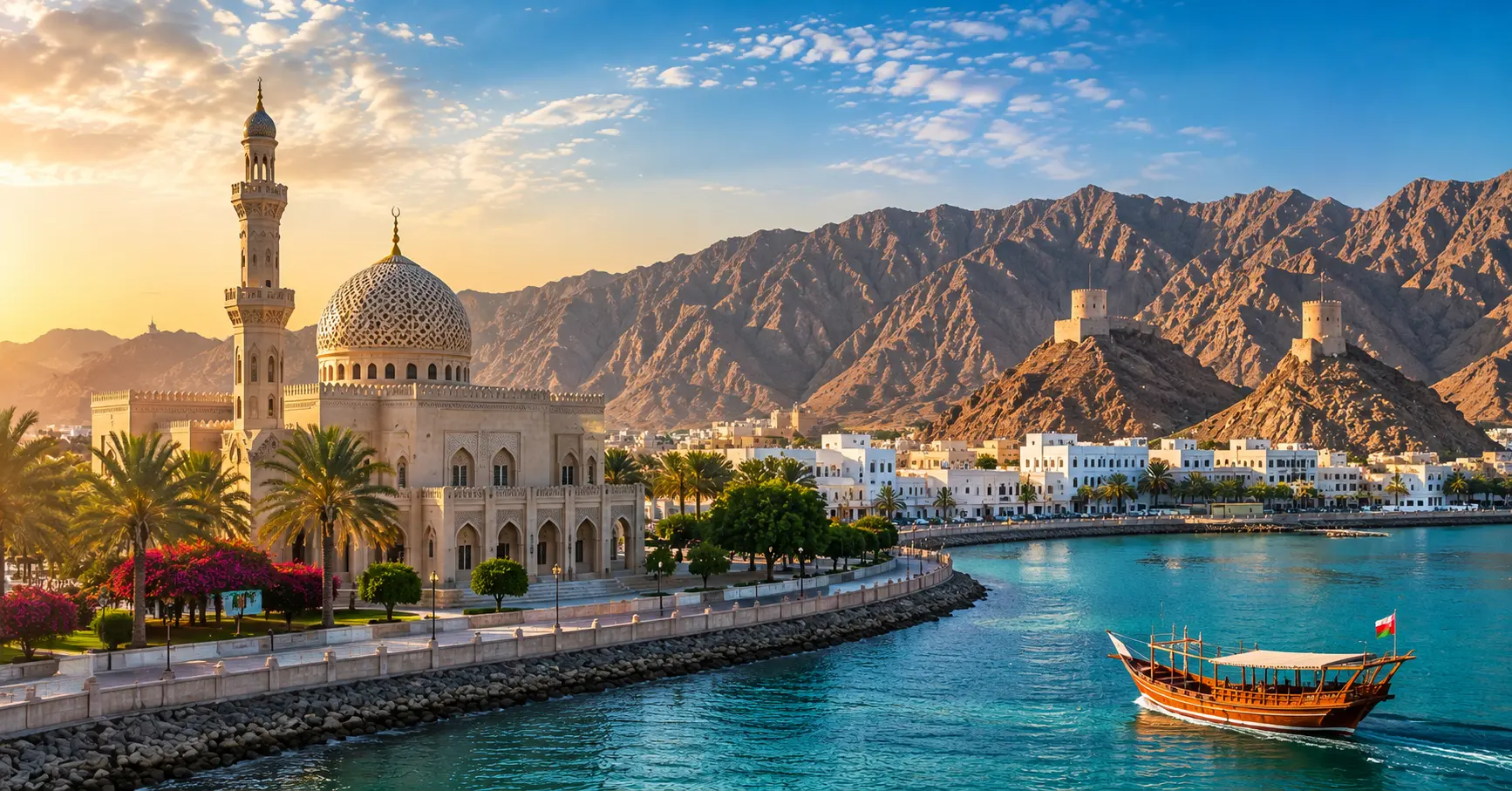
Oman Trip: The Ultimate 10-Day Oman Travel Guide for Indian Travellers – Muscat, Wadis, Desert, Mountains and Salalah
An Oman trip is unlike a typical Gulf holiday. Instead of concentrating only on modern shopping malls and skyscrapers, Oman takes you through dramatic mountains, ancient forts, traditional souqs, turquoise wadis, vast deserts, fishing villages and some of the most beautiful coastlines in the Arabian Peninsula.
For Indian travellers, Oman is particularly appealing because it can be combined into a relatively compact road trip. Muscat provides culture and architecture, Nizwa introduces Oman’s historic heartland, Wahiba Sands delivers the classic desert experience, while Wadi Shab, Bimmah Sinkhole and the coastal villages add a completely different side to the journey.
Oman also changes dramatically with the seasons. Winter is ideal for exploring the country’s mountains and deserts, while the Dhofar region around Salalah transforms during the Khareef season. Oman’s tourism authority describes winter, roughly November to early March, as mild and dry, with Muscat averaging around 26°C, while autumn temperatures gradually fall to around 28°C.
This guide is designed for travellers who want to see more than Muscat while still keeping the journey practical.
Destination at a Glance
| Travel Detail | Oman |
|---|---|
| Country | Sultanate of Oman |
| Main Tourist Base | Muscat |
| Ideal Trip Duration | 7–10 days |
| Best Time to Visit | November to March |
| Best Time for Salalah | Mid-June to September |
| Currency | Omani Rial (OMR) |
| Planning Exchange Rate | 1 OMR ≈ ₹248; actual rate varies |
| Language | Arabic; English widely used in tourism |
| Time Difference from India | Oman is 1 hour 30 minutes behind India |
| Visa for Indian Citizens | Visa rules depend on eligibility; many Indian travellers need an e-Visa, while specific exemptions/conditions apply |
| Nearest Major Airport | Muscat International Airport |
| Suitable For | Couples, families, solo travellers and groups |
| Recommended Stay | 7–10 nights |
| Budget Traveller | Around ₹5,000–₹8,000 per person/day excluding flights |
| Comfortable Traveller | Around ₹9,000–₹15,000 per person/day excluding international flights |
| Luxury Traveller | ₹20,000+ per person/day depending on hotels and experiences |
For currency calculations in this guide, ₹248 per OMR is used as a convenient planning figure based on the current exchange-rate tool; actual card, bank and cash-exchange rates can differ.
Why Should You Visit Oman?
Oman is one of those destinations where the attraction is not concentrated in one city.
The country’s appeal comes from the variety of experiences you can combine during a single holiday.
1. Spectacular Mountains
The Al Hajar Mountains rise dramatically behind Muscat and extend across much of northern Oman.
You can drive through mountain roads, visit traditional villages and explore high-altitude landscapes.
2. Beautiful Wadis
Oman’s wadis are among its most distinctive natural attractions.
Depending on the location, you can find:
- Turquoise pools
- Rocky gorges
- Palm plantations
- Natural swimming areas
- Hiking trails
Wadi Shab is one of the best-known examples.
3. Dramatic Desert Landscapes
The Wahiba Sands, also known as the Sharqiya Sands, offer the classic Arabian desert experience.
You can:
- Ride across dunes
- Watch sunset
- Stay in a desert camp
- Try dune bashing
- Experience traditional Bedouin-inspired hospitality
- Stargaze away from city lights
4. Historic Forts
Oman has an impressive collection of forts and castles.
Nizwa Fort, Bahla Fort, Nakhal Fort and others provide a window into Oman’s history.
Nizwa Fort is particularly important because it was not simply a defensive structure. It also functioned as a centre of local administration and the residence of the Imam and his family.
5. Traditional Souqs
Modern shopping is easy to find in Muscat, but the more interesting shopping experience is often inside traditional markets.
Muttrah Souq is one of the most atmospheric places to shop for:
- Frankincense
- Perfumes
- Silver jewellery
- Traditional clothing
- Spices
- Handicrafts
6. Arabian Coastline
Oman has a long coastline with quiet beaches, dramatic cliffs and fishing villages.
The coastal road around Sur, Tiwi and Ras Al Jinz is especially attractive for travellers who enjoy road trips.
Best Time to Visit Oman
The best general period for an Oman trip is:
November to March
The weather is considerably more comfortable for sightseeing, hiking and desert excursions than during the hottest months.
Oman’s tourism information describes winter as lasting approximately from November to early March, with mild and dry conditions and Muscat averaging around 26°C.
Oman Weather by Season
| Season | What to Expect |
|---|---|
| November–March | Mild, dry and excellent for sightseeing |
| March–May | Warmer; mountains can remain pleasant |
| June–August | Very hot across much of northern Oman |
| September–October | Heat gradually begins to ease |
| Mid-June–September in Salalah | Khareef season with cooler, greener conditions |
Winter in Oman
Winter is the easiest season for a first-time visitor.
Daytime temperatures are generally comfortable enough for:
- Walking
- Hiking
- Desert excursions
- Fort visits
- Road trips
- Outdoor dining
Evenings in the mountains and desert can become surprisingly cool.
Carry a light jacket.
Summer in Oman
Summer is much more demanding in northern Oman.
Daytime temperatures can become extremely high.
This does not mean Oman is impossible in summer, but the itinerary needs to change.
Plan:
- Early-morning sightseeing
- Indoor attractions in the afternoon
- Swimming or coastal activities
- Air-conditioned restaurants
- Shorter outdoor walks
The Special Case of Salalah
Salalah is different.
The Khareef season generally runs from mid-June to September.
During this period, the Dhofar region experiences cooler, wetter and greener conditions than most of Oman.
If your main objective is:
green mountains + mist + waterfalls + unusual monsoon scenery
then Salalah during Khareef is the exception to the usual Oman winter recommendation.
How Many Days Are Enough for Oman?
4–5 Days
Good for:
Muscat + Nizwa + desert
but too short for a relaxed road trip.
7 Days
A good introduction:
Muscat + Nizwa + Wahiba Sands + Wadi Shab
10 Days
The best balance for a first trip:
Muscat + Nizwa + Jebel Akhdar + Wahiba Sands + Wadi Shab + Sur
12–14 Days
You can add:
- Ras Al Jinz
- Misfat Al Abriyeen
- Nakhal
- Bahla
- Salalah, if flights fit the schedule
Visa Information for Indian Travellers
Visa rules for Indian passport holders require particular attention because eligibility can depend on additional conditions.
The Embassy of India in Muscat currently states that Indian nationals generally require a visit/tourist visa, with applications handled through the Royal Oman Police e-Visa system. It also notes special arrangements for Indian passport holders who hold qualifying visas or residence permits from countries such as the USA, UK, Canada, Japan or Schengen countries, and for certain Indian residents of GCC countries.
Oman’s official visa information also states that visa applications are available online and that citizens of eligible countries can receive visa-free entry for stays of up to 14 days.
For an Indian traveller planning from India
Do not simply assume that every Indian passport holder receives visa-free entry.
Before booking a non-refundable trip, check your exact eligibility based on:
- Indian passport
- Existing foreign visas, if any
- GCC residence status, if applicable
- Length of stay
- Purpose of travel
- Passport validity
For travellers who require an e-Visa, Oman’s Royal Oman Police operates the official electronic visa system.
Passport Validity
A passport valid for at least six months from the date of arrival is required for the relevant Oman visa process.
Keep:
- Passport
- Visa approval
- Hotel bookings
- Return flight
- Travel insurance
- Copies of important documents
readily accessible.
Flights from India to Oman
For Indian travellers, Muscat International Airport is the principal gateway.
Direct and connecting services can be available from major Indian cities depending on airline schedules and season.
The most useful starting airports generally include:
- Delhi
- Mumbai
- Hyderabad
- Kochi
- Bengaluru
- Chennai
- Kozhikode
- Lucknow
Flight schedules change frequently, so compare direct and one-stop options before booking.
For example, current airline schedules show active Muscat–Delhi services, demonstrating the strong India–Oman air connection.
Nearest Airport for Most Tourists
Muscat International Airport
For a conventional Oman holiday, this should be your arrival and departure point.
It is particularly convenient because Muscat itself can be explored before beginning your road trip.
How to Travel Around Oman
This is one of the most important decisions you’ll make.
Option 1: Rental Car
Best for: couples, families and experienced road-trippers.
Oman is exceptionally suitable for self-drive travel in the main tourist regions.
Advantages:
- Freedom
- Flexible stops
- Easy access to remote locations
- No dependency on tour schedules
Option 2: Private Driver
Best for: families, senior travellers and groups.
You can build a customised route and avoid driving yourself.
This is especially useful for:
- Mountain roads
- Desert excursions
- Long coastal journeys
Option 3: Organised Tours
Best for: solo travellers and visitors who don’t want to drive.
This can be particularly convenient for:
- Wahiba Sands
- Wadi Shab
- Nizwa
- Day trips from Muscat
Should You Rent a Car in Oman?
For a 7–10 day road trip:
Yes, if you are comfortable driving abroad.
A rental car gives you much more flexibility than relying on taxis.
However, don’t choose a vehicle based only on the cheapest rental price.
For mountain and desert routes, vehicle type matters.
A 4WD is useful or necessary for certain excursions, although many major tourist routes can be completed in a normal car.
Currency of Oman
The official currency is the:
Omani Rial (OMR)
One rial is divided into:
1,000 baisa
For easy planning, this guide uses approximately:
1 OMR ≈ ₹248
Actual exchange rates can vary.
Useful Price Conversions
| Oman Price | Approx. Indian Rupees |
|---|---|
| 1 OMR | ₹248 |
| 2 OMR | ₹496 |
| 5 OMR | ₹1,240 |
| 10 OMR | ₹2,480 |
| 20 OMR | ₹4,960 |
| 50 OMR | ₹12,400 |
| 100 OMR | ₹24,800 |
Treat these as approximate planning figures rather than guaranteed conversion rates.
Cash or Card?
Cards are widely useful in Muscat and other developed tourist areas.
However, carry cash when travelling into:
- Villages
- Small cafés
- Remote wadis
- Desert areas
- Small souqs
A sensible strategy is:
Card for hotels, fuel and major purchases
Cash for small expenses
SIM Card and Internet in Oman
A local SIM or eSIM is strongly recommended.
Major telecom providers operate in Oman, and tourist connectivity is generally good in cities and populated areas.
However, coverage becomes less predictable in:
- Mountains
- Desert
- Remote coastal roads
- Wadis
Before leaving Muscat, download:
- Offline maps
- Hotel addresses
- Driving routes
- Important phone numbers
- Booking confirmations
Internet in Hotels and Cafés
Wi-Fi is common in:
- Hotels
- Restaurants
- Shopping malls
- Cafés
But don’t assume that Wi-Fi will be reliable during a remote road trip.
Your mobile data is the more useful backup.
Safety in Oman
Oman is generally regarded as a comfortable destination for tourists, but natural-environment safety deserves more attention than city crime.
The biggest risks on an Oman trip are often associated with:
- Heat
- Flash floods
- Mountain roads
- Desert driving
- Swimming in unfamiliar areas
- Dehydration
Wadi Safety
Never underestimate a wadi.
Weather conditions can change rapidly, and rainfall upstream can cause sudden flooding.
If there has been significant rain, don’t enter a wadi simply because the weather where you are standing looks fine.
Desert Safety
If driving into the dunes:
- Use an experienced operator
- Don’t drive into remote sand alone
- Carry sufficient water
- Keep your phone charged
- Inform someone of your route
For most visitors, a professional desert operator is the safer choice.
Mountain Driving
Drive slowly on:
- Steep descents
- Hairpin bends
- Narrow roads
- Gravel sections
Don’t focus on scenery while driving.
Pull over safely before taking photographs.
Why Oman Is Different From Other Gulf Destinations
A Dubai holiday can be built around:
shopping + skyscrapers + entertainment
An Oman holiday is more about:
road trips + mountains + forts + wadis + deserts + villages + beaches
That difference is exactly what makes the country attractive.
Muscat – The Gateway to Oman
Muscat deserves at least two full days on a first Oman trip.
The city is relatively spread out, so don’t try to cover every attraction in one morning.
The best approach is to divide Muscat into:
Grand Mosque + modern Muscat
and
Muttrah + Old Muscat
1. Sultan Qaboos Grand Mosque
| Information | Details |
|---|---|
| Location | Sultan Qaboos Street, Muscat |
| Google Rating | Approximately 4.8/5 |
| Approx. Reviews | 16,000+ |
| Entry Fee | 8 OMR for visitors according to current tourism information, about ₹1,984 |
| Opening Hours | Non-Muslim visitors: Saturday–Thursday, 8:00 AM–11:00 AM |
| Recommended Duration | 1.5–2 hours |
| Best Time to Visit | Early morning |
| How to Reach | Taxi or rental car |
| Approx. Transport Cost | ₹300–₹800 from central Muscat |
| Practical Tip | Dress conservatively; women should cover their hair and visitors should cover shoulders and knees |
The Sultan Qaboos Grand Mosque is one of the most impressive buildings in Oman.
It was inaugurated in 2001 and was constructed using nearly 300,000 tonnes of Indian sandstone. The complex includes a huge dome, five minarets and a famous hand-woven Persian carpet. The main prayer hall accommodates roughly 6,500 worshippers, while the overall complex can accommodate around 20,000.
The mosque currently welcomes non-Muslim visitors from Saturday to Thursday between 8 AM and 11 AM, with modest clothing required.
Why Is It Famous?
The architecture combines Islamic design traditions with an extraordinary scale.
Inside, pay attention to:
- The enormous prayer hall
- Chandeliers
- Decorative arches
- Persian carpet
- Geometric patterns
- Marble work
Don’t rush through the building.
The interior is considerably more impressive than photographs suggest.
Is It Worth Visiting?
Absolutely.
For a first Oman trip, this should be one of the first attractions on your itinerary.
2. Muttrah Fort
| Information | Details |
|---|---|
| Location | Muttrah, Muscat |
| Google Rating | Approximately 4.5/5 |
| Approx. Reviews | 4,200+ |
| Entry Fee | Non-resident adult approximately 3 OMR, about ₹744 |
| Opening Hours | Current tourism information lists 8:00 AM–5:00 PM daily |
| Recommended Duration | 1–1.5 hours |
| Best Time to Visit | Late afternoon |
| How to Reach | Taxi or rental car |
| Approx. Transport Cost | ₹300–₹700 |
| Practical Tip | Combine the fort with Muttrah Corniche and Souq |
Muttrah Fort sits on a rocky hill overlooking the historic harbour.
The fort was originally built by the Portuguese in the 1580s and later rebuilt under the Al Ya’arubah rulers. It has three circular towers and offers excellent views over the old harbour and Muttrah district.
Why Is It Famous?
It represents Oman’s maritime and military history.
The location is as important as the structure itself.
From the upper sections, you can see:
- Muttrah Corniche
- Harbour
- Traditional buildings
- Mountains
- Sea
Is It Worth Visiting?
Yes.
Visit in the late afternoon and combine it with the souq afterward.
3. Muttrah Souq
| Information | Details |
|---|---|
| Location | Muttrah Corniche, Muscat |
| Google Rating | Approximately 4.4/5 |
| Approx. Reviews | 30,000+ |
| Entry Fee | Free |
| Opening Hours | Generally around 9:00 AM–11:00 PM; Friday hours can differ |
| Recommended Duration | 1.5–2 hours |
| Best Time to Visit | Evening |
| How to Reach | Taxi, rental car or walk from Corniche |
| Approx. Transport Cost | ₹300–₹700 |
| Practical Tip | Compare prices before buying souvenirs and bargain politely |
Muttrah Souq is one of the most atmospheric traditional markets in Oman.
Current listings show approximately 30,000 reviews and a rating around 4.4/5, while operating hours vary by day, particularly on Friday. Mutrah Souq
The narrow lanes contain shops selling:
- Frankincense
- Perfumes
- Silver jewellery
- Khanjars
- Traditional clothing
- Spices
- Decorative items
- Souvenirs
Why Is It Famous?
The souq preserves the atmosphere of an old Arabian marketplace.
The architecture, narrow passages and smell of frankincense create an experience that modern shopping malls simply cannot reproduce.
Is It Worth Visiting?
Definitely.
This is where you should buy your Oman souvenirs.
4. Royal Opera House Muscat
| Information | Details |
|---|---|
| Location | Al Kharjiyah Street, Muscat |
| Google Rating | Approximately 4.7/5 |
| Approx. Reviews | 10,000+ |
| Entry Fee | House tour currently around 3.15–4.20 OMR for adults, depending on category |
| Opening Hours | House tours generally Saturday–Thursday, 10:00 AM–3:30 PM |
| Recommended Duration | 1–1.5 hours |
| Best Time to Visit | Morning or before a scheduled performance |
| How to Reach | Taxi or rental car |
| Approx. Transport Cost | ₹300–₹700 |
| Practical Tip | Check tour availability before arriving |
The Royal Opera House Muscat is one of the city’s most elegant modern buildings.
The official venue currently lists house tours from 10 AM to 3:30 PM, Saturday through Thursday, subject to availability. Adult tour pricing is currently listed around 3.15–4.20 OMR, depending on the ticket category.
Why Is It Famous?
The architecture combines:
- Islamic influences
- Mughal-inspired details
- European elements
- Traditional Omani design
A tour takes you through parts of the building and provides insight into its architectural and cultural significance.
Is It Worth Visiting?
Yes, particularly if you enjoy architecture.
If your trip is focused entirely on outdoor adventure, however, you can prioritise other attractions.
5. Bait Al Zubair Museum
| Information | Details |
|---|---|
| Location | Old Muscat |
| Google Rating | Approximately 4.5/5 |
| Approx. Reviews | 2,300+ |
| Entry Fee | Around 5–6 OMR, approximately ₹1,240–₹1,488 |
| Opening Hours | Generally daytime; current listings show around 9:00 AM–5:00 PM |
| Recommended Duration | 1.5–2 hours |
| Best Time to Visit | Morning or afternoon |
| How to Reach | Taxi/rental car |
| Approx. Transport Cost | ₹300–₹700 |
| Practical Tip | Combine with Old Muscat attractions |
Bait Al Zubair provides a useful introduction to Omani heritage.
Its collections cover aspects of:
- Traditional clothing
- Weapons
- Jewellery
- Household objects
- Heritage
- Omani culture
Current tourism booking information lists tickets from around 5–6 OMR depending on the booking and ticket category.
Is It Worth Visiting?
Yes for culture and history enthusiasts.
It is especially useful if this is your first visit to Oman and you want context before travelling into the interior.
6. Al Alam Palace
| Information | Details |
|---|---|
| Location | Old Muscat |
| Google Rating | Approximately 4.6/5 |
| Approx. Reviews | 6,700+ |
| Entry Fee | Exterior viewing generally free |
| Opening Hours | Exterior area accessible; palace itself is not a conventional public museum |
| Recommended Duration | 30–45 minutes |
| Best Time to Visit | Late afternoon |
| How to Reach | Taxi or rental car |
| Approx. Transport Cost | ₹300–₹700 |
| Practical Tip | Combine with Al Jalali and Al Mirani viewpoints |
Al Alam Palace is the ceremonial palace of the Omani Sultan.
The colourful façade makes it one of the most recognisable landmarks in Old Muscat.
You generally visit to photograph the exterior rather than tour the palace interior.
Is It Worth Visiting?
Yes, but briefly.
Don’t spend an hour here when you can combine it with the surrounding historic district.
7. Al Jalali and Al Mirani Forts
| Information | Details |
|---|---|
| Location | Old Muscat |
| Google Rating | Approximately 4.5/5 for the historic area |
| Entry Fee | Exterior viewing generally free; access restrictions may apply |
| Opening Hours | Exterior viewpoints accessible according to local conditions |
| Recommended Duration | 30–45 minutes |
| Best Time to Visit | Late afternoon |
| How to Reach | Taxi/rental car |
| Approx. Transport Cost | ₹300–₹700 |
| Practical Tip | Photograph from the waterfront rather than trying to enter restricted areas |
These historic forts guard the harbour around Old Muscat.
They provide an excellent reminder that Oman was once a major maritime power in the region.
A Perfect First Day in Muscat
Don’t try to visit everything.
A better sequence is:
Morning
Sultan Qaboos Grand Mosque
↓
Late Morning
Royal Opera House
↓
Lunch
Muscat restaurant
↓
Afternoon
Old Muscat
↓
Al Alam Palace
↓
Al Jalali and Al Mirani
↓
Sunset
Muttrah Fort
↓
Evening
Muttrah Corniche + Muttrah Souq
This gives you a full but manageable first day.
Muscat Day 1: Distance and Budget
Total local driving: approximately 35–50 km
Driving time: approximately 1.5–2.5 hours spread across the day
Transport: Rental car/taxi
Approximate transport cost: ₹1,000–₹2,500 per person depending on group size
Approximate daily budget: ₹4,000–₹8,000 excluding hotel
Suggested hotel areas:
- Al Khuwair
- Qurum
- Ruwi
- Muttrah
- Al Mouj for a premium stay
Where to Eat in Muscat
Muscat offers much more variety than the smaller towns you will visit later.
For your first evening, consider trying:
- Shuwa
- Majboos
- Mashuai
- Omani bread
- Grilled seafood
- Hummus
- Dates
- Halwa
Indian food is also widely available, particularly because of Oman’s large Indian expatriate community.
8. Nizwa Fort
| Information | Details |
|---|---|
| Location | Nizwa, Ad Dakhiliyah Governorate |
| Google Rating | Approximately 4.6/5 |
| Approx. Reviews | 10,000+ |
| Entry Fee | Approximately 5 OMR for international adult visitors, about ₹1,240 |
| Opening Hours | Generally 8:00 AM–8:00 PM; Friday hours can differ |
| Recommended Duration | 1.5–2 hours |
| Best Time to Visit | Early morning or late afternoon |
| How to Reach | Rental car, private driver or tour |
| Approx. Transport Cost from Muscat | ₹1,500–₹3,000 by taxi/private transfer; much less per person in a shared vehicle |
| Practical Tip | Visit the fort and Nizwa Souq together, preferably in the morning |
Nizwa Fort is one of the most important historical attractions in Oman.
Its enormous circular tower dominates the old city and gives visitors an excellent introduction to Oman’s history.
The fort was constructed in stages, with the main tower dating to the 17th century during the reign of Imam Sultan bin Saif Al Ya’arubi. It was designed as both a defensive structure and an administrative centre. (experienceoman.om)
Why Is Nizwa Fort Famous?
The enormous tower is its defining feature.
It rises roughly 34 metres and has a diameter of about 45 metres.
Inside, the fort contains:
- Defensive passages
- Storage rooms
- Wells
- Traditional living areas
- Exhibition spaces
- Stairways
- Historical displays
The design reflects the strategic importance of Nizwa.
The fort was not built simply as a military structure. It was closely connected with the political and religious administration of the region.
What Should You Experience?
Don’t just walk around the central courtyard.
Climb into the tower.
The higher levels provide views across:
- Nizwa
- Date plantations
- Mountains
- Historic neighbourhoods
The contrast between the ancient fort and the modern city beyond it is particularly interesting.
Is Nizwa Fort Worth Visiting?
Definitely.
If you visit only one fort in Oman, Nizwa Fort is the strongest choice.
9. Nizwa Souq
| Information | Details |
|---|---|
| Location | Adjacent to Nizwa Fort |
| Google Rating | Approximately 4.5/5 |
| Approx. Reviews | 4,000+ |
| Entry Fee | Free |
| Opening Hours | Generally morning and evening; individual shops vary |
| Recommended Duration | 1–2 hours |
| Best Time to Visit | Morning, especially on Friday |
| How to Reach | Walking from Nizwa Fort |
| Approx. Transport Cost | None if visiting with the fort |
| Practical Tip | Friday morning is particularly interesting because of the traditional livestock market |
Nizwa Souq is one of the best places to see traditional commerce in Oman.
You can find:
- Dates
- Spices
- Pottery
- Silver jewellery
- Khanjars
- Traditional clothing
- Honey
- Handicrafts
Friday Livestock Market
If your schedule permits, try to be in Nizwa on a Friday morning.
The traditional livestock market is one of the most distinctive cultural experiences in the city.
Local sellers bring animals to the market, creating a lively atmosphere that is quite different from a conventional tourist attraction.
Important Etiquette
This is a genuine local market, not a staged performance.
Avoid:
- Getting in people’s way
- Taking intrusive close-up photographs
- Blocking sellers
- Touching animals without permission
10. Birkat Al Mouz
| Information | Details |
|---|---|
| Location | Near Nizwa, at the foothills of Jebel Akhdar |
| Google Rating | Approximately 4.5/5 |
| Approx. Reviews | 3,000+ |
| Entry Fee | Free for general sightseeing |
| Opening Hours | Open area; daylight recommended |
| Recommended Duration | 1–2 hours |
| Best Time to Visit | Morning or late afternoon |
| How to Reach | Rental car/private vehicle |
| Approx. Transport Cost from Nizwa | ₹300–₹800 |
| Practical Tip | Combine with the old village, falaj irrigation channels and date plantations |
Birkat Al Mouz is a historic village surrounded by date plantations and mountain scenery.
It is particularly interesting because it provides a transition between the flat interior and the mountains of Jebel Akhdar.
Why Is It Famous?
The village is associated with traditional falaj irrigation systems.
These channels have historically transported water from mountain sources to agricultural areas.
The ancient irrigation system demonstrates how communities adapted to Oman’s dry climate.
What Should You Experience?
Walk through the old village.
Look for:
- Mud-brick buildings
- Date plantations
- Irrigation channels
- Mountain views
Don’t rush.
Birkat Al Mouz works best as a slow, atmospheric stop rather than a checklist attraction.
11. Jebel Akhdar
| Information | Details |
|---|---|
| Location | Al Hajar Mountains, near Nizwa |
| Google Rating | Approximately 4.8/5 |
| Approx. Reviews | Several thousand |
| Entry Fee | No separate general sightseeing fee |
| Opening Hours | Mountain access subject to road conditions |
| Recommended Duration | 1–2 days |
| Best Time to Visit | October–April; cooler months are especially comfortable |
| How to Reach | 4WD required beyond the checkpoint under normal access rules |
| Approx. Transport Cost | ₹2,000–₹5,000 for a shared/private mountain transfer |
| Practical Tip | Carry warm clothing; temperatures can be significantly lower than Muscat |
Jebel Akhdar means “Green Mountain”, although its appearance depends heavily on the season.
The mountain is part of the Al Hajar range and is famous for:
- Deep valleys
- Terraced farms
- Fruit orchards
- Rose cultivation
- Mountain villages
- Cooler temperatures
Why Is Jebel Akhdar Famous?
The altitude creates a surprisingly different climate from Muscat.
The area is known for growing:
- Pomegranates
- Apricots
- Peaches
- Walnuts
- Almonds
- Grapes
The mountain is also famous for its roses.
During the rose season, villages can become associated with the production of rose water.
What Should You Experience?
The most rewarding activity is simply driving through the mountains and stopping at viewpoints.
You can also visit villages and walk along mountain paths.
For a more immersive experience, stay overnight.
A day trip from Muscat is possible, but it is much more satisfying when incorporated into a road trip from Nizwa.
Is Jebel Akhdar Worth Visiting?
Yes, especially if you enjoy landscapes and cooler mountain weather.
For a first Oman trip, it is one of the strongest additions after Nizwa.
12. Al Hamra Old Village
| Information | Details |
|---|---|
| Location | Al Hamra, Ad Dakhiliyah Governorate |
| Google Rating | Approximately 4.4/5 |
| Approx. Reviews | 1,500+ |
| Entry Fee | Free for general village exploration |
| Opening Hours | Outdoor historic area; daylight recommended |
| Recommended Duration | 1–2 hours |
| Best Time to Visit | Morning or late afternoon |
| How to Reach | Rental car/private vehicle |
| Approx. Transport Cost | ₹300–₹800 from nearby towns |
| Practical Tip | Combine with Misfat Al Abriyeen |
Al Hamra is one of the better places to understand traditional Omani village architecture.
Old mud-brick houses stand alongside date plantations and the mountains.
Why Is It Worth Visiting?
The village offers a more authentic impression of traditional settlement patterns than a restored monument alone.
You can see how houses were historically positioned close to agricultural areas and water sources.
13. Misfat Al Abriyeen
| Information | Details |
|---|---|
| Location | Al Hamra area |
| Google Rating | Approximately 4.7/5 |
| Approx. Reviews | 2,000+ |
| Entry Fee | Free for general village access |
| Opening Hours | Open village; daylight recommended |
| Recommended Duration | 2–3 hours |
| Best Time to Visit | Morning or late afternoon |
| How to Reach | Car/private vehicle |
| Approx. Transport Cost | ₹300–₹800 |
| Practical Tip | Wear comfortable shoes because the village involves walking on uneven paths |
Misfat Al Abriyeen is one of Oman’s most picturesque mountain villages.
The village is built into the mountainside and surrounded by agricultural terraces.
Why Is It Famous?
The village combines:
- Stone houses
- Date palms
- Mountain terraces
- Falaj irrigation
- Narrow walking paths
- Dramatic valley views
It feels very different from modern Muscat.
What Should You Experience?
Walk slowly through the village.
Look at how water flows through the irrigation channels.
Stop at a viewpoint overlooking the valley.
If you have time, have tea or a simple meal at a local guesthouse.
Is It Worth Visiting?
Yes.
It is one of the best stops for travellers who want to experience traditional Oman rather than only major monuments.
14. Bahla Fort
| Information | Details |
|---|---|
| Location | Bahla, Ad Dakhiliyah Governorate |
| Google Rating | Approximately 4.5/5 |
| Approx. Reviews | 2,500+ |
| Entry Fee | Low-cost/nominal ticket where applicable; verify locally |
| Opening Hours | Generally daytime; schedules can change |
| Recommended Duration | 1–1.5 hours |
| Best Time to Visit | Morning or late afternoon |
| How to Reach | Rental car/private vehicle |
| Approx. Transport Cost | ₹500–₹1,000 from Nizwa |
| Practical Tip | Combine with Jabrin Castle if you enjoy Omani history |
Bahla Fort is another major historical monument in the interior.
It forms part of a historic settlement surrounded by walls and traditional buildings.
Why Is It Famous?
Bahla is recognised as a UNESCO World Heritage site because of its cultural landscape and historical importance.
The fort represents the architectural traditions of medieval Oman.
Is It Worth Visiting?
Yes for history enthusiasts.
If you have limited time, however, prioritise Nizwa Fort.
15. Jabrin Castle
| Information | Details |
|---|---|
| Location | Near Bahla |
| Google Rating | Approximately 4.7/5 |
| Approx. Reviews | 3,000+ |
| Entry Fee | Approximately 0.5 OMR, around ₹124 |
| Opening Hours | Generally 8:00 AM–6:00 PM; verify before travel |
| Recommended Duration | 1–1.5 hours |
| Best Time to Visit | Morning |
| How to Reach | Rental car/private vehicle |
| Approx. Transport Cost | ₹500–₹1,000 from Nizwa |
| Practical Tip | Look carefully at the ceilings, ventilation and defensive design |
Jabrin Castle is often considered one of Oman’s most beautiful historic castles.
Unlike a purely military fort, it was also designed as a residence and centre of learning.
Why Is It Famous?
The interior contains beautifully decorated ceilings, rooms and architectural details.
It provides a more intimate experience than Nizwa Fort.
Is It Worth Visiting?
Yes.
If you enjoy architecture, history and photography, add it to your Nizwa-area itinerary.
16. Nakhal Fort
| Information | Details |
|---|---|
| Location | Nakhal, Al Batinah South |
| Google Rating | Approximately 4.6/5 |
| Approx. Reviews | 5,000+ |
| Entry Fee | Around 0.5 OMR, approximately ₹124, where applicable |
| Opening Hours | Generally daytime; schedules can vary |
| Recommended Duration | 1–1.5 hours |
| Best Time to Visit | Morning or late afternoon |
| How to Reach | Rental car/private vehicle |
| Approx. Transport Cost from Muscat | ₹1,500–₹3,000 depending on vehicle |
| Practical Tip | Combine with Nakhal hot springs |
Nakhal Fort is dramatically positioned against the mountains.
Its setting is arguably more impressive than the building itself.
17. Nakhal Hot Springs
| Information | Details |
|---|---|
| Location | Near Nakhal Fort |
| Google Rating | Approximately 4.4/5 |
| Approx. Reviews | 2,000+ |
| Entry Fee | Generally free |
| Opening Hours | Daylight; local access conditions apply |
| Recommended Duration | 45–60 minutes |
| Best Time to Visit | Morning |
| How to Reach | Rental car/private vehicle |
| Approx. Transport Cost | Included with Nakhal excursion |
| Practical Tip | Dress modestly and respect local visitors using the bathing areas |
The hot springs provide a relaxing stop after visiting the fort.
However, remember that this is also a local recreational area.
Dress respectfully.
18. Wadi Bani Khalid
| Information | Details |
|---|---|
| Location | Al Sharqiyah North Governorate |
| Google Rating | Approximately 4.6/5 |
| Approx. Reviews | 10,000+ |
| Entry Fee | Free |
| Opening Hours | Daylight; avoid unsafe conditions after heavy rain |
| Recommended Duration | 3–4 hours |
| Best Time to Visit | November–March |
| How to Reach | Rental car/private vehicle |
| Approx. Transport Cost | ₹1,000–₹2,500 depending on starting point |
| Practical Tip | Carry swimwear, water shoes, drinking water and dry clothes |
Wadi Bani Khalid is one of Oman’s most famous wadis.
Unlike some narrow, rugged wadis, it contains relatively accessible pools surrounded by dramatic rocky scenery.
Why Is It Famous?
The combination of:
clear water + mountains + palm trees + rocky landscape
makes it one of the most photogenic natural attractions in Oman.
The water can remain present for much of the year.
What Should You Experience?
Start near the main pools.
If you’re comfortable walking, continue deeper into the wadi.
The further you go, the quieter the surroundings can become.
Swimming is possible in designated areas, but visitors should always assess conditions and follow local instructions.
Is It Worth Visiting?
Absolutely.
For a first-time Oman traveller, Wadi Bani Khalid is one of the natural attractions that should be high on your list.
Wadi Bani Khalid Practical Advice
Wear clothing suitable for swimming and walking.
For visitors, particularly women, modest swimwear is advisable because the wadi is also used by local families.
Avoid:
- Loud behaviour
- Music
- Excessively revealing swimwear
- Jumping into unfamiliar pools
19. Wahiba Sands
| Information | Details |
|---|---|
| Location | Ash Sharqiyah Sands, eastern Oman |
| Google Rating | Approximately 4.7/5 |
| Approx. Reviews | Several thousand |
| Entry Fee | No general entry fee; desert camps/activities are separately priced |
| Opening Hours | Open landscape; excursions are scheduled by operators |
| Recommended Duration | 1 night minimum |
| Best Time to Visit | November–March |
| How to Reach | 4WD or desert camp transfer |
| Approx. Transport Cost | ₹2,000–₹5,000 for shared desert transfer |
| Practical Tip | Book an overnight desert camp rather than visiting only for a few hours |
Wahiba Sands is one of the defining experiences of an Oman trip.
The dunes stretch across a vast area of golden and reddish sand.
Why Is Wahiba Sands Famous?
The landscape represents the classic Arabian desert.
But the best part is not simply seeing dunes.
It is spending a night in the desert.
You can experience:
- Sunset
- Dune bashing
- Camel rides
- Traditional dinner
- Campfire
- Stargazing
- Sunrise
Desert Camp Options
You will generally find different levels of accommodation.
Basic Camp
Approximate:
25–40 OMR per person
or:
₹6,200–₹9,900
depending on inclusions.
Comfortable Camp
Approximate:
40–70 OMR per person
or:
₹9,900–₹17,400
Luxury Desert Camp
Can cost:
70 OMR+ per person
with premium camps charging considerably more during peak periods.
Prices often include combinations of:
- Accommodation
- Dinner
- Breakfast
- Transfers
- Desert activities
Always check exactly what is included.
Best Time for the Desert
Winter is ideal.
Daytime temperatures are manageable, while evenings can be cool.
This is one reason November to March works so well for a broader Oman itinerary.
Desert Sunset
Try to reach the camp early enough to see the sunset.
Don’t arrive after dark.
The transition from bright desert to sunset colours is one of the highlights of the experience.
Desert Sunrise
Wake up early.
The desert changes dramatically as the first light hits the dunes.
It is worth getting out of bed.
Dune Bashing
Dune bashing is generally conducted in 4WD vehicles.
For first-time visitors, it can be exciting but physically demanding.
If you are travelling with:
- Young children
- Pregnant travellers
- Elderly passengers
- Back or neck problems
ask about a gentler desert transfer instead.
Camel Ride
Camel rides are often short.
Treat them as a cultural experience rather than an extended adventure.
Follow the operator’s instructions and treat the animals respectfully.
Is Wahiba Sands Worth Visiting?
Absolutely.
An Oman itinerary without at least one desert experience feels incomplete.
20. Wadi Shab
| Information | Details |
|---|---|
| Location | Tiwi, South Al Sharqiyah |
| Google Rating | Approximately 4.7/5 |
| Approx. Reviews | 10,000+ |
| Entry Fee | Boat transfer generally around 1 OMR return, approximately ₹248; access itself is generally free |
| Opening Hours | Daylight; boat services operate during visitor hours |
| Recommended Duration | 3–5 hours |
| Best Time to Visit | November–March |
| How to Reach | Rental car/private vehicle |
| Approx. Transport Cost from Muscat | ₹1,500–₹3,000 shared-equivalent |
| Practical Tip | Start early, wear water-friendly footwear and carry minimal belongings |
Wadi Shab is one of the most famous natural attractions in Oman.
The journey itself is part of the experience.
Visitors take a short boat ride before walking through the wadi.
Why Is Wadi Shab Famous?
The wadi combines:
- Rocky cliffs
- Palm trees
- Turquoise pools
- Hiking
- Natural swimming
- Hidden water sections
The final sections can require swimming.
What Should You Experience?
Begin early.
The hike can become uncomfortable during the hotter part of the day.
Wear:
- Water shoes
- Quick-drying clothes
- Sunscreen
- Hat
Carry a waterproof bag for valuables.
Is Wadi Shab Worth Visiting?
Yes, but only if you are reasonably comfortable walking and swimming.
If you cannot swim or have mobility issues, you can still enjoy the initial section, but the deepest parts are not suitable for everyone.
21. Bimmah Sinkhole
| Information | Details |
|---|---|
| Location | Hawiyat Najm Park, near Dibab |
| Google Rating | Approximately 4.4/5 |
| Approx. Reviews | 8,000+ |
| Entry Fee | Free |
| Opening Hours | Generally daytime |
| Recommended Duration | 45–90 minutes |
| Best Time to Visit | Morning |
| How to Reach | Rental car/private vehicle |
| Approx. Transport Cost from Muscat | ₹1,500–₹3,000 depending on vehicle |
| Practical Tip | Combine it with Wadi Shab on a coastal road trip |
The Bimmah Sinkhole is a natural limestone depression filled with blue-green water.
It is one of the easiest natural attractions to visit on the Muscat–Sur coastal route.
Why Is It Famous?
The contrast is what makes it special:
pale limestone + blue-green water + rugged cliffs
You can descend the steps and, depending on conditions and local rules, swim.
Is It Worth Visiting?
Yes.
But don’t spend half a day here.
An hour is generally enough for most visitors.
Combine it with Wadi Shab.
22. Sur
| Information | Details |
|---|---|
| Location | Al Sharqiyah South Governorate |
| Google Rating | Approximately 4.4/5 for the main city attractions |
| Approx. Reviews | Varies by attraction |
| Entry Fee | Most city sightseeing free |
| Opening Hours | Outdoor attractions vary |
| Recommended Duration | Half day |
| Best Time to Visit | Morning and late afternoon |
| How to Reach | Rental car/private vehicle |
| Approx. Transport Cost | Part of road-trip driving |
| Practical Tip | Stay overnight if visiting Ras Al Jinz |
Sur is an important coastal city with a long maritime tradition.
It is historically associated with:
- Dhow building
- Fishing
- Indian Ocean trade
- Coastal commerce
What Should You See in Sur?
Consider:
- Dhow factory
- Corniche
- Old harbour
- Lighthouse
- Traditional neighbourhoods
The city works best as a relaxed overnight stop rather than a rapid sightseeing checkpoint.
23. Ras Al Jinz Turtle Reserve
| Information | Details |
|---|---|
| Location | Ras Al Jinz, near Sur |
| Google Rating | Approximately 4.1/5 |
| Approx. Reviews | 7,000+ |
| Entry Fee | Paid; turtle-viewing programmes cost more than general museum access |
| Opening Hours | Viewing sessions are scheduled, particularly at night and early morning |
| Recommended Duration | 2–3 hours |
| Best Time to Visit | Seasonal turtle nesting periods |
| How to Reach | Rental car/private vehicle |
| Approx. Transport Cost from Sur | ₹500–₹1,000 |
| Practical Tip | Book a guided viewing session and never use flash photography near turtles |
Ras Al Jinz is famous for green turtles that come ashore to nest.
The experience is highly dependent on nature.
There is no guarantee that you will see turtles during every visit.
Why Is It Famous?
The reserve protects an important nesting beach.
The attraction is not a conventional wildlife park.
The turtles are wild animals.
That means the experience can be unpredictable.
Is It Worth Visiting?
Yes for wildlife enthusiasts.
Don’t visit with unrealistic expectations of seeing dozens of turtles on demand.
Best Coastal Road Route
If you have enough time, use:
Muscat
↓
Bimmah Sinkhole
↓
Wadi Shab
↓
Sur
↓
Ras Al Jinz
This is one of the most scenic road-trip sections in Oman.
The Best 5-Day Interior Route
For travellers with only five days after Muscat, use:
Muscat
↓
Nizwa
↓
Jebel Akhdar
↓
Wadi Bani Khalid
↓
Wahiba Sands
↓
Muscat
This route gives you:
- History
- Mountains
- Desert
- Wadi
- Villages
without excessive backtracking.
Recommended 7-Day Oman Route
For a first-time traveller:
Day 1
Muscat
Day 2
Muscat
Day 3
Muscat → Nizwa → Jebel Akhdar
Day 4
Jebel Akhdar → Wadi Bani Khalid
Day 5
Wadi Bani Khalid → Wahiba Sands
Day 6
Wahiba Sands → Sur
Day 7
Sur → Wadi Shab → Bimmah Sinkhole → Muscat
This is ambitious but possible with an early start.
Better 8-Day Route
For a more relaxed journey:
Day 1
Muscat
Day 2
Muscat
Day 3
Muscat → Nizwa
Day 4
Nizwa → Jebel Akhdar → Nizwa
Day 5
Nizwa → Wadi Bani Khalid → Wahiba Sands
Day 6
Wahiba Sands → Sur
Day 7
Sur → Wadi Shab → Bimmah Sinkhole
Day 8
Return to Muscat and depart
This is my preferred structure for travellers who want to experience the country’s highlights without rushing.
Day-Wise Practical Details
Day 3: Muscat to Nizwa
Distance: Approximately 160–170 km
Travel time: Around 1.5–2 hours without major stops
Mode: Rental car/private vehicle
Transport cost: ₹1,500–₹3,000 equivalent depending on vehicle
Daily budget: ₹4,000–₹8,000 excluding hotel
Morning
Leave Muscat after breakfast.
Afternoon
Explore:
- Nizwa Fort
- Nizwa Souq
Evening
Drive toward Jebel Akhdar or stay in Nizwa.
Suggested Hotel Area
Nizwa town for budget-conscious travellers.
Jebel Akhdar for a premium mountain experience.
Day 4: Jebel Akhdar
Distance: Approximately 50–100 km local driving
Travel time: 2–4 hours including viewpoints
Transport: 4WD
Transport cost: ₹2,000–₹5,000 depending on arrangement
Daily budget: ₹5,000–₹12,000
Morning
Mountain viewpoints.
Afternoon
Village walks and plantations.
Evening
Sunset from a mountain viewpoint.
Stay overnight.
Day 5: Jebel Akhdar → Wadi Bani Khalid → Wahiba Sands
Distance: Approximately 250–300 km depending on route
Travel time: 4–6 hours plus sightseeing
Transport: 4WD/rental car
Transport cost: ₹2,000–₹5,000 equivalent
Daily budget: ₹7,000–₹15,000 including desert camp
Morning
Leave the mountains early.
Afternoon
Explore Wadi Bani Khalid.
Evening
Continue to Wahiba Sands.
Watch sunset.
Stay in desert camp.
Day 6: Wahiba Sands → Sur
Distance: Approximately 200 km
Travel time: 3–4 hours
Transport: 4WD + rental car/private vehicle
Transport cost: ₹1,500–₹3,500
Daily budget: ₹4,000–₹8,000
Morning
Desert sunrise.
Breakfast.
Afternoon
Drive toward Sur.
Evening
Explore Sur Corniche.
Stay overnight.
Day 7: Sur → Wadi Shab → Bimmah Sinkhole → Muscat
Distance: Approximately 250–300 km depending on stops
Travel time: 4–5 hours driving
Transport: Rental car/private vehicle
Transport cost: ₹1,500–₹3,000
Daily budget: ₹4,000–₹8,000
Morning
Visit Wadi Shab.
Afternoon
Stop at Bimmah Sinkhole.
Evening
Return to Muscat.
Stay near the airport if departing the following morning.
Where to Stay in Nizwa
Budget
₹2,000–₹4,000
Best for:
- Backpackers
- Couples
- Short stays
Mid-Range
₹4,000–₹8,000
Best for:
- Families
- Couples
- Road-trip travellers
Luxury
₹10,000–₹25,000+
Jebel Akhdar has several high-end mountain resorts.
This is where spending more can genuinely enhance the experience because the views and setting become part of the accommodation.
Where to Stay in Jebel Akhdar
A mountain resort can cost significantly more than a Nizwa hotel.
But if your budget permits, consider staying one night.
The experience of watching sunset and sunrise from the mountains is far better than making a rushed day trip.
Where to Stay in Wahiba Sands
Choose according to budget.
Basic Camp
25–40 OMR
Comfortable Camp
40–70 OMR
Luxury Camp
70 OMR+
Prices vary considerably according to:
- Season
- Meal plan
- Private bathroom
- Desert activities
- Transfer arrangements
What to Eat in Oman’s Interior
This is where you should become more adventurous.
Try:
Shuwa
Slow-cooked meat traditionally prepared for long periods.
It is particularly associated with celebrations and special occasions.
Majboos
Rice cooked with meat or chicken and spices.
It is somewhat familiar to Indian travellers because of the rice-and-spice combination, although the flavour profile is distinctly Omani/Gulf.
Mashuai
Traditionally prepared grilled or roasted kingfish served with rice and lemon-based accompaniments.
Omani Halwa
A thick, sweet dessert traditionally flavoured with:
- Rose water
- Cardamom
- Saffron
- Nuts
Vegetarian Food in Oman
Vegetarians can travel comfortably, particularly in Muscat.
Look for:
- Falafel
- Hummus
- Fattoush
- Tabbouleh
- Vegetable rice
- Grilled vegetables
- Lentil soup
- Vegetable curries
- Indian vegetarian food
Outside the capital, inform your hotel or restaurant clearly.
Important Food Tip for Road Trips
Don’t wait until you are hungry to find food in remote areas.
Keep:
- Water
- Dates
- Nuts
- Fruit
- Sandwiches
- Biscuits
in your car.
Fuel stations are useful stops but shouldn’t be your only food strategy.
Salalah: Oman’s Green Southern Escape
Salalah is in Dhofar Governorate, in the southern part of Oman.
It feels very different from Muscat.
Instead of the dry, rocky scenery associated with northern Oman, Salalah has:
- Coconut plantations
- Banana farms
- Frankincense trees
- Long beaches
- Mountain valleys
- Seasonal waterfalls
- Mist-covered hills during Khareef
The transformation is particularly dramatic during the monsoon season.
When Should You Visit Salalah?
There are two very different reasons to visit.
November to April
Best for:
- Sunshine
- Beaches
- Clear skies
- Comfortable outdoor sightseeing
- Road trips
Mid-June to September
Best for:
- Khareef greenery
- Mist
- Waterfalls
- Wadis
- Cool mountain weather
- Lush landscapes
Oman’s tourism information specifically highlights the Khareef season in Dhofar and attractions such as Wadi Darbat and Al Mughsail Beach during this period.
If your dream is to see a green Oman, Salalah during Khareef is the place to go.
24. Wadi Darbat
| Information | Details |
|---|---|
| Location | Near Taqah, Dhofar |
| Google Rating | Approximately 4.6/5 |
| Approx. Reviews | 10,000+ |
| Entry Fee | Generally free for the natural area; activities may cost extra |
| Opening Hours | Daylight recommended |
| Recommended Duration | 2–4 hours |
| Best Time to Visit | Khareef season for the greenest landscape |
| How to Reach | Rental car or private vehicle |
| Approx. Transport Cost from Salalah | ₹1,000–₹2,000 |
| Practical Tip | Visit after rainfall during Khareef for the best scenery |
Wadi Darbat is one of the most attractive natural areas around Salalah.
During Khareef, rain replenishes the wadi and surrounding landscape, creating green hills, grasslands, waterfalls and small lakes. The official tourism authority describes it as a series of lakes surrounded by rolling hills, with the landscape becoming especially lush during Khareef.
Why Is Wadi Darbat Famous?
It demonstrates just how dramatically Dhofar changes during the monsoon.
You may see:
- Cows
- Camels
- Goats
- Green hills
- Water
- Mist
- Picnic areas
The scenery is almost completely different from the desert landscapes of northern Oman.
What Should You Experience?
Don’t simply stop at the first viewpoint.
Spend some time walking around the valley.
During Khareef, the atmosphere can be cool and misty, which makes it particularly pleasant after the heat of the rest of Oman.
Is It Worth Visiting?
Absolutely.
If visiting Salalah during Khareef, Wadi Darbat should be near the top of your list.
25. Al Mughsail Beach
| Information | Details |
|---|---|
| Location | West of Salalah |
| Google Rating | Approximately 4.6/5 |
| Approx. Reviews | 8,000+ |
| Entry Fee | Free |
| Opening Hours | Open area; daylight recommended |
| Recommended Duration | 1.5–2 hours |
| Best Time to Visit | Late afternoon or Khareef season |
| How to Reach | Rental car/private vehicle |
| Approx. Transport Cost from Salalah | ₹1,000–₹2,000 |
| Practical Tip | Combine the beach with the blowholes and mountain viewpoints |
Al Mughsail is one of Dhofar’s signature coastal attractions.
The beach itself is beautiful, but the more unusual feature is the series of natural blowholes created by erosion.
The official tourism authority identifies Al Mughsail Beach as one of Dhofar’s important attractions because of these naturally formed fountains.
What Makes Mughsail Special?
The landscape combines:
white sand + blue Arabian Sea + limestone cliffs + mountain scenery
During Khareef, the mountains behind the coast can become covered in mist and greenery.
That contrast is one of the reasons Salalah feels so different from the rest of Oman.
26. Al Mughsail Blowholes
The blowholes are particularly interesting when the sea is active.
Waves push water through openings in the limestone, creating sprays and fountains.
Important Safety Rule
Stay behind designated barriers.
Do not climb onto wet rocks simply to get a closer photograph.
The sea can be powerful and unpredictable.
27. Jebel Samhan
| Information | Details |
|---|---|
| Location | Dhofar Governorate |
| Google Rating | Approximately 4.7/5 |
| Approx. Reviews | 2,000+ |
| Entry Fee | Generally free for viewpoints |
| Opening Hours | Daylight recommended |
| Recommended Duration | 2–3 hours |
| Best Time to Visit | Khareef for mist and clouds; clear months for panoramic views |
| How to Reach | Rental car/private vehicle |
| Approx. Transport Cost | ₹1,500–₹3,000 |
| Practical Tip | Carry a jacket even if Salalah is warm |
Jebel Samhan is one of Dhofar’s most dramatic mountain areas.
The elevation creates enormous views over the surrounding landscape.
During Khareef, clouds and mist can dramatically change the scenery.
Is It Worth Visiting?
Yes, especially for photographers.
However, don’t expect clear panoramic views every time during Khareef.
Sometimes the attraction is precisely the mist.
28. Ayn Razat
| Information | Details |
|---|---|
| Location | Near Salalah |
| Google Rating | Approximately 4.3/5 |
| Approx. Reviews | 3,000+ |
| Entry Fee | Generally free |
| Opening Hours | Daylight recommended |
| Recommended Duration | 1–2 hours |
| Best Time to Visit | Khareef and cooler months |
| How to Reach | Taxi/rental car |
| Approx. Transport Cost | ₹700–₹1,500 |
| Practical Tip | Combine with other eastern Salalah attractions |
Ayn Razat is associated with springs, gardens and water channels.
It provides a quieter alternative to some of the busier Khareef viewpoints.
29. Al Baleed Archaeological Park
| Information | Details |
|---|---|
| Location | Salalah |
| Google Rating | Approximately 4.5/5 |
| Approx. Reviews | 2,500+ |
| Entry Fee | Paid; verify the current combined museum/site ticket |
| Opening Hours | Generally daytime/evening depending on season |
| Recommended Duration | 2–3 hours |
| Best Time to Visit | Late afternoon |
| How to Reach | Rental car/taxi |
| Approx. Transport Cost | ₹500–₹1,000 |
| Practical Tip | Combine the archaeological site with the Frankincense Museum |
Al Baleed was an important medieval trading settlement.
Its significance is closely connected with the historic frankincense trade of Dhofar.
Why Is Al Baleed Important?
Dhofar was historically one of the world’s major sources of high-quality frankincense.
The ancient settlements around the region prospered partly because of this trade.
Walking among the ruins gives visitors a better understanding of the historical importance behind Salalah’s frankincense culture.
30. Museum of the Frankincense Land
| Information | Details |
|---|---|
| Location | Al Baleed Archaeological Park, Salalah |
| Google Rating | Approximately 4.4/5 |
| Approx. Reviews | 1,000+ |
| Entry Fee | Usually combined with archaeological-site admission |
| Opening Hours | Daytime/evening schedule varies |
| Recommended Duration | 1–1.5 hours |
| Best Time to Visit | Late afternoon |
| How to Reach | Taxi/rental car |
| Approx. Transport Cost | ₹500–₹1,000 |
| Practical Tip | Visit before exploring the Al Baleed ruins |
This museum provides context for:
- Oman’s maritime history
- Frankincense trade
- Dhofar’s archaeology
- Traditional culture
It is particularly useful because the historical significance of frankincense can otherwise be easy to miss.
31. Sultan Qaboos Mosque, Salalah
| Information | Details |
|---|---|
| Location | Central Salalah |
| Google Rating | Approximately 4.7/5 |
| Approx. Reviews | 4,000+ |
| Entry Fee | Generally free for worshippers; visitor access restrictions apply |
| Opening Hours | Religious-site access varies |
| Recommended Duration | 30–60 minutes |
| Best Time to Visit | Morning, subject to access |
| How to Reach | Taxi/rental car |
| Approx. Transport Cost | ₹300–₹700 |
| Practical Tip | Dress modestly and check visitor access before planning |
The mosque is one of Salalah’s most recognisable architectural landmarks.
It is worth seeing even if you have already visited the Sultan Qaboos Grand Mosque in Muscat because the surroundings and architectural presentation are different.
32. Mirbat
| Information | Details |
|---|---|
| Location | Eastern Dhofar |
| Google Rating | Approximately 4.4/5 |
| Approx. Reviews | Varies by attraction |
| Entry Fee | General town sightseeing free |
| Opening Hours | Outdoor sightseeing |
| Recommended Duration | 2–3 hours |
| Best Time to Visit | Morning or late afternoon |
| How to Reach | Rental car/private vehicle |
| Approx. Transport Cost from Salalah | ₹1,000–₹2,000 |
| Practical Tip | Combine with Taqah and eastern Dhofar |
Mirbat is an old coastal settlement with a history connected to:
- Fishing
- Maritime trade
- Frankincense
- Traditional architecture
The town provides a quieter cultural experience than central Salalah.
Best Salalah Road Trip
A useful full-day eastern route is:
Salalah
↓
Taqah
↓
Wadi Darbat
↓
Mirbat
↓
Return to Salalah
A western route is:
Salalah
↓
Al Mughsail
↓
Blowholes
↓
Coastal viewpoints
↓
Return to Salalah
How Many Days Should You Spend in Salalah?
2 Days
Enough for:
- City
- Al Baleed
- Wadi Darbat
- Mughsail
3 Days
Better.
You can add:
- Jebel Samhan
- Ayn Razat
- Taqah
- Mirbat
4–5 Days
Ideal during Khareef.
You can explore the region without rushing.
Is Salalah Worth Adding to a First Oman Trip?
It depends on your trip length.
5–7 Days
No, unless Salalah itself is your main objective.
8–10 Days
Possibly, if you are willing to reduce the northern itinerary.
12–14 Days
Yes.
You can comfortably combine northern Oman with Salalah if domestic flights are used.
Musandam: Oman’s Fjord Country
Musandam is separated from the main part of Oman by the UAE.
The regional capital is:
Khasab
The landscape is completely different.
Instead of desert dunes and wadis, you’ll see:
- Rugged mountains
- Deep sea inlets
- Fishing villages
- Dolphins
- Dramatic cliffs
- Traditional dhow boats
33. Khasab
| Information | Details |
|---|---|
| Location | Musandam Governorate |
| Google Rating | Approximately 4.5/5 |
| Approx. Reviews | Varies |
| Entry Fee | Town sightseeing generally free |
| Opening Hours | Outdoor sightseeing |
| Recommended Duration | 1 day plus boat excursion |
| Best Time to Visit | October–April |
| How to Reach | Domestic flight or road via UAE |
| Approx. Transport Cost | ₹1,500–₹4,000 local movement |
| Practical Tip | Check border requirements carefully if entering by road through the UAE |
Khasab is the gateway to Musandam.
The town itself is modest, but the surrounding landscape is spectacular.
34. Musandam Dhow Cruise
| Information | Details |
|---|---|
| Location | Khasab harbour |
| Google Rating | Usually high for established operators |
| Approx. Reviews | Operator-dependent |
| Entry Fee | Tour prices generally around 15–30 OMR, approximately ₹3,720–₹7,440 |
| Opening Hours | Day cruises generally depart in the morning |
| Recommended Duration | 5–7 hours |
| Best Time to Visit | October–April |
| How to Reach | Khasab harbour |
| Approx. Transport Cost | Usually included in tour |
| Practical Tip | Choose a cruise that includes dolphin watching and swimming stops |
The dhow cruise is the main reason to visit Musandam.
Traditional wooden boats travel through narrow sea channels surrounded by mountains.
Why Is Musandam Famous?
The landscape resembles fjords, although the geological formation is different from Scandinavian fjords.
The dramatic combination of:
mountains + deep blue sea + narrow inlets
creates some of Oman’s most striking scenery.
Dolphin Watching
Dolphins are frequently encountered during boat excursions.
However, remember that they are wild animals.
There is no guarantee of sightings.
Don’t choose an operator that encourages boats to chase or surround dolphins aggressively.
Swimming and Snorkelling
Many dhow cruises stop at sheltered areas.
Depending on conditions, you may be able to:
- Swim
- Snorkel
- Relax on the boat
Carry:
- Swimwear
- Towel
- Sunscreen
- Waterproof phone pouch
Is Musandam Worth Visiting?
Yes, but only if you have enough time.
For a 5-day Oman trip:
Skip it.
For a 10–14 day trip:
Consider adding it.
Recommended Hotels in Oman
Your accommodation strategy should change according to the region.
Muscat
Budget
₹2,000–₹4,000 per night
Suitable areas:
- Ruwi
- Al Khuwair
Mid-Range
₹4,000–₹9,000
Good for:
- Couples
- Families
- Road-trippers
Luxury
₹10,000–₹30,000+
Suitable areas:
- Qurum
- Al Mouj
- Waterfront resorts
Nizwa
Budget
₹2,000–₹4,000
Mid-Range
₹4,000–₹8,000
Luxury
₹8,000–₹20,000+
Jebel Akhdar
Mountain resorts are generally more expensive.
Expect approximately:
₹8,000–₹30,000+
depending on season and property.
This is one area where paying more can genuinely improve the experience because of the views and setting.
Wahiba Sands
Basic
₹6,000–₹10,000
Comfortable
₹10,000–₹18,000
Luxury
₹18,000–₹30,000+
Check whether the price includes:
- Dinner
- Breakfast
- Transfers
- Dune activities
Salalah
Budget
₹2,000–₹4,000
Mid-Range
₹4,000–₹9,000
Luxury
₹10,000–₹25,000+
During Khareef, prices can rise sharply.
Book early.
Best Omani Foods to Try
A first-time visitor should try at least these:
Shuwa
Slow-cooked meat.
Majboos
Spiced rice with meat or chicken.
Mashuai
Fish-based dish.
Omani Halwa
Sweet dessert.
Dates
Try different varieties.
Omani Bread
Excellent with tea, honey or savoury dishes.
Harees
Wheat and meat-based dish with a soft texture.
Mishkak
Seasoned grilled meat skewers.
Vegetarian Travellers
Vegetarian travellers should have a relatively easy time in Muscat.
Indian restaurants are particularly useful.
Outside Muscat, plan ahead.
A useful phrase to learn is:
“Ana nabati”
meaning:
I am vegetarian.
Also clarify whether a dish contains:
- Meat
- Chicken
- Fish
- Meat stock
- Animal fat
Shopping Guide for Oman
Oman has some excellent souvenirs.
1. Frankincense
Probably the most obvious purchase.
Dhofar is historically famous for frankincense production.
Prices vary considerably according to quality.
2. Omani Perfume
Traditional fragrances can make excellent gifts.
Look for:
- Frankincense-based scents
- Oud
- Attars
- Rose fragrances
3. Omani Halwa
A delicious edible souvenir.
Buy sealed packages for easier transport.
4. Dates
Excellent for family and friends.
Choose vacuum-packed or properly sealed products for travel.
5. Silver Jewellery
Traditional Omani silver jewellery is attractive and distinctive.
Compare workmanship and purity before purchasing.
6. Khanjar Souvenirs
The traditional Omani dagger is culturally significant.
For tourists, decorative versions are easier to transport.
Check airline and customs rules before purchasing anything sharp or antique.
Where to Shop
Muttrah Souq
Best overall experience.
Nizwa Souq
Excellent for traditional products.
Salalah
Best for:
- Frankincense
- Perfumes
- Dhofari products
Bargaining Tips
Bargaining is more appropriate in traditional markets than modern malls.
But don’t turn every purchase into a negotiation.
A good approach is:
Ask → compare → negotiate politely → decide.
If the seller refuses your price, simply move on.
Driving in Oman
If you’re planning a self-drive Oman trip, this section is important.
Drive on the Right
Oman drives on the right-hand side of the road.
This is different from India.
Take extra care during your first few hours.
Driving Distances
Don’t judge Oman from the map alone.
A route may look short but take considerably longer because of:
- Mountain roads
- Stops
- Speed restrictions
- Villages
- Photography breaks
Fuel
Fuel stations are available along major routes.
Don’t wait until your tank is nearly empty when travelling into remote areas.
A good rule is:
Refuel whenever the tank reaches around half.
4WD Requirements
A normal car works for many major tourist routes.
However, a 4WD can be important for:
- Certain Jebel Akhdar access
- Desert driving
- Remote mountain tracks
Always check the current road requirement before starting.
International Driving Permit
Indian travellers intending to rent a vehicle should check the rental company’s current requirements for:
- Indian driving licence
- International Driving Permit
- Passport
- Credit card
- Minimum driving age
Don’t assume that your Indian licence alone will automatically be accepted by every rental company.
Oman SIM Cards
Two particularly practical options are Omantel and Ooredoo.
Omantel currently offers tourist plans including a 5 OMR package with 8 GB data and 50 local/international minutes and SMS, with 14-day validity. Its tourist SIM is valid for 30 days from activation.
Ooredoo also currently offers tourist SIM packages, and its tourist SIMs can be purchased at airports and other stores. The tourist line is valid for 30 days.
What I Recommend
For a 7–10 day trip:
5–10 OMR SIM/eSIM budget
is generally enough for normal navigation, messaging and browsing, depending on your usage.
At approximately ₹248 per OMR:
5 OMR ≈ ₹1,240
10 OMR ≈ ₹2,480
Internet Strategy
Download offline maps before leaving Muscat.
You should have access to:
- Google Maps
- Hotel details
- Rental-car information
- Desert camp contact
- Flight details
without depending completely on mobile coverage.
Oman Packing Checklist
| Item | Why You Need It |
|---|---|
| Passport | Essential |
| Visa/e-Visa documents | Essential where applicable |
| Travel insurance | Strongly recommended |
| Driving licence | Required for rental arrangements |
| International Driving Permit | Check rental-company requirement |
| Comfortable shoes | Essential |
| Water shoes | Wadis |
| Swimwear | Wadis/beaches |
| Light jacket | Mountains/desert evenings |
| Modest clothing | Religious sites |
| Sunscreen | Essential |
| Sunglasses | Essential |
| Hat/cap | Useful |
| Power bank | Essential |
| Universal adapter | Recommended |
| Reusable water bottle | Useful |
| Waterproof phone pouch | Wadis/boat trips |
| Small first-aid kit | Recommended |
| Personal medicines | Essential |
What Women Should Pack
For normal sightseeing, Oman does not require visitors to dress as conservatively as local residents everywhere.
However, respectful clothing is important.
Carry:
- Loose trousers
- Long skirts
- Long-sleeved tops
- Light scarf
- Shawl
For mosque visits, women should be prepared to cover their hair and wear clothing covering arms and legs.
What Men Should Pack
Avoid very short shorts when visiting:
- Mosques
- Villages
- Traditional areas
- Religious sites
For beach resorts, dress codes can be more relaxed.
Photography Tips for Oman
Muscat
Best for:
- Architecture
- Mosques
- Corniche
- Mountains
Nizwa
Best for:
- Fort towers
- Souq
- Date plantations
Jebel Akhdar
Best for:
- Terraces
- Mountain roads
- Sunrise
Wahiba Sands
Best for:
- Sunset
- Sunrise
- Dune patterns
- Night sky
Wadi Shab
Best for:
- Water
- Rock formations
- Palm trees
Salalah
During Khareef:
- Mist
- Green mountains
- Waterfalls
- Coconut palms
Musandam
Best for:
- Dhow cruises
- Mountains
- Sea
- Dolphins
Local Etiquette in Oman
Oman is known for hospitality, but visitors should respect local customs.
Dress Modestly
Especially outside beaches and resorts.
Ask Before Photographing People
This is particularly important in villages and traditional markets.
Remove Shoes Where Requested
Some religious or private spaces require it.
Use the Right Hand
When eating or handing something to another person, using the right hand is generally considered more respectful.
Respect Prayer Times and Religious Spaces
Don’t enter restricted areas or photograph people during prayer without permission.
Alcohol in Oman
Alcohol is available at licensed hotels and establishments, but public drinking is not appropriate.
Don’t assume that every restaurant or hotel serves alcohol.
If you drink, do so only in licensed venues and follow local laws.
Money-Saving Tips for Oman
1. Rent a Car
For couples or groups, a rental car can be much cheaper than arranging separate private transfers every day.
2. Share a Desert Transfer
A 4WD vehicle divided among four people can dramatically reduce the per-person cost.
3. Mix Accommodation
Use:
mid-range hotel + guesthouse + desert camp
rather than staying in luxury properties every night.
4. Eat Local
Traditional restaurants can provide much better value than international hotel restaurants.
5. Fill the Car
Fuel is generally not the largest expense.
The bigger cost is often private transportation.
6. Travel Outside Peak Periods
Hotel prices in popular mountain and desert destinations can increase substantially during the cooler season.
Common Oman Tourist Mistakes
Mistake 1: Trying to See the Entire Country in Five Days
Don’t.
Choose a region.
Mistake 2: Visiting the Desert Only for Two Hours
Stay overnight if possible.
Mistake 3: Ignoring Mountain Temperatures
Jebel Akhdar can feel dramatically cooler.
Mistake 4: Entering a Wadi After Heavy Rain
Flash flooding is a genuine danger.
Mistake 5: Forgetting Water
The dry climate can cause dehydration quickly.
Mistake 6: Wearing Beach Clothes Everywhere
Dress appropriately when visiting towns and religious sites.
Mistake 7: Driving Too Fast
Mountain roads and sudden curves require concentration.
Mistake 8: Scheduling Wadi Shab at Noon
Start early.
Mistake 9: Visiting Salalah During Khareef Without Booking Hotels
Accommodation demand can rise substantially.
Mistake 10: Treating Every Desert Camp as the Same
Check exactly what is included.
Estimated Oman Trip Budget
For an Indian traveller flying from Delhi and travelling for approximately 8–10 days:
| Traveller Type | Approximate Total Budget |
|---|---|
| Budget Solo | ₹75,000–₹1,00,000 |
| Comfortable Solo | ₹1,00,000–₹1,40,000 |
| Couple | ₹1,50,000–₹2,20,000 |
| Family of Four | ₹2,50,000–₹3,50,000 |
| Luxury Couple | ₹2,50,000–₹4,00,000+ |
These estimates include approximate international flights but can vary considerably.
What Changes the Budget Most?
The biggest variables are:
- International airfare
- Hotel category
- Rental car versus private driver
- Desert camp
- Domestic flights to Salalah
- Travel season
- Number of paid activities
The Best 10-Day Oman Trip
If you want one itinerary that balances everything, I would choose:
Day 1
Arrive in Muscat
Day 2
Grand Mosque, Royal Opera House, Old Muscat and Muttrah
Day 3
Muscat → Nizwa → Nizwa Fort → Jabrin/Bahla
Day 4
Nizwa → Birkat Al Mouz → Jebel Akhdar
Day 5
Jebel Akhdar → Wadi Bani Khalid → Wahiba Sands
Day 6
Desert sunrise → Sur
Day 7
Sur → Wadi Shab → Bimmah Sinkhole → Muscat
Day 8
Muscat → Salalah by domestic flight
Day 9
Wadi Darbat + Taqah + eastern Dhofar
Day 10
Al Mughsail + Frankincense heritage → Salalah departure
This is a packed itinerary, but it covers an extraordinary amount of Oman.
A More Relaxed 10-Day Oman Trip
For families and couples, I would actually recommend reducing the number of locations.
Days 1–2
Muscat
Days 3–4
Nizwa + Jebel Akhdar
Day 5
Wahiba Sands
Day 6
Wadi Bani Khalid + Sur
Day 7
Wadi Shab + Bimmah Sinkhole + Muscat
Days 8–10
Muscat or Salalah
This gives you more breathing room.
Oman Trip for Couples
The most memorable experiences for couples are:
- Sunset at Wahiba Sands
- Mountain stay at Jebel Akhdar
- Wadi Shab
- Muttrah Corniche
- Desert stargazing
- Salalah during Khareef
- Musandam dhow cruise
If romance is the priority, don’t fill every day with sightseeing.
Spend at least one night in a beautiful mountain or desert property.
Oman Trip for Families
Families should prioritise:
- Muscat
- Nizwa
- Jebel Akhdar
- Wahiba Sands
- Wadi Bani Khalid
Avoid extremely long driving days with young children.
Choose hotels with:
- Swimming pools
- Breakfast
- Family rooms
- Easy parking
Oman Trip for Solo Travellers
Solo travellers can save money by joining:
- Wadi Shab tours
- Desert excursions
- Nizwa day trips
- Musandam boat trips
Renting a car alone is possible, but shared tours can be financially attractive for remote areas.
Oman Trip for Senior Travellers
Prioritise:
- Muscat
- Nizwa
- Jebel Akhdar
- Desert camp with comfortable facilities
- Salalah
Be selective with:
- Wadi Shab hikes
- Long mountain walks
- Rough 4WD routes
A private driver can make a huge difference.
Frequently Asked Questions About Oman Trip
Is Oman good for an Indian family holiday?
Yes. Oman works particularly well for families because the country combines beaches, mountains, forts, wadis, deserts and comfortable hotels. A rental car or private vehicle makes family travel much easier.
How many days are enough for an Oman trip?
Seven days is enough for the main northern circuit. Ten days allows a much more complete journey. Twelve to fourteen days is ideal if you want to include Salalah or Musandam without rushing.
What is the best month to visit Oman?
For most of the country, November to March is the most comfortable period for sightseeing and outdoor activities. Salalah is different: mid-June to September is the main Khareef period.
Is Oman expensive compared with Dubai?
Oman can be less expensive than a luxury Dubai holiday, particularly if you use local restaurants and self-drive. However, mountain resorts and desert camps can be expensive, so the final cost depends heavily on accommodation and activities.
Is Oman safe for tourists?
Oman is generally a comfortable destination for tourists. The more important safety concerns are environmental: extreme heat, flash floods, mountain roads and desert conditions. Visitors should take these seriously.
Can Indians rent a car in Oman?
Indian travellers can rent cars subject to the rental company’s documentation and eligibility requirements. Check whether your Indian driving licence and an International Driving Permit are required before booking.
Is Salalah worth visiting during Khareef?
Yes, particularly if you want to see green mountains, mist, waterfalls and seasonal streams. It is one of the most unusual natural experiences in the Arabian Peninsula.
Is Musandam worth adding to an Oman itinerary?
Yes for travellers with 10–14 days. Its mountains, dhow cruises, sea inlets and dolphin-watching experiences are very different from mainland Oman.
Final Oman Shopping Checklist
Before leaving Oman, consider buying:
- Frankincense
- Omani perfume
- Dates
- Omani halwa
- Coffee
- Spices
- Silver jewellery
- Traditional handicrafts
- Small khanjar souvenirs
- Oman-themed gifts
For food products, choose properly sealed packages suitable for international travel.
Final Oman Packing Strategy
If you are doing the complete road trip, pack for several environments:
Muscat: light, breathable clothes
Mountains: warm layer
Desert: light clothes + jacket for night
Wadis: swimwear + water shoes
Mosques: modest clothing
Salalah Khareef: light rain protection + warm layer
Musandam: sun protection + swimwear
This is much better than packing only for hot weather.
The Oman Route I Would Recommend Most
For a first-time Indian traveller with 8–10 days, my preferred route is:
Muscat
↓
Nizwa
↓
Jebel Akhdar
↓
Wadi Bani Khalid
↓
Wahiba Sands
↓
Sur
↓
Wadi Shab
↓
Bimmah Sinkhole
↓
Muscat
This is the most balanced version.
If you have additional time, choose Salalah OR Musandam, rather than trying to squeeze both into the same short holiday.
Conclusion
An Oman trip is best experienced as a road journey through several completely different landscapes.
Begin in Muscat, where the Sultan Qaboos Grand Mosque, Muttrah Souq, Old Muscat and the Corniche introduce you to the country’s architecture and culture.
Then move inland to Nizwa, where the enormous fort and traditional souq provide a glimpse into Oman’s historic heartland. Continue into the mountains of Jebel Akhdar, explore traditional villages such as Misfat Al Abriyeen, and then descend toward the desert.
The combination of Wadi Bani Khalid and Wahiba Sands is one of the strongest sections of the trip. Spend time swimming in turquoise pools, then experience sunset and sunrise among the dunes.
Continue toward Sur, followed by Wadi Shab and Bimmah Sinkhole, before returning to Muscat.
Travellers with more time should consider Salalah, particularly during Khareef. The green valleys of Wadi Darbat, misty mountains, Al Mughsail coastline and Dhofar’s frankincense heritage reveal an entirely different Oman.
For an even longer trip, head north to Musandam and experience the spectacular coastline around Khasab by traditional dhow.
The biggest mistake would be trying to cover all of these regions in a single rushed itinerary.
For most travellers, the smartest approach is:
7 days: Muscat + Nizwa + mountains + desert + wadis
8–10 days: Add Sur and the coastal road
10–12 days: Add Salalah
12–14 days: Consider Musandam as well
Oman rewards travellers who slow down.
The forts tell its history, the mountains reveal its geography, the wadis provide its adventure, the desert creates its atmosphere and the villages show a side of Arabia that feels far removed from the glass towers of the Gulf.
That combination is what makes Oman such a rewarding destination.
Travel Disclaimer
Travel costs, hotel prices, exchange rates, attraction entry fees, transportation schedules, flight frequencies, visa requirements, opening hours, road conditions, weather, national-park access, wadi conditions and tour availability can change over time.
Google ratings and review counts are approximate and change continuously. Attraction timings and ticket prices should be checked again immediately before travel.
Visa eligibility for Indian passport holders can depend on individual circumstances, including other visas or residence permits held by the traveller. Verify the latest rules with Omani authorities before booking non-refundable travel.
Never enter wadis during dangerous weather conditions, and follow local instructions regarding swimming, hiking, mountain driving and desert activities.