Bikaner Trip Guide: Best Places to Visit, 3-Day Itinerary, Food, Hotels, Shopping and Desert Experiences
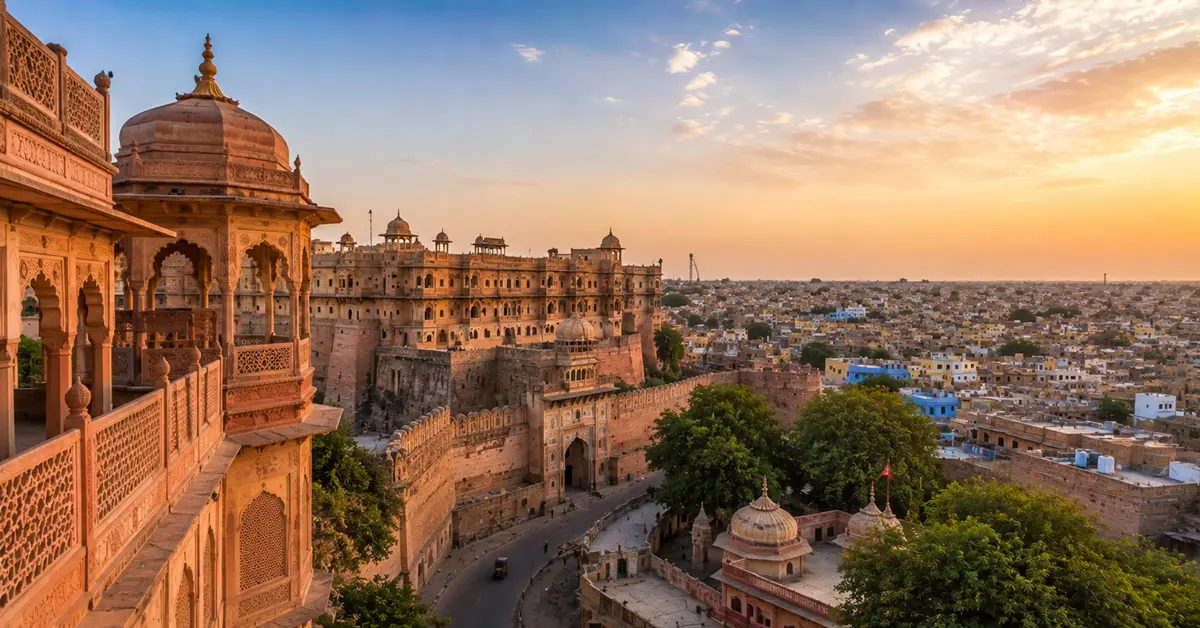
A Bikaner trip offers a different side of Rajasthan. While Jaipur and Udaipur often dominate Rajasthan travel plans, Bikaner feels less polished and more atmospheric, with an old city filled with red-sandstone havelis, narrow lanes, colourful markets and centuries-old temples.
The city is particularly famous for Junagarh Fort, the extraordinary Karni Mata Temple at Deshnoke, Rampuria Havelis, traditional Rajasthani food and its long association with camels. It also provides relatively easy access to desert landscapes without requiring the same amount of travel as Jaisalmer.
Bikaner is a particularly good destination for travellers who enjoy history, architecture, food, photography and unusual cultural experiences. A well-planned two- or three-day visit is enough to see its major attractions without rushing.
What makes Bikaner especially appealing is the combination. You can spend the morning exploring a royal palace, walk through a centuries-old market in the afternoon, visit a temple unlike almost anything else in India and finish the day eating spicy bhujia or a traditional Rajasthani meal.
Destination at a Glance
| Information | Details |
|---|---|
| Country / State | India / Rajasthan |
| Destination Type | Heritage city, desert culture and food destination |
| Ideal Trip Duration | 2–3 days |
| Best Time to Visit | October to March |
| Currency | Indian Rupee (₹ / INR) |
| Languages | Hindi, Rajasthani, Marwari and English |
| Time Difference | None within India |
| Visa Requirement | Not applicable to Indian citizens; foreign visitors need an appropriate Indian visa |
| Suitable Travellers | Solo travellers, couples, families, senior citizens and groups |
| Approx. Daily Budget | Budget: ₹1,500–₹3,000; Mid-range: ₹3,500–₹6,500; Premium: ₹8,000+ per person |
Why Should You Visit Bikaner?
Bikaner deserves more attention than it usually receives on Rajasthan itineraries.
1. See One of Rajasthan’s Finest Forts
Junagarh Fort is the obvious starting point.
Unlike many famous Rajasthan forts that dominate hilltops, Junagarh stands on relatively flat terrain in the middle of Bikaner.
Its interiors are the real highlight.
Inside you will find ornate courtyards, richly decorated rooms, mirror work, painted ceilings, carved stonework and collections associated with the royal family.
Current Google-derived visitor information places Junagarh Fort at approximately 4.5/5 from more than 36,000 reviews, making it one of the city’s most reviewed attractions.
2. Experience the Unusual Karni Mata Temple
Approximately 30 kilometres from Bikaner lies Deshnoke and the famous Karni Mata Temple.
The temple is popularly known as the Rat Temple because thousands of rats, locally known as kabbas, are considered sacred.
For many visitors, this is one of the most unusual religious experiences in India.
The Rajasthan Tourism Department currently lists the temple as open from 4:00 AM to 10:00 PM every day, with no admission charge.
The temple is not simply a curiosity, however. It has deep religious significance for devotees and is associated with Karni Mata, a revered figure in the region.
3. Walk Through the Rampuria Havelis
Bikaner’s old city is particularly attractive to photographers.
The Rampuria Havelis are a group of elaborate merchant mansions built using the region’s distinctive red sandstone.
Their façades combine elements of:
- Rajput architecture
- Mughal design
- Victorian influences
- Intricate stone carving
- Jharokhas
- Decorative windows
Current visitor data places Rampuria Haveli at approximately 4.5/5 from around 1,250 Google reviews.
The surrounding streets are almost as interesting as the buildings themselves.
4. Discover Bikaner’s Camel Culture
Bikaner’s connection with camels is deeply rooted in the region’s history.
The ICAR-National Research Centre on Camel provides visitors with an opportunity to learn about camel breeds, breeding, research and the animal’s importance to desert life.
Current visitor information places the attraction at approximately 4.3/5 from more than 1,300 Google reviews.
The centre is currently listed as open from 2:00 PM to 6:00 PM, with closure on Sundays and public holidays.
A visit here is especially enjoyable for families and travellers who have never experienced Rajasthan’s camel culture beyond tourist photographs.
5. Eat Where Bikaner Made Its Name
Bikaner’s food reputation extends far beyond one famous snack.
The city is strongly associated with:
- Bikaneri bhujia
- Rasgulla
- Kachori
- Samosa
- Ghewar
- Raj Kachori
- Rajasthani thali
- Dal baati churma
- Gatte ki sabzi
- Ker sangri
Food lovers can easily spend several hours exploring local sweet shops and snack markets.
6. Experience a Less Crowded Rajasthan
One of Bikaner’s biggest advantages is that it generally feels less overwhelming than Jaipur.
You still get:
- Royal architecture
- Heritage buildings
- Traditional markets
- Rajasthani cuisine
- Desert landscapes
- Colourful textiles
- Temples
But the sightseeing experience can feel slower.
That makes Bikaner particularly attractive if you have already visited Rajasthan’s more famous destinations and want something different.
Best Time for a Bikaner Trip
Bikaner has a desert climate.
That means summers can be extremely hot, while winters are much more comfortable.
For most travellers, October to March is the best period.
October to November
This is an excellent time to visit.
The extreme summer heat has eased and outdoor sightseeing becomes considerably more comfortable.
This period is especially good for:
- Fort sightseeing
- Old-city walks
- Desert excursions
- Photography
- Temple visits
December to January
These are some of the coolest months.
Daytime can be pleasant, but early mornings and evenings can become genuinely cold.
If you plan a desert camp or overnight outdoor experience, carry warm clothing.
Fog can occasionally affect early-morning transportation.
February to March
Another excellent period.
Temperatures gradually increase, but sightseeing remains comfortable for much of the day.
This is particularly good for travellers who dislike very cold winter mornings.
Avoiding the Extreme Summer
April to June can become extremely hot.
Temperatures may rise well above 40°C during the hottest periods.
A Bikaner trip during summer is possible, but sightseeing needs to be organised around the heat.
If you must visit:
- Start early
- Visit indoor attractions during midday
- Carry water
- Wear breathable clothing
- Keep outdoor desert activities for late afternoon
- Avoid prolonged walking between noon and 4 PM
Monsoon in Bikaner
July to September can bring some rainfall and increased humidity, but Bikaner remains considerably drier than many other parts of India.
The landscape can look different after rain, but the weather is less predictable for outdoor desert activities.
For a first visit, I would still recommend the cooler months.
Bikaner Weather Guide
| Season | Expected Conditions |
|---|---|
| Winter | Cool mornings and evenings, pleasant afternoons |
| Spring | Comfortable initially, progressively warmer |
| Summer | Very hot and dry |
| Monsoon | Warm, occasionally humid, limited rainfall |
| Autumn | Comfortable and increasingly pleasant |
How Many Days Are Enough for Bikaner?
Bikaner is relatively compact.
One Day
You can see the highlights, but the experience will be rushed.
A possible one-day route is:
Junagarh Fort → Rampuria Havelis → Old City → Karni Mata Temple
This works only with efficient transportation.
Two Days
Two days are enough for the principal attractions.
You can include:
- Junagarh Fort
- Rampuria Havelis
- Old-city markets
- Karni Mata Temple
- Camel Research Centre
- Local food
Three Days
Three days are ideal.
This gives you time to:
- Explore Junagarh Fort properly
- Walk through the old city
- Visit Deshnoke
- Visit the Camel Research Centre
- Experience local food
- Shop
- Add a desert excursion
- Slow down instead of rushing
For this guide, the recommended itinerary will be three days.
How to Reach Bikaner
Bikaner is well connected to other major Rajasthan destinations and North Indian cities.
By Air
Bikaner has Nal Airport, also known as Bikaner Airport, located approximately 13–15 kilometres from the city.
However, flight availability is considerably more limited than at Jaipur or Jodhpur.
For that reason, flying is not always the most practical choice.
Travellers should check current schedules carefully before planning the entire trip around a flight.
Flying via Jaipur
For many travellers, Jaipur International Airport can be a more practical gateway.
You can then continue to Bikaner by:
- Train
- Bus
- Private cab
- Rental car
The road journey from Jaipur is roughly 330–350 kilometres and usually takes around 5–6 hours, depending on traffic and road conditions.
This is particularly useful if Bikaner is part of a broader Rajasthan itinerary.
By Train
Bikaner Junction is an important railway station.
There are rail connections with cities including:
- Delhi
- Jaipur
- Jodhpur
- Ahmedabad
- Kolkata
- Mumbai
- Chandigarh
Train travel can be an excellent choice for Bikaner because you can save both money and, in some cases, a hotel night by using an overnight service.
By Road
Road travel works particularly well if you are combining Bikaner with other Rajasthan destinations.
Popular combinations include:
Jaipur → Bikaner → Jaisalmer
or
Jodhpur → Bikaner → Jaipur
or
Delhi → Bikaner → Jaisalmer
A private car is particularly useful if your itinerary includes Karni Mata Temple, desert areas and attractions outside the city.
Approximate Road Distances
| Route | Approximate Distance |
|---|---|
| Jaipur to Bikaner | 330–350 km |
| Jodhpur to Bikaner | 250–260 km |
| Jaisalmer to Bikaner | 330–340 km |
| Delhi to Bikaner | 450–470 km |
| Deshnoke from Bikaner | Approximately 30 km |
| Gajner from Bikaner | Approximately 30–35 km |
Distances vary according to the route and exact starting point.
Getting Around Bikaner
Bikaner is relatively easy to navigate.
Auto-Rickshaws
Useful for short distances.
Typical short rides may cost around:
₹50–₹150
Always confirm the fare before beginning if the auto is not metered.
App-Based Cabs
Availability can vary compared with larger cities.
For a family or group, a local cab booked for several hours can be more convenient than arranging individual rides.
A half-day local cab may cost approximately:
₹800–₹1,500
while a full-day vehicle may be around:
₹1,500–₹3,000+
depending on vehicle type and itinerary.
Private Cab
This is the most practical option if your Bikaner trip includes:
- Karni Mata Temple
- Camel Research Centre
- Gajner
- Desert areas
- Multiple attractions in one day
Local SIM and Internet
Indian travellers can use their existing mobile connections.
Major telecom networks generally work in Bikaner, although signal strength can vary outside the city.
Foreign visitors can obtain an Indian SIM after completing the required identification and KYC process.
Hotels, cafés and restaurants generally offer Wi-Fi.
For desert excursions, download important information and maps beforehand because connectivity can become less reliable away from the city.
Currency and Payments
Bikaner’s currency is the Indian Rupee (₹ / INR).
UPI is widely useful in established businesses.
Cards are commonly accepted at:
- Hotels
- Larger restaurants
- Modern shops
- Some tourist attractions
Cash is still useful for:
- Auto-rickshaws
- Small food shops
- Local markets
- Temple offerings
- Small handicraft stores
- Rural excursions
Carry smaller notes.
Is Bikaner Safe for Tourists?
Bikaner is generally comfortable for tourists, particularly in the main sightseeing areas.
Still, normal precautions are important.
Keep your wallet and phone secure in crowded markets.
Avoid isolated areas late at night.
If you are travelling alone, use reliable transportation after dark.
When visiting the old city, watch your belongings because narrow lanes and busy markets can become crowded.
Women travelling alone should follow the same general precautions they would use in any unfamiliar city.
Top Attractions in Bikaner
For a first trip, I recommend prioritising:
Must Visit
- Junagarh Fort
- Rampuria Havelis
- Karni Mata Temple
- National Research Centre on Camel
Highly Recommended
- Lalgarh Palace
- Prachina Museum
- Bhandasar Jain Temple
- Laxminath Temple
- Old City markets
If You Have Extra Time
- Gajner Palace
- Gajner Wildlife Sanctuary
- Raisar Sand Dunes
- Shiv Bari Temple
- Devi Kund Sagar
- Desert camps
1. Junagarh Fort
| Information | Details |
|---|---|
| Location | Junagarh Fort Road, Bikaner |
| Google Rating | Approximately 4.5/5 |
| Approx. Reviews | 36,000+ |
| Entry Fee | Current visitor reports indicate approximately ₹150 for Indian adults; foreign visitor rates are higher |
| Timings | Approximately 10:00 AM–4:30 PM |
| Recommended Duration | 2–3 hours |
| Best Time to Visit | Morning or late afternoon |
| How to Reach | Auto, cab or private vehicle |
| Approx. Transport Cost | ₹80–₹250 from central Bikaner |
| Practical Tip | Keep at least two hours; the interiors deserve much more time than the exterior suggests |
Current Google-derived visitor information places Junagarh Fort at around 4.5/5 with more than 36,000 reviews. Current visitor reports also indicate that Indian adult admission is around ₹150 and that guided tours may be included with the ticket, although ticket structures can change.
Why Is Junagarh Fort Famous?
Junagarh is one of Bikaner’s defining monuments.
The fort was constructed during the reign of Raja Rai Singh in the late 16th century and subsequently expanded and modified by later rulers.
Its most impressive feature is not simply the outer walls.
It is what lies inside.
The complex contains:
- Anup Mahal
- Chandra Mahal
- Phool Mahal
- Badal Mahal
- Ganga Mahal
- Har Mandir
- Royal courtyards
- Museum collections
- Palanquins
- Weapons
- Royal furniture
- Costumes
- Decorative objects
The architecture brings together several influences, including Rajput, Mughal and later European elements.
Gold work, painted surfaces, mirror decoration, carved stone and intricate woodwork make many interiors exceptionally detailed.
Unlike a fort designed mainly for defence on a hilltop, Junagarh feels like a combination of fortress, palace and royal residence.
What Should You Experience?
Do not rush through the fort simply to take photographs.
Look at the ceilings.
Look at the doors.
Notice the tiny details around the courtyards.
Pay attention to the rooms that were designed for different royal functions.
The museum collection also helps connect the architecture with the people who lived there.
Is It Worth Visiting?
Absolutely.
If you have only one paid attraction in Bikaner, this should probably be it.
2. Karni Mata Temple, Deshnoke
| Information | Details |
|---|---|
| Location | Deshnoke, approximately 30 km from Bikaner |
| Google Rating | Approximately 4.2/5 |
| Approx. Reviews | 3,000+ |
| Entry Fee | Free |
| Timings | 4:00 AM–10:00 PM |
| Recommended Duration | 45–90 minutes |
| Best Time to Visit | Early morning or late afternoon |
| How to Reach | Cab, taxi or train to Deshnoke |
| Approx. Transport Cost | ₹500–₹1,500 by cab round trip |
| Practical Tip | Wear washable footwear or carry socks; photography and behaviour should remain respectful |
The Rajasthan Tourism Department currently confirms that Karni Mata Temple is open every day from 4 AM to 10 PM and has no admission fee.
Why Is Karni Mata Temple Famous?
The temple’s most unusual feature is its population of sacred rats.
Thousands of rats live within the temple complex and are considered kabbas by devotees.
They are fed and protected.
For visitors unfamiliar with this tradition, the first few minutes can be surprising.
But it is important to approach the temple as a functioning place of worship rather than simply as a strange tourist attraction.
The temple itself is also architecturally impressive, particularly its marble façade and silver doors. The Rajasthan Tourism description highlights the temple’s marble work and silver gates.
What Should You Experience?
Observe the rituals respectfully.
Notice how devotees interact with the sacred rats.
Look at the detailed entrance and interior decoration.
If you are comfortable, you may follow the traditional practice of walking through the temple barefoot.
Is It Worth Visiting?
Yes, if you are comfortable with the temple’s unique religious environment.
It is one of the most distinctive experiences around Bikaner.
3. Rampuria Havelis
| Information | Details |
|---|---|
| Location | Joshiwara / Old Bikaner |
| Google Rating | Approximately 4.5/5 |
| Approx. Reviews | 1,200+ |
| Entry Fee | Generally free for exterior viewing |
| Timings | Best experienced during daylight; access to interiors varies |
| Recommended Duration | 45–90 minutes |
| Best Time to Visit | Early morning or late afternoon |
| How to Reach | Walk/auto through Old City |
| Approx. Transport Cost | ₹50–₹150 |
| Practical Tip | Most visitors should expect exterior viewing because individual havelis may be privately controlled |
Current visitor information places Rampuria Haveli at approximately 4.5/5 from around 1,250 Google reviews.
Why Is It Famous?
The Rampuria Havelis were commissioned by the wealthy Rampuria merchant family and are celebrated for their elaborate red-sandstone façades.
The architecture combines different influences in a way that is particularly characteristic of Bikaner.
You may notice:
- Victorian-style details
- Mughal elements
- Rajput jharokhas
- Carved stone
- Decorative balconies
- Intricate windows
- Colourful interiors where access is permitted
The surrounding lanes are an important part of the experience.
This is not an attraction where you enter a ticket gate, follow a fixed route and leave.
Instead, you walk through the old city and discover the architecture among ordinary residential and commercial life.
Is It Worth Visiting?
Definitely.
For photographers and architecture enthusiasts, Rampuria Havelis can be one of Bikaner’s most rewarding experiences.
4. National Research Centre on Camel
| Information | Details |
|---|---|
| Location | Jorbeer, Bikaner |
| Google Rating | Approximately 4.3/5 |
| Approx. Reviews | 1,300+ |
| Entry Fee | Approximately ₹50 for Indian visitors; confirm current rate |
| Timings | 2:00 PM–6:00 PM |
| Weekly Closure | Sunday and public holidays |
| Recommended Duration | 1–2 hours |
| Best Time to Visit | Afternoon |
| How to Reach | Cab/auto/private vehicle |
| Approx. Transport Cost | ₹200–₹500 round trip within city |
| Practical Tip | Check operating days before planning; try the camel-milk products if available |
Current official tourism information lists the centre’s visitor hours as 2 PM–6 PM, with closure on Sundays and public holidays.
Current visitor information places it at approximately 4.3/5 from more than 1,300 Google reviews.
Why Is It Famous?
This is not simply a place where tourists see camels.
It is a research institution dedicated to camel breeding, management and conservation.
Visitors can learn about different camel breeds and their role in Rajasthan’s desert economy.
One of the most memorable experiences is the opportunity to try camel-milk products when the visitor facility is operating.
Depending on availability, products may include:
- Camel-milk kulfi
- Camel-milk lassi
- Other dairy products
Is It Worth Visiting?
Yes, particularly for families and first-time visitors to Rajasthan.
It is educational, unusual and closely connected to the landscape around Bikaner.
5. Prachina Museum
| Information | Details |
|---|---|
| Location | Inside Junagarh Fort complex |
| Google Rating | Approximately 4.3/5 |
| Approx. Reviews | 1,300+ |
| Entry Fee | Approximately ₹50 if charged separately |
| Timings | Approximately 9:00 AM–6:00 PM |
| Recommended Duration | 30–60 minutes |
| Best Time to Visit | During the Junagarh Fort visit |
| How to Reach | Same as Junagarh Fort |
| Approx. Transport Cost | No additional cost |
| Practical Tip | Confirm whether the museum fee is already included in your current fort ticket |
Current visitor information places Prachina Museum at approximately 4.3/5 from more than 1,300 Google reviews.
Why Is It Famous?
The museum focuses on Bikaner’s royal and cultural heritage.
Its collection includes:
- Royal clothing
- Textiles
- Furniture
- Utensils
- Decorative objects
- Portraits
- Traditional crafts
It is particularly useful for understanding how the royal family actually lived rather than simply looking at the palace architecture.
Is It Worth Visiting?
Yes if you enjoy history, textiles and royal culture.
Since it is associated with Junagarh Fort, it should be treated as part of that sightseeing experience rather than a separate trip.
6. Lalgarh Palace
| Information | Details |
|---|---|
| Location | Lalgarh Palace Road, Bikaner |
| Google Rating | Approximately 4.3/5 for the heritage property |
| Approx. Reviews | Varies by individual listing |
| Entry Fee | Museum/access charges vary |
| Timings | Access depends on the section being visited |
| Recommended Duration | 45–90 minutes |
| Best Time to Visit | Late afternoon |
| How to Reach | Cab or auto |
| Approx. Transport Cost | ₹100–₹300 |
| Practical Tip | Much of the property operates as a heritage hotel, so public access can be limited |
Why Is Lalgarh Palace Famous?
Lalgarh Palace was commissioned for Maharaja Ganga Singh and represents a later phase of Bikaner’s royal architecture.
Compared with Junagarh, it feels more European in influence.
The building combines:
- Red sandstone
- Rajput details
- Mughal-inspired elements
- European planning
- Carved stone screens
- Ornate interiors
The palace is also associated with the heritage-hotel tradition of Rajasthan.
Is It Worth Visiting?
Yes for architecture lovers, but it is not as essential as Junagarh Fort.
If you have limited time, prioritise Junagarh and Rampuria Havelis first.
Bikaner Attractions: What Should You Prioritise?
| Traveller Type | Best Attractions |
|---|---|
| First-time visitor | Junagarh Fort, Rampuria Havelis, Karni Mata Temple |
| Family | Junagarh Fort, Camel Research Centre, Sukhdev/old-city markets |
| Couple | Junagarh Fort, Rampuria Havelis, desert sunset |
| History lover | Junagarh Fort, Prachina Museum, Lalgarh Palace |
| Architecture lover | Junagarh, Rampuria Havelis, Lalgarh Palace |
| Food lover | Old City, Bada Bazaar, local sweet shops |
| Photography enthusiast | Rampuria Havelis, Junagarh, old city, desert |
| Spiritual traveller | Karni Mata, Bhandasar Jain Temple, Laxminath Temple |
A Practical 3-Day Bikaner Structure
The most efficient three-day arrangement is:
Day 1
Junagarh Fort → Prachina Museum → Rampuria Havelis → Old City food
Day 2
Karni Mata Temple → National Camel Research Centre → local markets → evening desert experience
Day 3
Lalgarh Palace → Bhandasar Jain Temple → Laxminath Temple → shopping and food
This avoids repeatedly crossing the city.
What Makes Bikaner Different from Jaisalmer?
Travellers sometimes wonder whether Bikaner is worth visiting if they are already going to Jaisalmer.
The answer is yes, if you enjoy history and architecture.
Jaisalmer is particularly famous for:
- Golden sandstone
- Fort life
- Desert camps
- Sand dunes
Bikaner is particularly strong in:
- Junagarh Fort
- Royal interiors
- Merchant havelis
- Food
- Karni Mata Temple
- Camel culture
- Old-city architecture
The two destinations complement rather than completely replace each other.
Temples, Desert Experiences, Gajner, Food and Complete 3-Day Itinerary
Bikaner is best explored at a measured pace. The city itself is compact, but its most interesting experiences are spread across very different settings: royal palaces in the city, old merchant havelis, temples, camel country and desert landscapes outside the centre.
The ideal approach is to keep the first day focused on heritage, use the second for Karni Mata Temple and camel culture, and reserve the third for temples, shopping and a slower look at Bikaner’s old city. If you have an additional day, Gajner or a proper desert excursion can be added without rushing the main attractions.
7. Bhandasar Jain Temple
| Information | Details |
|---|---|
| Location | Old Bikaner, near Rampuria Haveli |
| Google Rating | Approximately 4.6/5 |
| Approx. Reviews | 2,000+ |
| Entry Fee | Free |
| Timings | Generally open from morning to evening; timings can vary with temple activities |
| Recommended Duration | 30–45 minutes |
| Best Time to Visit | Morning |
| How to Reach | Auto-rickshaw or walking from nearby old-city attractions |
| Approx. Transport Cost | ₹50–₹150 |
| Practical Tip | Dress modestly and maintain silence inside the temple |
Bhandasar Jain Temple is one of Bikaner’s most fascinating religious buildings.
It dates back to the 15th century and is dedicated to Sumatinath, the fifth Jain Tirthankara.
Why Is Bhandasar Jain Temple Famous?
The temple is particularly known for its colourful interiors.
Look closely at:
- Painted ceilings
- Decorative pillars
- Intricate carvings
- Frescoes
- Stonework
- Religious artwork
One of the most repeated stories associated with the temple concerns the use of ghee in its construction. Local tradition says a very large quantity of ghee was used in the mortar because of the scarcity of water in the region. The story has become an integral part of the temple’s popular identity, although it should be understood as a longstanding tradition rather than automatically treated as a scientifically established construction record.
The temple’s interiors are considerably more elaborate than its relatively modest exterior might suggest.
What Should You Experience?
Spend a few minutes simply looking upward.
The painted ceilings are easy to miss if you treat the temple as a quick photo stop.
Observe the fine details and the atmosphere of the old neighbourhood surrounding it.
Is It Worth Visiting?
Yes.
It is particularly worthwhile when combined with Rampuria Havelis because both attractions are located in the historic part of Bikaner.
8. Laxminath Temple
| Information | Details |
|---|---|
| Location | Old Bikaner |
| Google Rating | Approximately 4.6/5 |
| Approx. Reviews | 1,000+ |
| Entry Fee | Free |
| Timings | Generally morning and evening worship periods |
| Recommended Duration | 30–45 minutes |
| Best Time to Visit | Morning or evening |
| How to Reach | Auto-rickshaw or local cab |
| Approx. Transport Cost | ₹50–₹150 |
| Practical Tip | Avoid visiting during peak ritual periods if you want a quieter experience |
Laxminath Temple is one of Bikaner’s oldest temples and is dedicated to Lord Vishnu and Goddess Lakshmi.
It was patronised by the Bikaner royal family and remains an important religious site.
Why Is It Famous?
The temple is known for its marble work, silver decoration and traditional artwork.
Its importance comes not only from architecture but also from its connection with Bikaner’s royal history.
The temple gives you another perspective on the city’s religious heritage after visiting Karni Mata Temple.
Is It Worth Visiting?
Yes, particularly for travellers interested in religious architecture.
If your itinerary is already crowded, keep the visit relatively short.
9. Gajner Palace
| Information | Details |
|---|---|
| Location | Gajner, approximately 30–35 km from Bikaner |
| Google Rating | Approximately 4.4/5 for the heritage property |
| Approx. Reviews | 5,000+ across current listings |
| Entry Fee | Access to the heritage hotel and grounds may be restricted; restaurant/guest access varies |
| Timings | Approximately 9:00 AM–8:00 PM for listed visitor access |
| Recommended Duration | 1.5–2 hours |
| Best Time to Visit | Late afternoon |
| How to Reach | Private cab is most convenient |
| Approx. Transport Cost | ₹1,000–₹2,000 round trip by private cab |
| Practical Tip | Confirm visitor access before making a special trip because the palace operates as a heritage hotel |
Gajner Palace sits beside a lake and is surrounded by the Gajner Wildlife Sanctuary. Current Incredible India information lists visitor hours from approximately 9 AM to 8 PM and describes the palace’s combination of Rajasthani, Jain, Mughal and European architectural influences.
Why Is Gajner Palace Famous?
The palace was developed as a royal retreat and hunting lodge.
Its location beside the lake is the major attraction.
The architecture combines:
- Red sandstone
- Jharokhas
- Chhatris
- Jaalis
- Carved pillars
- Antique furnishings
The setting is considerably greener than central Bikaner.
That contrast makes it a pleasant excursion after spending time among the city’s dense old buildings.
Is It Worth Visiting?
Yes, if you have at least three days or are interested in heritage hotels and photography.
If you only have two days, Junagarh Fort and the old city deserve priority.
10. Gajner Wildlife Sanctuary
| Information | Details |
|---|---|
| Location | Around Gajner, approximately 30–35 km from Bikaner |
| Google Rating | Approximately 4.3/5 |
| Approx. Reviews | 1,000+ across visitor listings |
| Entry Fee | Charges and permit arrangements vary |
| Timings | Currently listed approximately 10:00 AM–5:00 PM |
| Recommended Duration | 1.5–3 hours |
| Best Time to Visit | Early morning or late afternoon |
| How to Reach | Private vehicle/cab |
| Approx. Transport Cost | ₹1,000–₹2,000 round trip from Bikaner |
| Practical Tip | Confirm current safari/access arrangements before travelling |
Current Incredible India information lists Gajner Wildlife Sanctuary’s opening hours as approximately 10 AM to 5 PM.
What Can You See?
The sanctuary’s landscape is centred around the lake and surrounding dry-country habitat.
Depending on season and conditions, visitors may encounter:
- Blackbuck
- Chinkara
- Nilgai
- Wild boar
- Migratory birds
- Local bird species
The experience is not comparable to a major national park safari.
Do not visit expecting guaranteed wildlife sightings.
Instead, think of it as a peaceful nature excursion combining lake scenery, desert ecology and heritage surroundings.
Is It Worth Visiting?
Yes for nature lovers and photographers.
For a first-time visitor with limited time, however, it is optional.
11. Raisar Sand Dunes
| Information | Details |
|---|---|
| Location | Raisar area outside Bikaner |
| Google Rating | Ratings vary by individual camp/operator |
| Approx. Reviews | Varies by operator |
| Entry Fee | No standard general entry fee; activities are operator-based |
| Timings | Best around sunrise and sunset |
| Recommended Duration | 2–4 hours |
| Best Time to Visit | October–March |
| How to Reach | Private cab/camp transfer |
| Approx. Transport Cost | ₹800–₹2,000 depending on vehicle and package |
| Practical Tip | Book activities with a clear price breakdown and confirm whether transfers are included |
Raisar provides one of the easier ways to add a desert experience to a Bikaner itinerary.
It is less about dramatic giant dunes and more about experiencing the open desert landscape close to the city.
Depending on the operator and season, activities can include:
- Camel rides
- Jeep rides
- Sunset viewing
- Cultural performances
- Traditional dinner
- Overnight camping
Is Raisar Better Than Jaisalmer for a Desert Experience?
It depends on what you want.
If the desert is the main reason for your Rajasthan trip, Jaisalmer is generally the stronger choice.
But if Bikaner is already on your itinerary, Raisar provides a convenient opportunity to experience desert landscapes without travelling several hundred kilometres.
For a short Bikaner trip, that convenience is its biggest advantage.
Bikaner Food Guide
Food is one of the strongest reasons to spend more than one day in Bikaner.
The city is famous for snacks, sweets and savoury foods that are easy to find in local markets.
Current restaurant listings show a wide range of traditional and multi-cuisine establishments, including long-established sweet shops and restaurants around the city.
Bikaneri Bhujia
No visit to Bikaner is complete without trying its most famous snack.
Bikaneri bhujia is a thin, crispy savoury snack traditionally made using gram flour and spices.
It is:
- Spicy
- Crunchy
- Salty
- Easy to carry
- Excellent as a snack
You can buy small packets for a few rupees or larger branded/packaged quantities for gifting.
For an authentic market experience, compare products from established local sweet and snack shops.
Bikaneri Rasgulla
Bikaner’s rasgulla is different from the Bengali version many travellers know.
The local preparation is traditionally made from chhena and cooked in syrup, with a slightly different texture and flavour profile.
Try it fresh rather than buying only packaged sweets.
Kachori
Bikaner is excellent for kachoris.
Depending on the shop, you can find:
- Dal kachori
- Pyaaz kachori
- Matar kachori
- Mawa kachori
Expect approximately:
₹20–₹60 per piece
at ordinary local shops.
Pyaaz Kachori
This is particularly useful as a quick breakfast or evening snack.
The crispy exterior and spicy onion filling make it ideal with tea.
Ghewar
Ghewar is a traditional Rajasthani sweet with a honeycomb-like texture.
It is particularly popular around festivals but is available at many sweet shops beyond festival periods.
Approximate price:
₹250–₹600 per kilogram
depending on quality and preparation.
Dal Baati Churma
A Rajasthan classic.
The combination includes:
- Baked baati
- Dal
- Churma
- Ghee
A restaurant portion can cost approximately:
₹200–₹450 per person
depending on the restaurant.
Gatte Ki Sabzi
Gatte are gram-flour dumplings cooked in a spiced yoghurt-based gravy.
This is an excellent vegetarian option.
Ker Sangri
This traditional desert-region dish uses dried berries and beans.
It is particularly interesting because the ingredients reflect Rajasthan’s arid environment.
Rajasthani Thali
If you want to try several dishes at once, order a Rajasthani thali.
A typical thali may contain:
- Dal
- Baati
- Churma
- Gatte
- Ker sangri
- Seasonal vegetables
- Roti
- Rice
- Pickles
- Sweets
Approximate price:
₹250–₹600 per person
Must-Try Drinks
Chaas
A simple and refreshing choice in hot weather.
₹30–₹80
Lassi
Usually thicker and richer.
₹50–₹120
Traditional Sharbat
Local sharbat shops can be an interesting stop during an old-city walk.
Where to Eat in Bikaner
Rather than limiting yourself to one restaurant, use different places for different experiences.
Gallops Restaurant and Coffee House
Located opposite Junagarh Fort, Gallops is convenient after a fort visit and offers multi-cuisine food.
Current listings show around 3.9/5 from approximately 495 reviews on Tripadvisor.
A meal can be approximately:
₹300–₹700 per person
depending on what you order.
Chhotu Motu Joshi Sweet Shop
A useful stop for local sweets and snacks.
Current listings place it in the inexpensive category, with traditional Indian food and sweets.
Try:
- Bhujia
- Kachori
- Sweets
- Rasgulla
Bhikharam Chandmal Bhujiawala
A well-known name for Bikaneri snacks.
Current listings show it with approximately 4.4/5 from around 120 reviews on Tripadvisor.
It is particularly suitable for buying packaged snacks to take home.
Laxmi Niwas Palace
For a more premium dining experience, Laxmi Niwas Palace offers an elegant heritage setting.
Current Tripadvisor listings show approximately 4.5/5 from more than 225 reviews.
Expect substantially higher prices than a local sweet shop.
Local Food Around Kote Gate
For travellers who want to explore local food rather than sit in a hotel restaurant, Kote Gate and surrounding market areas are worth exploring.
Recent local recommendations include kachori, samosa, chole bhature, sweets and sharbat around the old-city markets.
The advantage is simple: you can combine food with your old-city walk.
Vegetarian Food in Bikaner
Vegetarian travellers will have no difficulty eating well here.
In fact, many of Bikaner’s most famous dishes are vegetarian.
Must Try
- Bikaneri bhujia
- Kachori
- Pyaaz kachori
- Dal baati churma
- Gatte ki sabzi
- Ker sangri
- Churma
- Rasgulla
- Ghewar
- Rajasthani thali
Three-Day Bikaner Trip Itinerary
Now we can bring the attractions and food together into a practical itinerary.
Day 1: Junagarh Fort, Rampuria Havelis and Old Bikaner
Theme: Royal Bikaner and its historic heart
| Day 1 Planning | Approximate Details |
|---|---|
| Total distance | 8–12 km |
| Road travel time | 45–75 minutes total |
| Main transport | Auto/cab + walking |
| Transport cost | ₹250–₹700 per person |
| Daily sightseeing and food budget | ₹1,500–₹3,500 per person excluding hotel |
| Suggested hotel area | Near Junagarh / Station Road / old city |
| Best for | First-time visitors, history lovers, photographers |
Morning: Junagarh Fort
Start around 9:00 AM.
Have breakfast before leaving.
Reach Junagarh Fort around 9:30 AM.
Spend 2–3 hours exploring the fort.
Do not rush.
The interiors are much more interesting than simply photographing the exterior.
Lunch Near the Fort
After the fort, choose a restaurant nearby.
Gallops is convenient because it is directly opposite the fort and offers a broad menu. Current listings place its typical price in the moderate range.
Budget:
₹250–₹700 per person
Afternoon: Prachina Museum
If it is operating separately, spend around 30–60 minutes exploring the museum collection.
Because it is associated with the fort, this is an efficient continuation rather than another journey.
Late Afternoon: Rampuria Havelis
Head towards the old city around 4:00 PM.
Walk slowly through the area.
Allow approximately 60–90 minutes.
The late afternoon light can make the red sandstone particularly attractive for photography.
Evening: Old City Food Walk
This is the perfect time to explore the local food scene.
Try:
Pyaaz kachori
then:
Bikaneri bhujia
then perhaps:
Rasgulla or ghewar
Do not eat a huge quantity at one place.
The idea is to sample several things.
Day 1 Schedule
| Time | Activity |
|---|---|
| 8:00–9:00 AM | Breakfast |
| 9:30 AM–12:00 PM | Junagarh Fort |
| 12:00–1:00 PM | Prachina Museum / fort surroundings |
| 1:00–2:00 PM | Lunch |
| 2:00–3:30 PM | Hotel rest |
| 4:00–5:30 PM | Rampuria Havelis |
| 5:30–7:30 PM | Old-city walk |
| 7:30–9:00 PM | Local food |
| 9:00 PM onward | Hotel |
Day 2: Karni Mata, Camel Research Centre and Desert Sunset
Theme: Religion, camels and the desert
| Day 2 Planning | Approximate Details |
|---|---|
| Total distance | 65–90 km depending on desert location |
| Road travel time | 2–3 hours |
| Main transport | Private cab |
| Transport cost | ₹1,500–₹3,000 per vehicle |
| Daily budget | ₹2,000–₹4,500 per person excluding hotel |
| Suggested hotel area | Central Bikaner |
| Best for | Families, couples and first-time visitors |
Morning: Karni Mata Temple
Leave Bikaner around 7:00 AM.
The journey to Deshnoke takes roughly 45–60 minutes by road.
Reach the temple around 8:00 AM.
The temple is currently listed as open from 4 AM to 10 PM and is free to enter.
Spend approximately 45–90 minutes.
Remember that this is a functioning temple.
Late Morning: Return to Bikaner
Return to the city around 10:00 AM.
Have brunch or an early lunch.
Afternoon: National Research Centre on Camel
The centre is currently listed as open from 2 PM to 6 PM, with closure on Sundays and public holidays.
Therefore, do not schedule it in the morning.
Reach around 2:00 PM.
Spend approximately 1–2 hours.
If camel-milk products are available, trying one can be a fun part of the visit.
Late Afternoon: Desert Excursion
Leave for Raisar or your selected desert camp around 4:00 PM.
Reach before sunset.
Depending on your package, you can enjoy:
- Camel ride
- Jeep ride
- Sunset
- Tea
- Dinner
- Folk music
- Cultural performances
A sunset-only experience is sufficient if you do not want to spend the night outside the city.
Evening
Return to Bikaner after dinner or remain at the camp if you have booked an overnight stay.
Day 2 Schedule
| Time | Activity |
|---|---|
| 7:00 AM | Leave Bikaner |
| 8:00–9:15 AM | Karni Mata Temple |
| 9:15–10:15 AM | Return to Bikaner |
| 10:30–11:30 AM | Brunch |
| 12:00–1:30 PM | Hotel rest |
| 2:00–3:30 PM | Camel Research Centre |
| 4:00 PM | Leave for desert area |
| 5:00–7:00 PM | Camel ride / sunset |
| 7:00–9:00 PM | Dinner / cultural programme |
| 9:00 PM onward | Return or overnight camp |
Day 3: Bhandasar, Laxminath, Lalgarh and Shopping
Theme: Temples, royal architecture and local shopping
| Day 3 Planning | Approximate Details |
|---|---|
| Total distance | 15–25 km |
| Road travel time | 1–1.5 hours |
| Main transport | Auto/cab + walking |
| Transport cost | ₹300–₹800 per person |
| Daily budget | ₹1,500–₹4,000 per person excluding hotel |
| Suggested hotel area | Central Bikaner |
| Best for | Culture, shopping and relaxed travellers |
Morning: Bhandasar Jain Temple
Start around 8:00 AM.
Spend approximately 30–45 minutes.
Look carefully at the ceiling paintings and decorative details.
Laxminath Temple
Continue to Laxminath Temple.
Allow around 30–45 minutes.
The two temples together provide an interesting contrast in religious architecture.
Late Morning: Lalgarh Palace
Continue to Lalgarh Palace.
Allow approximately one hour, subject to current visitor access.
If access to some areas is restricted because the property operates as a heritage hotel, do not try to force entry.
Lunch
Have a proper Rajasthani lunch.
Order:
- Dal baati churma
- Gatte ki sabzi
- Ker sangri
- Roti
- Chaas
Budget:
₹250–₹500 per person
Afternoon: Shopping
Spend the afternoon around:
- Kote Gate
- Bada Bazaar
- Old-city markets
- Station Road
Buy:
- Bhujia
- Sweets
- Rajasthani textiles
- Mojaris
- Handicrafts
- Decorative items
- Spices
Evening: Final Food Experience
Finish the trip with a relaxed dinner.
If you want a premium experience, consider a heritage hotel restaurant.
If you prefer authenticity and low cost, explore local snack shops instead.
Day 3 Schedule
| Time | Activity |
|---|---|
| 8:00–8:45 AM | Bhandasar Jain Temple |
| 9:00–9:45 AM | Laxminath Temple |
| 10:15–11:30 AM | Lalgarh Palace |
| 12:00–1:00 PM | Lunch |
| 1:00–2:30 PM | Hotel rest |
| 3:00–6:00 PM | Shopping / old-city exploration |
| 6:00–7:30 PM | Tea, sweets and snacks |
| 7:30–9:00 PM | Final dinner |
| 9:00 PM onward | Hotel |
Complete 3-Day Bikaner Budget
| Expense | Approximate Cost |
|---|---|
| Budget accommodation, 2 nights | ₹2,000–₹5,000 |
| Mid-range accommodation, 2 nights | ₹5,000–₹10,000 |
| Food for 3 days | ₹1,500–₹4,000 |
| Local transport | ₹800–₹2,000 |
| Karni Mata excursion | ₹500–₹1,500 |
| Camel centre + desert transport | ₹800–₹2,000 |
| Attraction fees | ₹300–₹800+ |
| Approx. budget trip excluding travel to Bikaner | ₹5,900–₹15,300+ |
A couple sharing a comfortable mid-range room can reasonably plan around:
₹12,000–₹25,000 for three days, excluding travel to and from Bikaner, major shopping and luxury experiences.
Where to Stay in Bikaner
Bikaner is not an enormous city, so most visitors can stay in or around the central areas and reach the major attractions without difficulty.
For a first visit, I would generally recommend staying around Junagarh Fort, Station Road, Civil Lines or the central market areas.
Best Areas to Stay
| Area | Best For |
|---|---|
| Junagarh Fort area | First-time visitors and sightseeing |
| Station Road | Budget travellers and railway access |
| Civil Lines | Families and quieter stays |
| Old City | Heritage atmosphere and food |
| Lalgarh area | Heritage hotels and premium stays |
| Gajner outskirts | Luxury retreat and nature |
Staying near the centre is particularly useful if you are travelling without your own vehicle.
Budget Hotels in Bikaner
Budget accommodation generally includes smaller hotels, guesthouses and basic independent properties.
Approximate Price
₹900–₹2,500 per room per night
Prices vary according to season, room type and weekend demand.
When selecting a budget hotel, don’t look only at the room price.
Check whether the property provides:
- Air conditioning
- Hot water
- Wi-Fi
- Parking
- Lift
- Breakfast
- 24-hour reception
- Clean bathrooms
In Bikaner’s hot climate, reliable air conditioning is particularly important outside winter.
Mid-Range Hotels
This is the category I would recommend for most couples and families.
Approximate Price
₹2,500–₹6,000 per room per night
A comfortable mid-range hotel should provide:
- Air-conditioned rooms
- Wi-Fi
- Restaurant
- Parking
- Good housekeeping
- Easy access to major roads
Staying centrally can also reduce your daily transportation expenses.
Luxury and Heritage Hotels
Bikaner has several properties where the accommodation itself becomes part of the experience.
Approximate Price
₹6,000–₹18,000+ per room per night
Prices can rise considerably during the winter tourist season, festivals and weekends.
Heritage properties can be particularly attractive for couples celebrating a special occasion.
Instead of treating the hotel simply as a place to sleep, you get:
- Historic architecture
- Courtyards
- Traditional interiors
- Royal décor
- Heritage dining
- Large gardens
Recommended Hotel Strategy
You do not necessarily need to spend heavily on accommodation in Bikaner.
If your priority is sightseeing:
Choose a comfortable central hotel.
If your priority is the heritage experience:
Choose a palace-style property.
If your priority is desert relaxation:
Consider spending one night at a desert camp or Gajner rather than upgrading the entire Bikaner stay.
That can create a much more memorable trip without making every night expensive.
Bikaner Shopping Guide
Shopping is another enjoyable part of exploring the city.
The best purchases are generally things that are:
- Lightweight
- Easy to carry
- Connected to Rajasthan
- Useful after returning home
- Not excessively fragile
1. Bikaneri Bhujia
This is the obvious purchase.
You can buy:
- Small packets
- Family packs
- Gift boxes
- Mixed snack boxes
Approximate prices:
₹50–₹500+
depending on size and brand.
For travel, choose sealed packaging.
2. Rajasthani Sweets
Good options include:
- Rasgulla
- Ghewar
- Mawa sweets
- Traditional milk-based sweets
Fresh sweets are best consumed quickly.
If you are travelling onward for several days, ask the shopkeeper which products are suitable for carrying.
3. Mojaris
Traditional Rajasthani footwear makes a good souvenir.
Approximate price:
₹300–₹1,500+
Handcrafted or premium versions can cost more.
Check the stitching and sole carefully before purchasing.
4. Phulkari and Rajasthani Textiles
Look for:
- Dupattas
- Shawls
- Bed covers
- Bags
- Embroidered fabrics
- Traditional garments
Prices can range widely depending on material and craftsmanship.
A simple textile may cost a few hundred rupees, while handcrafted or premium pieces can run into several thousand.
5. Lac Bangles
Colourful lac bangles are inexpensive and easy to carry.
Approximate price:
₹100–₹500+
depending on workmanship.
6. Handicrafts
You may find:
- Wooden items
- Decorative boxes
- Metalware
- Puppets
- Wall décor
- Traditional ornaments
If buying a large handicraft, ask about packaging before completing the purchase.
Where to Shop
Kote Gate
One of the best starting points for local shopping.
Expect a busy market atmosphere.
Bada Bazaar
Good for:
- Textiles
- Snacks
- Traditional products
- Everyday shopping
Old City
Best for combining shopping with architecture and food.
The old city is not just a shopping destination.
The streets themselves are part of the experience.
Bargaining in Bikaner
Bargaining is common in many traditional markets.
A sensible approach is:
Ask → compare → negotiate → decide.
Do not start with an unrealistically low offer.
For inexpensive products, the difference may only be ₹20–₹50, so spending ten minutes negotiating may not be worthwhile.
For expensive textiles or handicrafts, however, comparing multiple shops can make a meaningful difference.
Hidden Gems in and Around Bikaner
The following places are not necessarily essential for a first-time visitor, but they can make a longer trip more interesting.
Devi Kund Sagar
Devi Kund is a royal cremation ground associated with the Bikaner royal family.
The cenotaphs are particularly attractive for architecture and photography.
Look for:
- Stone chhatris
- Carved pillars
- Domed structures
- Decorative ceilings
- Royal memorials
The site is considerably quieter than Junagarh Fort.
Is It Worth Visiting?
Yes for photographers and architecture enthusiasts.
It is less important if you have only one day.
Shiv Bari Temple
Shiv Bari Temple is an old temple associated with Lord Shiva.
The temple’s red sandstone architecture fits naturally into Bikaner’s architectural character.
It is a relatively peaceful stop and can be included if you have extra time.
Gajner Lake
Even if you do not stay at Gajner Palace, the surrounding landscape provides a welcome change from central Bikaner.
The lake, palace and dry-country vegetation create an interesting combination for photography.
The best light is generally around sunrise and sunset.
Desert Village Experience
Instead of choosing a large commercial desert camp, travellers looking for a more intimate experience can look for smaller cultural experiences around the desert villages outside Bikaner.
These may include:
- Local meals
- Folk music
- Camel rides
- Village walks
- Handicrafts
- Sunset experiences
Always confirm exactly what is included in the package before paying.
Bikaner Photography Guide
Bikaner is a very photogenic city.
The key is to photograph different aspects of it rather than only taking monument photographs.
Junagarh Fort
Look for:
- Doorways
- Courtyards
- Painted ceilings
- Carved stone
- Reflections
- Symmetry
A wide-angle lens is useful for interiors.
Rampuria Havelis
The best photographs often come from simply walking slowly through the surrounding lanes.
Look for:
- Red sandstone façades
- Jharokhas
- Decorative windows
- Street life
- Contrasting colours
Early morning is particularly useful because the streets can be less crowded.
Karni Mata Temple
Photography should be approached respectfully.
Do not interfere with worship or block passages simply to get a photograph.
Follow any restrictions imposed inside the temple.
Desert
The best time is:
Golden hour before sunset.
Avoid photographing only the dunes.
Include:
- Camel silhouettes
- Footprints
- Travellers
- Vegetation
- Local musicians
- Camp structures
This creates a stronger sense of place.
Common Tourist Mistakes in Bikaner
Mistake 1: Visiting in Peak Summer Without a Plan
The heat can make walking unpleasant.
If you travel during the hottest months, sightseeing should begin early.
Mistake 2: Spending Only Two Hours in Junagarh Fort
The fort deserves time.
Rushing through the rooms means missing the architectural details that make it special.
Mistake 3: Treating Karni Mata Temple as Only a Tourist Attraction
The rats are what make the temple famous internationally, but the site is a genuine place of worship.
Visitors should behave accordingly.
Mistake 4: Booking a Desert Package Without Checking the Details
Always ask:
- Is transportation included?
- Is the camel ride included?
- Is dinner included?
- Is breakfast included?
- Is the cultural programme included?
- Is GST included?
- Is it a private or shared camp?
- What time is pickup?
A cheap-looking package can become expensive once extras are added.
Mistake 5: Assuming Every Palace Is Fully Open
Some heritage properties function as hotels or private properties.
Public access can therefore be limited.
Check before travelling.
Mistake 6: Carrying Too Much Luggage
If your Rajasthan trip includes Jaipur, Jodhpur, Bikaner and Jaisalmer, you will frequently change hotels.
Keep luggage manageable.
Mistake 7: Forgetting Winter Clothing
Rajasthan is hot in popular travel imagery, but winter mornings and nights in Bikaner can be surprisingly cold.
Money-Saving Tips
Travel by Train
For travellers arriving from Delhi, Jaipur or other connected cities, trains can be considerably cheaper than private cabs.
Share a Cab
If travelling with friends, splitting the cost of a vehicle for Karni Mata and desert excursions can provide excellent value.
Eat Local
Local snacks and traditional restaurants can provide excellent food without premium hotel prices.
Stay Centrally
A central hotel can reduce daily transportation costs.
Combine Attractions
For example:
Rampuria Havelis + Bhandasar Jain Temple + Old City market
can be covered in the same general area.
Bikaner Packing Checklist
| Item | Why You Need It |
|---|---|
| Comfortable walking shoes | Forts, temples and old-city lanes |
| Cotton clothing | Warm weather |
| Light jacket | Winter mornings and evenings |
| Sunscreen | Strong desert sunshine |
| Sunglasses | Bright outdoor conditions |
| Hat/cap | Daytime protection |
| Water bottle | Hydration |
| Power bank | Navigation and photography |
| Small backpack | Daily sightseeing |
| Hand sanitiser | Useful during market and temple visits |
| Personal medicines | Convenience |
| Scarf/stole | Sun protection and temple visits |
| Moisturiser/lip balm | Dry climate |
What to Wear
For most sightseeing:
Light, breathable clothing works well.
For temples:
- Dress respectfully
- Avoid excessively revealing clothing
- Carry a scarf or stole if needed
- Be prepared to remove footwear
For winter:
Layering is better than carrying one extremely heavy jacket.
Local Etiquette
Bikaner is a culturally traditional city, particularly around temples and old neighbourhoods.
Keep these points in mind:
- Remove shoes where required.
- Dress modestly in temples.
- Ask before photographing people closely.
- Do not touch religious objects without permission.
- Avoid loud conversations inside temples.
- Do not feed animals unless permitted.
- Do not litter.
- Respect local customs.
- Follow photography restrictions.
Safety Tips for Bikaner
During the Day
Normal precautions are sufficient for most travellers.
Keep valuables secure in crowded markets.
At Night
Use a reliable auto, taxi or app-based transport rather than walking through unfamiliar outskirts.
In the Desert
Carry sufficient water.
Use sunscreen.
Follow the instructions of the camp operator.
Avoid wandering alone into unfamiliar desert areas.
Around Camels
Do not stand directly behind a camel.
Follow the handler’s instructions during rides.
At Karni Mata Temple
Be especially careful about footwear, personal belongings and hygiene.
Bikaner Trip for Different Travellers
Solo Traveller
Bikaner works well for a two- or three-day solo trip.
Focus on:
- Junagarh Fort
- Old City
- Rampuria Havelis
- Food
- Karni Mata Temple
Use a private cab for excursions outside the city.
Couples
Couples can combine heritage sightseeing with a desert sunset.
A good combination is:
Junagarh Fort → old-city food → desert sunset → heritage dinner
Families
Families should include:
- Junagarh Fort
- Camel Research Centre
- Karni Mata Temple
- Short desert excursion
Avoid packing too many temples and museums into one day if travelling with young children.
Senior Citizens
Choose a slower schedule.
A good pattern is:
Morning sightseeing → lunch → hotel rest → evening outing
Private transportation is worth considering because it reduces walking in the heat.
Bikaner Trip Budget by Traveller Type
| Traveller Type | Approximate Daily Budget |
|---|---|
| Budget solo traveller | ₹1,500–₹3,000 |
| Comfortable solo traveller | ₹3,500–₹5,500 |
| Couple sharing a room | ₹4,500–₹8,000 |
| Family of four | ₹7,000–₹13,000 |
| Group of 4–6 | ₹2,000–₹4,500 per person |
| Luxury traveller | ₹8,000–₹18,000+ per person |
These are planning estimates and exclude travel to and from Bikaner.
Estimated 3-Day Trip Cost
For a comfortable couple travelling from within Rajasthan or arriving by train, a practical starting estimate is:
₹12,000–₹25,000 for two people
excluding:
- Long-distance travel to Bikaner
- Premium shopping
- Luxury hotel upgrades
- Expensive desert packages
A budget traveller can spend considerably less.
How to Combine Bikaner with Other Rajasthan Destinations
Bikaner works particularly well as part of a longer Rajasthan route.
Route 1: Jaipur – Bikaner – Jaisalmer
Excellent for first-time visitors.
Jaipur: palaces and forts
↓
Bikaner: royal heritage and old city
↓
Jaisalmer: golden fort and desert
Route 2: Jodhpur – Bikaner – Jaisalmer
Ideal for travellers interested in Rajasthan’s desert architecture.
Route 3: Delhi – Bikaner – Jaisalmer – Jodhpur
A longer circuit with several overnight stops.
Route 4: Bikaner – Gajner – Jaisalmer
Good for travellers wanting a slower trip with heritage and desert experiences.
Bikaner vs Jaisalmer
| Bikaner | Jaisalmer |
|---|---|
| Junagarh Fort | Jaisalmer Fort |
| Red sandstone architecture | Golden sandstone architecture |
| Merchant havelis | Desert havelis |
| Karni Mata Temple | Desert camps |
| Camel research centre | Camel safaris |
| Strong food culture | Strong desert tourism |
| Generally quieter | More tourism-focused |
| Excellent for 2–3 days | Often 2–4 days |
If your primary interest is desert camping and sand dunes, Jaisalmer should probably receive more time.
If you prefer royal architecture, food and unusual cultural attractions, Bikaner deserves serious consideration.
Frequently Asked Questions About Bikaner Trip
How many days are enough for Bikaner?
Two to three days are ideal. Two days cover the major attractions, while three days allow time for temples, shopping, camel experiences and a desert excursion.
What is Bikaner famous for?
Bikaner is famous for Junagarh Fort, Bikaneri bhujia, Rampuria Havelis, Karni Mata Temple, camel culture and traditional Rajasthani architecture.
What is the best time to visit Bikaner?
October to March is generally the best period because temperatures are much more comfortable for sightseeing and desert activities.
Is Bikaner worth visiting?
Yes. Bikaner is particularly worthwhile for travellers interested in forts, architecture, food, history and less-commercialised Rajasthan experiences.
Is Bikaner suitable for a family trip?
Yes. Junagarh Fort, the Camel Research Centre, old-city food experiences and a short desert excursion can work very well for families.
How far is Karni Mata Temple from Bikaner?
The temple at Deshnoke is approximately 30 kilometres from central Bikaner, making it an easy half-day excursion.
What food should I try in Bikaner?
Do not leave without trying Bikaneri bhujia, pyaaz kachori, rasgulla, ghewar, dal baati churma, gatte ki sabzi and a traditional Rajasthani thali.
Can Bikaner be covered in one day?
The main highlights can technically be covered in one day, but it will be rushed. Two days are better, and three days are ideal if you want to include a desert experience and explore the city properly.
Final Bikaner Trip Itinerary at a Glance
| Day | Main Experiences |
|---|---|
| Day 1 | Junagarh Fort, Prachina Museum, Rampuria Havelis, Old City and local food |
| Day 2 | Karni Mata Temple, Camel Research Centre, Raisar desert experience |
| Day 3 | Bhandasar Jain Temple, Laxminath Temple, Lalgarh Palace, shopping and food |
This three-day plan gives you a balanced introduction to Bikaner.
You experience the royal city, the religious heritage, the merchant neighbourhoods, the camel culture, the desert landscape and, importantly, the food.
Conclusion
A Bikaner trip is best approached as more than a fort-and-temple tour.
Start with Junagarh Fort, where the scale and decoration of the royal interiors reveal the city’s importance under the Bikaner rulers. Continue into the old city to discover the Rampuria Havelis, narrow lanes and traditional markets. The next day, travel to Karni Mata Temple at Deshnoke, then learn about Rajasthan’s camel culture at the National Research Centre on Camel before watching the sun disappear over the desert.
Use the final day to slow down.
Visit Bhandasar Jain Temple and Laxminath Temple, explore Lalgarh’s architecture, shop for bhujia and Rajasthani handicrafts, and spend your final evening enjoying local food.
If you have more time, add Gajner Palace, Gajner Wildlife Sanctuary, Raisar Sand Dunes or a longer desert experience.
What makes Bikaner special is the contrast. Within a relatively short journey, you can move from elaborately decorated royal chambers to quiet Jain temples, from busy markets to open desert and from centuries-old architecture to the living traditions of Rajasthan.
It may not have the international fame of Jaipur or the dramatic desert image of Jaisalmer, but that is part of its appeal. Bikaner gives travellers an opportunity to experience a more relaxed and culturally layered side of Rajasthan.
For travellers who want history, architecture, food, photography and desert culture in one destination, two or three days in Bikaner can be exceptionally rewarding.
Travel Disclaimer
Travel costs, hotel prices, attraction entry fees, transportation schedules, operating hours, desert activity prices, local regulations, exchange rates and other travel information can change over time. Museum access, temple arrangements, heritage-property entry and wildlife-area rules may also change because of maintenance, festivals, weather, official decisions or other circumstances.
Travellers should verify the latest information, prices, availability, opening hours and transportation schedules before travelling.